Massive cryptocurrency project shutdowns in 2026: What’s going on?
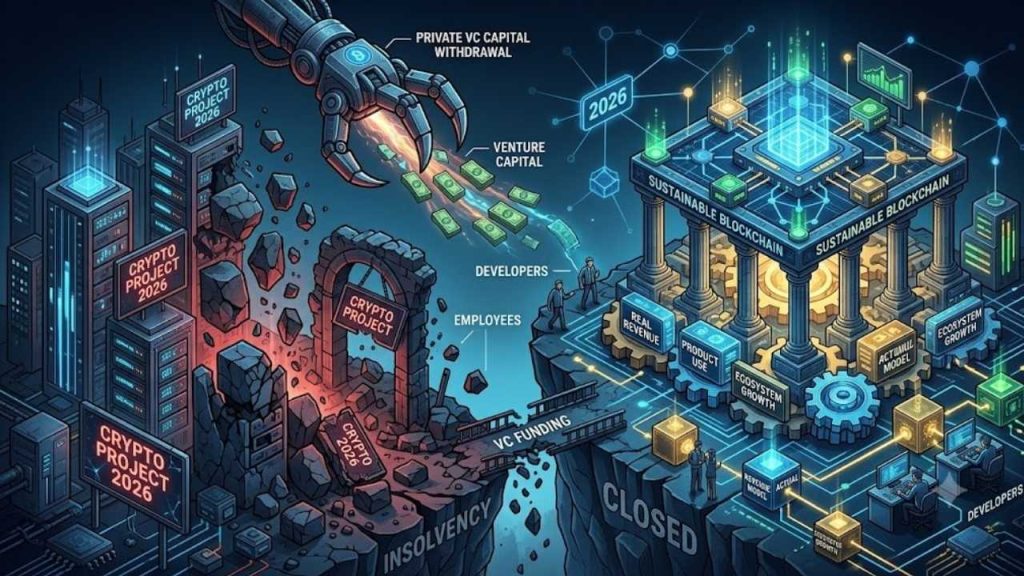
The wave of digital platform shutdowns in 2026 stems directly from the exhaustion of venture capital subsidies rather than a standard market cycle fluctuation. Venture capital funding declined significantly over the past four quarters, forcing the immediate exit of protocols that lack real cash flows and self-sustaining economic models.
The dominant narrative frames this structural adjustment as a widespread industry collapse. However, this liquidation process is critical today because it removes high-profile entities that failed to monetize their active user base or support their substantial fixed operating overhead during periods of reduced market trading volume.
The permanent cessation of operations simultaneously affected custodial services, derivatives exchanges, and digital collectible marketplaces. Billetera Leap Wallet confirmed its complete shutdown at the end of May 2026, exiting the market entirely after failing to sustain its daily operations and server overhead costs.
In the institutional trading segment, derivatives exchange Bit.com closed its operations due to strict market conditions and narrowing profit margins. According to an annual report on crypto development, independent open-source developer teams contracted by 18% over the preceding twelve months as capital reserves dried up across early-stage projects.
Similarly, well-known NFT platform Nifty Gateway ceased activities amid contracting trading volume and declining global venture funding. This retreat demonstrates that business models relying exclusively on non-fungible token transaction fee surcharges lost commercial viability following the sharp drop in broader speculative user transaction volume.
For its part, Magic Eden Wallet closed its wallet and reduced multi-chain operations to refocus strictly on Solana. This strategic decision reflects the operational impossibility of maintaining parallel technical integrations across multiple heterogeneous networks without guaranteed recurring protocol revenue to cover continuous maintenance costs.
Financial Rigor Over Venture Capital Subsidies
Liquidation data demonstrates a fundamental structural shift in capital allocation across the digital asset ecosystem. According to a Bank for International Settlements study, more than 70% of decentralized applications launched between 2021 and 2024 operated with recurring fiscal deficits funded entirely through treasury token distributions.
Operating costs exceeded real demand from end users across multiple consumer sectors. During the era of abundant liquidity, crypto firms absorbed transaction fee subsidies and promotional token incentives that masked the absence of genuine product-market fit within mainstream commercial retail markets.
Historical context reveals direct structural parallels with the technology sector purge of 2000 and the post-2018 ICO market consolidation. In both historical instances, corporate insolvencies did not destroy underlying technical infrastructure, but rather transferred market share toward financially solvent balance sheets with disciplined cash management.
Unlike 2022, when platform failures resulted from unregulated leverage and corporate fraud, the 2026 shutdowns represent an orderly capitulation driven by operational insolvency. A Federal Reserve research paper confirms that institutional liquidity now demands conventional balance sheet audit metrics before deploying capital into protocol infrastructure.
Furthermore, narrowing fee margins accelerated the retirement of secondary user interfaces across decentralized finance. The inability to retain active user accounts without continuous token emission schedules proved that previous transaction volumes were artificially inflated by unsustainable yield farming incentives rather than organic commercial demand.
Depleted working capital reserves severely limited the capacity of protocols to maintain complex multi-chain operational architectures. Escalating costs for security audits, cross-chain monitoring, and node infrastructure exceeded top-line revenues, forcing management teams into orderly liquidations before facing unmanaged corporate bankruptcies.
A detailed examination of operational expenses reveals that cloud hosting and RPC node fees accounted for up to 45% of total expenditures. As transaction volumes normalized, these fixed technical costs quickly consumed remaining capital reserves, leaving project leaders with no choice but to terminate service agreements.
Analytical Counterpoint and Industrial Restructuring
An opposing analytical viewpoint attributes these protocol shutdowns to regulatory tightening and legal uncertainty. Proponents of this view argue that compliance costs overwhelmed early-stage startups before they could achieve optimal operational scale and self-sustaining fee models across primary target jurisdictions.
This perspective holds validity within jurisdictions enforcing restrictive legal frameworks and complex licensing requirements. However, it fails to explain why well-funded platforms also shut down operations in regions with established regulatory clarity. The capital discipline thesis remains the primary explanatory factor driving recent closures.
The current thesis would be invalidated if a massive influx of venture capital returned to subsidize unprofitable infrastructure without requiring measurable return metrics. Without external financial subsidies, open network architectures must prove independent financial viability through organic user fees and sustainable protocol monetization.
Core blockchain technology maintains clear utility in interbank settlement and real-world asset tokenization applications. As outlined in the original bitcoin whitepaper document, removing inefficient financial intermediaries remains the core value proposition of decentralized network systems operating under transparent algorithmic rules.
Liquidity concentrates among few established market players holding dominant positions. The liquidation of insolvent projects redistributes remaining capital toward core infrastructure providers that demonstrate clear adoption metrics, reliable uptime, and sustainable long-term transaction volume under challenging market conditions.
Implications for the broader ecosystem point toward the ultimate dominance of protocols generating net positive cash flows. Eliminating deficit-running intermediaries reduces capital fragmentation and strengthens the overall security architecture of primary networks over coming quarters as capital consolidates around essential services.
Surviving platforms are actively transitioning toward direct service fees and value-added software subscription charges. Moving away from speculative token emissions toward traditional recurring revenue models establishes the foundation for a more mature and predictable corporate environment across the global Web3 ecosystem.
If transaction fee revenues generated across primary networks do not grow by more than 25% annualized before the final quarter of 2026, then secondary infrastructure shutdown rates will accelerate further, consolidating the market into fewer than ten global providers.
This article is for informational purposes and does not constitute financial advice.