Changing the Proof of Work to Expel Miners Would Destroy the Network Value
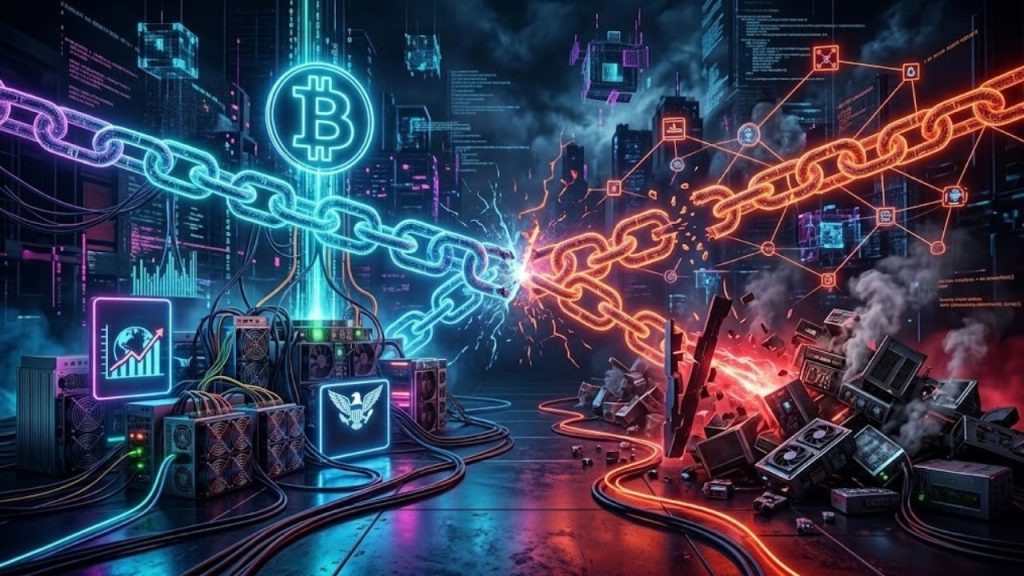
The recent controversy over the failed activation of the upgrade protocol has reignited a radical technical debate regarding the future of the main network. The proposal to change the algorithm seeks to expel rebellious miners. This maneuver would irrevocably alter the fundamental incentives of the original system.
Modifying the proof of work model is not a simple software update. Discarding the current infrastructure means destroying the security wall from which the network derives its immense value. The Satoshi original technical whitepaper document establishes that the majority CPU dictates the ultimate truth.
To understand the magnitude of the risk, we must observe the installed computational capacity. The network consumes massive resources guaranteeing immutability. An algorithmic alteration would immediately turn specialized equipment into scrap.
The comprehensive data from the Cambridge Bitcoin Electricity Consumption Index reveals that mining sustains a massive global scale industry. Disconnecting current operators through a forced fork would eliminate years of specialized hardware investment. This would leave the new chain highly vulnerable to severe external attacks.
Advocates argue that corporate miners exert too much pressure. They seek to purge the network of commercial influences to recover decentralization. This stance mistakenly assumes that code survives without computational force.
The technical counterpoint is valid under a strictly purist perspective. If a coalition of miners selectively censors blocks, the system loses its censorship resistance. Modifying the proof of work offers an emergency reset button against unacceptable monopolies of dominant computational hashing power.
However, this reset button carries catastrophic consequences for the entire ecosystem. The official report on blockchain technology by the NIST confirms that decentralized trust depends on unrecoverable physical effort. Without this energy expenditure from initial miners, the parallel network will lack demonstrable real security.
The risk of fragmenting liquidity
A hostile fork fragments liquidity and destroys accumulated institutional trust. Markets heavily penalize structural instability with abrupt drops. Creating an alternative network without physical backing equals printing worthless fake money.
Corporate adoption at scale demands operational predictability above everything else. If developers can arbitrarily alter the consensus mechanism when they lose an internal political dispute, the asset loses its monetary quality. No investment fund will inject capital into a system with completely mutable base rules.
The equilibrium of incentives keeps rational actors honest. Miners protect the ledger because they receive substantial financial rewards. Altering this balance destroys the delicate architecture of the modern digital economy.
Historically, attempts to change fundamental rules without broad consensus result in absolute failure. The block size war from several years ago demonstrated that noisy minorities cannot dictate the market direction. Institutional capital always follows the most secure and widely supported decentralized blockchain network.
The crucial role of dedicated hardware cannot be underestimated. The multibillion-dollar investment anchors the protocol to physical reality. Breaking this physical hardware link transforms a scarce asset into vulnerable software.
The disconnect between code and capital
Academic documents, such as the comprehensive International Monetary Fund analysis on PoW, warn that transitioning consensus models generates massive frictions. The sudden abandonment of installed infrastructure provokes deeply negative externalities and a direct loss of the immense capital accumulated over several years.
Mining operators assume a colossal operational risk by purchasing energy and hardware upfront. Their permanence guarantees that attacking Bitcoin becomes prohibitively expensive for any kind of external malicious adversarial entity.
The attempt to force this upgrade proposal reflects a worrying disconnect between code development and financial reality. Protocol improvements require total alignment of economic incentives. Ignoring this basic requirement invariably leads to irrelevant forks that the broader free market ultimately ends up completely ignoring.
Long-term viability requires extreme resilience against internal attacks. Developers drastically underestimate the complex logistics of building a new network. Security cannot be easily improvised through simple urgent open-source software patches.
If this dissident group advances with an algorithmic change, they will operate an amateur network without liquidity or major exchange support. The minority chain will face constant attacks due to its low mining difficulty. This will confirm that capital detests radical experiments involving scarce assets.
Any network resulting from this technical fracture will operate strictly on the industry margins. Its speculative value will quickly plummet. Forking the base protocol without massive computational power generates useless assets.
The free market acts as the supreme judge over these technical governance disputes. Financial institutions deposit billions based strictly on the immutability of the dominant chain. An abrupt change in validation will instantly destroy any remaining legitimacy of the new isolated rebellious faction.
The threat of changing the work mechanism is a strategic bluff by a minority. Executing it represents complete economic suicide. Nobody will finance a reboot that eliminates its primary defenders.
If a minority fork changes the proof of work during the coming months, its hash rate will represent less than two percent of the original chain. This will cause its permanent exclusion from regulated trading platforms for lacking protection against inevitable majority network attacks.
This article is for informational purposes only and does not constitute financial advice. All the detailed analysis provided previously reflects strictly testable metrics and verifiable data extracted from highly reliable sources available at the exact time of its publication in global markets.