Are Bitcoin miners disappearing because of AI? The HPC transition
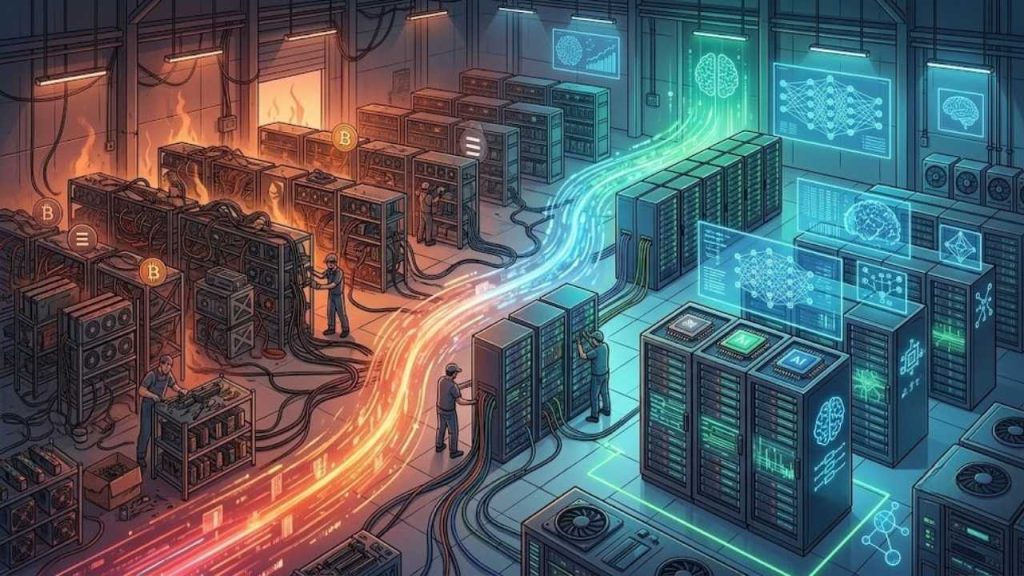
The dominant narrative suggests that Bitcoin operations are surrendering their infrastructure to artificial intelligence. However, this transition does not represent the end of mining, but rather a migration of computational resources aimed at maximizing operational margins across the industry.
This infrastructure arbitrage becomes highly relevant following the April 2024 block reward reduction. Operators face fixed energy costs while revenues from block validation decrease, driving a structural search for high profitability alternative markets in the current macroeconomic environment.
Obsolete hardware loses economic viability in the face of increasing network difficulty. Companies with access to low-cost electrical contracts understand that their primary asset is no longer the hardware, but the uninterrupted access to approved megawatts and industrial zoning.
The energy demand of traditional data centers is reaching its limit in several jurisdictions. According to the electricity consumption annual report from the International Energy Agency, the requirements for AI and cryptocurrencies could double by the year 2026.
This macroeconomic projection places mining data centers in a position of significant competitive advantage. They have advanced cooling systems, approved electrical substations, and spatial capacity, elements that language model developers urgently require to scale their current commercial operations.
The integration of specialized hardware for artificial intelligence represents a significant operational pivot. It is not about processing cryptographic algorithms, but about leasing compute capacity for neural network training, a business model that offers much more predictable long-term returns.
Infrastructure arbitrage and revenue diversification
The history of crypto asset mining demonstrates constant adaptation to changing market conditions. During the Chinese government ban in 2021, the industry managed to relocate its operational capacity to North America in less than six months without network downtime.
Today, the primary challenge is economic rather than regulatory. Diversification into high-performance computing allows companies to mitigate crypto market volatility, using the blockchain infrastructure as a highly scalable foundation capable of supporting multiple parallel industrial use cases effectively.
Profit margins largely explain this rapid reallocation of energy resources. While crypto asset extraction depends directly on the daily asset quotation and network difficulty, hosting contracts for artificial intelligence offer fixed, highly predictable revenue streams over multi-year corporate agreements.
Some of the largest operators in North America are already executing this structural transition. For example, recent corporate agreements demonstrate how the allocation of HPC capacity to machine learning companies generates billions of dollars in projected long-term revenues.
These corporate movements validate the underlying thesis that energy is the true technological bottleneck. Companies that control access to the electrical grid will ultimately dictate the pace of expansion for the next generations of advanced algorithms and large language models.
However, a contrary view argues that artificial intelligence will end up completely cannibalizing the mining space. Those holding this position point out that the revenue per megawatt of traditional high-performance computing currently exceeds that of standard cryptographic processing operations.
This perspective remains valid under current hardware pricing and utility cost conditions. If artificial intelligence margins remain significantly higher than mining, financial logic dictates that capital will flow toward profitability, displacing the least efficient operations in the energy market.
Structural limitations and the technical counterpoint
What would invalidate the total substitution thesis is the profound difference in infrastructure requirements. Artificial intelligence training demands near-total redundancy and uninterrupted uptime, attributes that increase capital expenditure costs considerably for any transitioning facility operator today.
Mining, on the contrary, operates in a highly flexible manner. It can shut down in seconds to stabilize the power grid and sell energy back, a technical advantage that the Cambridge electricity consumption index documents when analyzing operator load profiles.
The equipment required to run complex artificial intelligence models is much more expensive than standard application-specific integrated circuits. An AI data center requires ultra-low latency optical fiber and extremely strict ambient temperature control to function properly and avoid degradation.
First-generation mining facilities, often located in simple containers or rudimentary structures, cannot adapt to artificial intelligence without massive capital investment. This creates a hard entry barrier that effectively segments the digital infrastructure market right now on a global scale.
Therefore, we will observe a clear bifurcation of the energy sector. Facilities with sufficient capital will upgrade to enterprise-grade standards, while sites in remote locations with poor connectivity will continue to operate exclusively in the decentralized cryptographic domain.
The relationship between both technologies is not a zero-sum game, but rather an optimization of the electrical spectrum. The ability to absorb intermittent or surplus energy remains a use case where the decentralized protocol maintains an absolute operational superiority.
The implications for network security remain clear under this dynamic. The hash rate could experience slower growth compared to previous cycles, forcing the system to find a new equilibrium in technical difficulty to continue operating within secure mathematical parameters.
This algorithmic adjustment guarantees that the profitability of the remaining mining operations improves if the competition abandons the market entirely. It functions as a self-balancing mechanism where the exit of participants directly increases economic incentives for those who remain.
If the adoption of AI data centers faces new regulatory obstacles due to their high water consumption, part of that infrastructure could revert to cryptographic processing, demonstrating the underlying fungibility of approved megawatts designated for heavy industrial use.
If the average revenue per megawatt in the artificial intelligence industry decreases due to an oversupply of infrastructure over the next twenty-four months, we will observe a direct reallocation of idle compute capacity back toward decentralized block validation networks.
This article is for informational purposes only and does not constitute financial advice.