Can revenue double crypto valuations by implementing repurchases in decentralized protocols and networks?
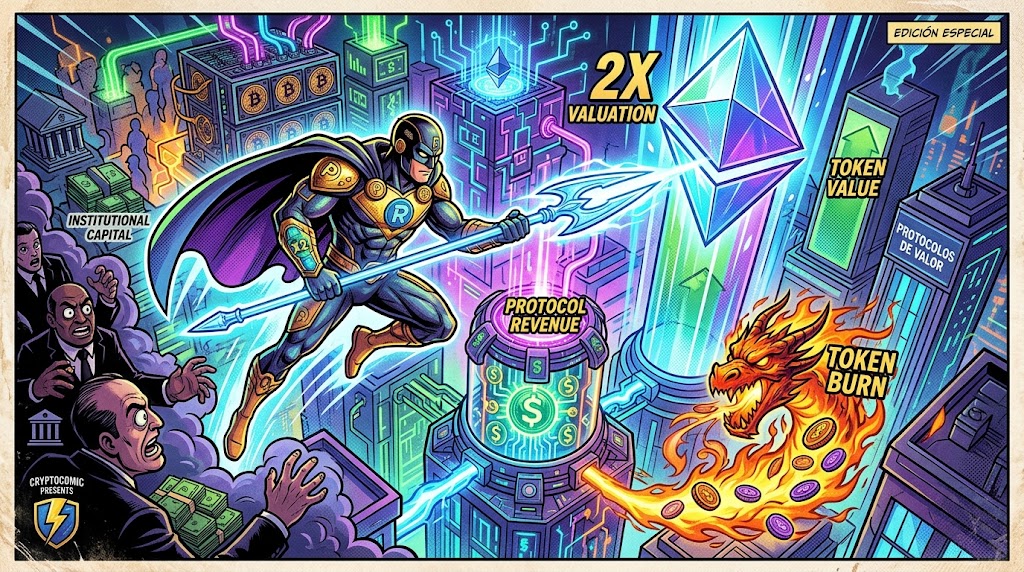
The industry debates whether adopting actual cash flows will transform digital assets. Matt Hougan suggests that integrating traditional financial metrics could radically boost asset valuation metrics, shifting the sector’s evaluation. A recent assessment in the official State of Crypto report highlights this financial metamorphosis.
Historically, protocols generated intense economic activity without returning direct profits to holders. Today, that speculative vision rapidly disappears facing structures designed to capture tangible yields, forcing investors to urgently update their fundamental models.
The market now demands verifiable profits to justify its current valuations. Outside the specific Bitcoin ecosystem, cryptographic assets are beginning to be evaluated under the exact strict metric governing conventional stocks and bonds, always prioritizing the attainment of demonstrable net incomes.
Decentralized exchanges lead the destructive token trend. Hyperliquid reported over eight hundred million dollars generated last year, allocating ninety-nine percent to repurchase and burn circulating supply. The Binance Research foundational analysis documents how transaction fees economically sustain these emerging platforms.
This specific platform has withdrawn one billion three hundred million dollars in tokens since its launch. Following this pattern, Uniswap invoices roughly one hundred million dollars annually, confirming that real revenues ceased being a distant technological promise.
Aave aims to incinerate thirty million dollars annually, equivalent to twenty percent of its total billing. Concurrently, Pump.fun registers millionaire revenues, validating a real financial traction and burning three hundred seventy million dollars through April of the current ongoing year.
Lighter repurchased six percent of its circulating supply relying on an annual billing of sixty-seven million dollars. These decentralized trading platforms demonstrate that deflationary monetary policies function perfectly when consistent organic demand permanently exists.
The shift towards a revenue model penetrates the operational base layer. The Solana network presented a formal technical proposal to increase its fee burn rate up to fourteen times, seeking to transfer direct monetary value towards the native token.
Aptos multiplied its gas fees ten times earlier this year, which tripled its transactional activity and raised annual burns from ninety thousand to almost two million tokens. This dynamic aggressively reduces supply.
This mechanic imitates the successful historical precedent established in two thousand twenty-one. The formal economic research on EIP-1559 clearly details how the Ethereum network introduced a destructive base fee, irrevocably linking intense on-chain activity with the programmed scarcity of the underlying asset.
Comparatively, traditional technological platforms took decades to distribute stable dividends. Apple or Microsoft consolidated their monopolies before initiating massive repurchases, while web3 protocols execute these financial maneuvers in their early growth phases to ensure immediate holder loyalty.
The sustainability debate
Critical analysts exist who question the longevity of this economic model based on repurchases. The opposing view maintains that burning tokens to artificially inflate prices decapitalizes projects that should be aggressively reinvesting those exact revenues into fundamental technological development.
This skepticism argument possesses obvious operational validity. Decentralized networks face severe bottlenecks in scalability and security. Prioritizing price over technical innovation technically weakens the project, leaving it exposed to aggressive competitors that constantly finance new infrastructure.
The duplicated valuations thesis would be invalidated if underlying transactional demand steadily retracts. Fees depend on active users operating uninterruptedly; without provable customer retention, the monetary flow will disappear, rendering any token burn mechanism completely inoperative and fundamentally useless.
The regulatory landscape in the United States recently offers a strategic respite. The litigation resolution between the securities agency and Ripple reduces heavy legal uncertainty, facilitating more developers to implement operational structures where they share yields without legal friction.
Furthermore, recent executive appointments in American supervisory entities project less restrictive guidelines. Formal documents like the investment implications technical evaluation exhaustively emphasize that a clear legal framework allows large institutional funds to calculate acceptable risk premiums to confidently inject capital.
Towards a fundamental evaluation
If juridical conditions favor cash flow distribution, discounted cash flow valuation models will replace pure speculation. The widespread adoption of transaction fee burning guarantees a highly measurable and consistent long-term monetary return for dedicated investors.
This environment forces the immediate redesign of global market reference indices. When digital assets offer a quantifiable passive yield through the constant reduction of supply, professional risk evaluators confidently incorporate these instruments into those strict corporate portfolios that systematically ignored them before.
If consolidated billing across layer one networks maintains a year-over-year growth exceeding thirty percent during three consecutive quarters, the aggregated valuations of these protocols will undergo a mathematically founded revaluation, definitively closing the current valuation gap against traditional technological enterprises.
This incentive alignment between active users and loyal holders will force an ecosystem purification. Projects without real cash flow will face significant institutional liquidity outflows, while profitable protocols will absorb that market share, establishing an entirely new rigorous survival standard.
Capital rigorously demands provable efficiency and transparent business models. As automatic token repurchases become standardized, the sector definitively abandons its purely experimental phase to smoothly integrate within the strict quantitative metrics that define global traditional finance.
This article is strictly for informational purposes for the reader and under no circumstances constitutes financial advice or formal investment recommendations.