
The GTA VI Effect Proves Cultural Catalysts Drive Tokenized Stocks
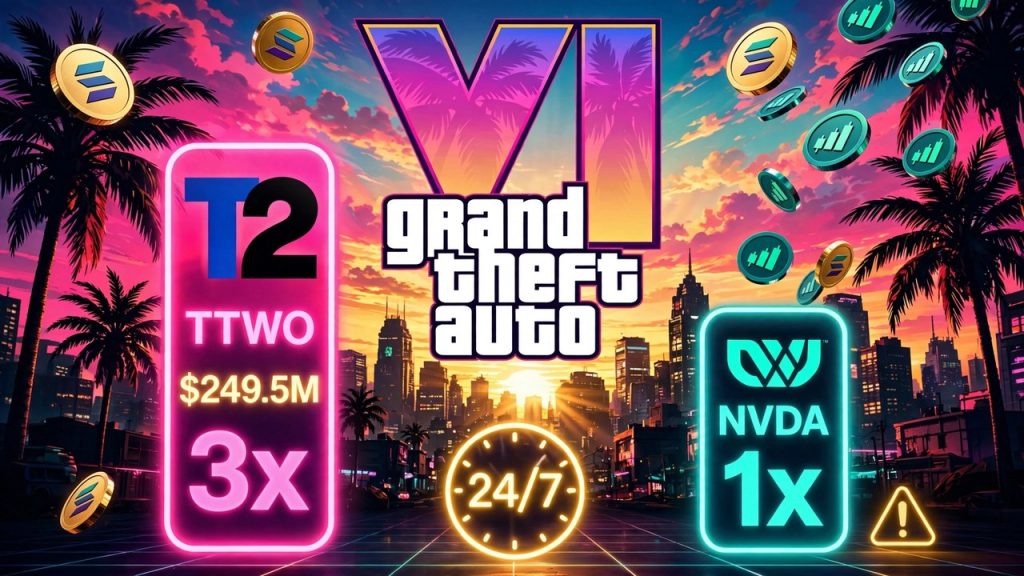
The trading of real-world assets on public blockchains no longer relies exclusively on institutional sovereign debt funds. According to data from Token Terminal, tokenized shares of Take-Two Interactive reached $249.5 million in daily trading volume.
That figure nearly tripled the decentralized trading activity recorded for Nvidia within the same operational window. Mass consumer culture beats institutional narratives, showing that a global entertainment release mobilizes retail capital faster than corporate fixed-income products.
The immediate catalyst was the PS5 pre-load launch for Grand Theft Auto VI announced on November 10. While traditional equity exchanges remained bound by fixed clearing hours, digital traders sought immediate direct exposure to the game publisher.
The architecture behind this capital flow reveals a clear technical preference for low latency. Roughly 96% of Take-Two’s tokenized volume concentrated on the Solana network through Backpack’s trading infrastructure.
This trading pattern indicates that retail participants prioritize instant settlement over legacy clearinghouses. When a cultural event creates financial urgency, waiting for Wall Street’s opening bell becomes commercially obsolete.
Meanwhile, Take-Two equity trading on the Nasdaq reflected a slower cadence constrained by regular market hours and banking intermediaries. The operational gap between both venues highlights two distinct speeds of price discovery.
Decentralized Liquidity Versus Regulatory Friction
Evaluating this surge requires comparing it against earlier synthetic equity cycles between 2020 and 2022. During that era, platforms such as Mirror Protocol and FTX attempted to capture retail demand through equity derivatives with shallow order books.
Unlike those early experiments, current Solana infrastructure absorbs hundreds of millions of dollars without fracturing spreads. Liquidity across decentralized exchanges has deepened considerably, as seen when Raydium edged past Pump.fun in daily spot volume.
Technical speed cannot eliminate legal risks, and the expansion of these instruments reignited scrutiny in Washington. Several U.S. senators formally questioned exemptions granted by the Securities and Exchange Commission regarding retail investor protection.
The core legislative dispute centers on legal parity between a token holder and a traditional shareholder. Many digital wrappers lack direct voting rights or face unresolved custody claims during an intermediary insolvency.
The securities regulator has also tightened its technical standards governing the safekeeping of digital equities. Specifically, the SEC mandates regulated custody for private keys tied to tokenized securities, raising compliance hurdles for decentralized trading venues.
Compounding these regulatory pressures is an acute operational security issue across permissionless networks. Exploiting media attention surrounding Rockstar Games, malicious actors deployed thousands of fraudulent contracts using GTA VI branding.
These counterfeit tokens aim to siphon funds from uninformed traders who confuse backed equity wrappers with unbacked speculative launches. Permissionless listing mechanics shift the entire burden of contract verification onto retail buyers.
Structural Scope and Model Limits
From an opposing viewpoint, advocates of institutional tokenization contend that this surge represents an isolated burst of transient speculation. They argue that tokenized Treasury bills and private credit form the true sustainable foundation of the sector.
That perspective holds merit when examining long-term capital stickiness. Asset managers require predictable yields and auditable legal frameworks, qualities largely absent during volatility spikes driven by video game releases.
This thesis would lose empirical validity if decentralized Take-Two volume drops by more than 90% within thirty days without rotating users into other consumer stocks. A complete return to inactivity would prove the event was merely anecdotal.
Still, dismissing cultural catalysts underestimates how younger cohorts interact with capital markets. For millions of digital-native participants, trading a familiar entertainment franchise feels far more intuitive than analyzing sovereign yield curves.
The core infrastructure challenge ahead lies in embedding authenticity verification without sacrificing the continuous availability of public blockchains. While regulated issuers take months to approve new listings, decentralized venues react within minutes.
If over the next two quarters at least three regulated issuers list entertainment company equities under verifiable custody standards, and those assets sustain more than $50 million in weekly trading volume, cultural catalysts will establish themselves as the primary retail gateway into tokenized assets. Otherwise, the market will remain divided between illiquid institutional niches and brief speculative episodes.
This article is for informational purposes only and does not constitute financial advice.