Why Cryptocurrency Regulation Is Moving From Enforcement to Market Structure

Financial markets continue to evolve as regulators develop ways to address new technological systems operating beyond traditional regulatory frameworks. As cryptocurrencies become more widely used in financial services, business activity, and money transfers, governments are introducing rules that define how companies can operate.
Cryptocurrency regulation has entered a new phase in which lawmakers are moving beyond enforcement actions and developing formal rules for licensing, supervision, and market conduct. The focus is increasingly shifting toward comprehensive legal frameworks rather than relying primarily on litigation after violations occur.
In the United States, this transition is reflected in legislation such as the GENIUS Act and in proposed market structure bills. Europe has already established a broad framework through MiCA, while jurisdictions in Asia and the Middle East continue to develop or refine their own regulatory systems.
Regulation of Cryptocurrencies Enters a More Formalized Era
Cryptocurrency regulation in 2026 is becoming increasingly formalized. In previous years, regulators often focused on penalizing violations after they occurred. Governments are now introducing rules for licensing, custody, disclosure, and consumer protection that apply before companies begin offering services.
The European Union’s Markets in Crypto-Assets regulation, known as MiCA, has become one of the most significant regulatory frameworks for the crypto market.
Singapore, Hong Kong, Japan, and the UAE are also developing or refining licensing systems intended to support blockchain companies while mitigating financial crime and consumer risks. In the United States, lawmakers have introduced legislation aimed at reducing uncertainty over how digital asset companies should be regulated.
Drivers of the Transition
- Governments are increasingly trying to establish rules before companies launch products rather than relying mainly on court cases.
- Stablecoins and tokenized securities require clearer rules for issuance, custody, reserves, and disclosure.
- Institutional investors are demanding more consistent compliance standards before allocating capital to digital assets.
Why Was Enforcement the First Regulatory Strategy?
During the early development of cryptocurrencies, few laws directly addressed digital assets. Regulators therefore relied on existing legislation covering securities, commodities, taxation, and money laundering.
In the United States, the Securities and Exchange Commission frequently initiated legal proceedings against cryptocurrency exchanges, token issuers, and decentralized finance projects.
Because there was no comprehensive federal framework for cryptocurrencies, these cases became an important source of regulatory guidance. However, enforcement actions often addressed individual disputes without providing uniform rules for the broader market.
Why Market Structure Regulation Is Now the Main Goal
Several factors are driving the move toward market structure regulation. One of the most important is the growing participation of institutional investors, which has increased demand for reliable compliance standards before capital is committed to digital assets.
The expansion of stablecoins, security tokens, and asset-backed tokens has also created a need for clearer rules governing issuance, reserves, custody, and disclosure.
Consumer protection is another priority. Governments are introducing reserve, custody, transparency, and cybersecurity requirements that allow regulators to supervise companies through established standards instead of depending primarily on litigation.
Market Structure Regulation Areas
- Classification of digital assets as securities, commodities, payment tokens, or other regulated instruments.
- Licensing requirements for exchanges, brokers, custodians, and wallet service providers.
- Reserve, anti-money laundering, disclosure, and market-monitoring requirements for stablecoin issuers.
US Legislation on Market Structure
The United States has taken several steps toward establishing a federal regulatory framework for digital assets.
The GENIUS Act was enacted in July 2025 as the country’s first federal legislation specifically addressing payment stablecoins. The law establishes requirements related to reserves, reporting, anti-money laundering compliance, and issuer disclosures.
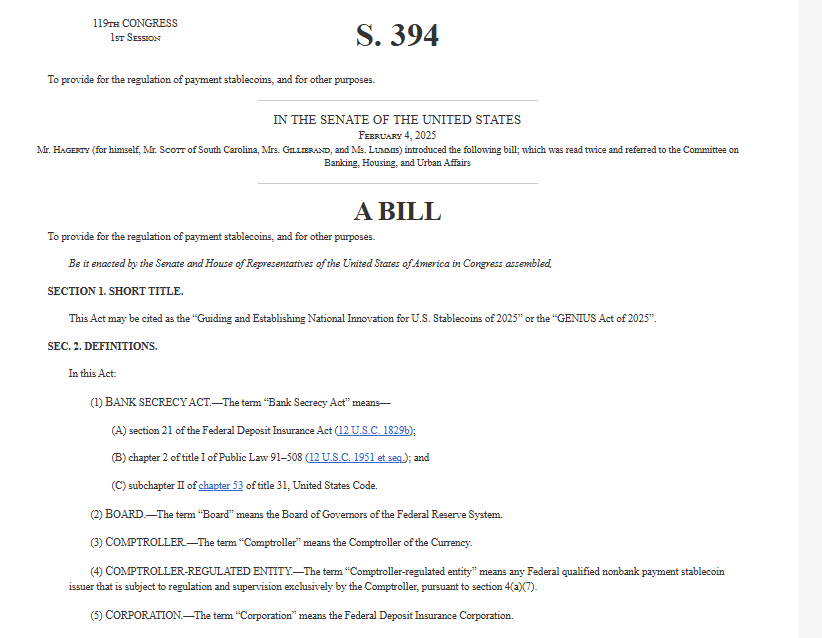
Guiding and Establishing National Innovation for U.S. Stablecoins of 2025. Source: Congress.
Congress has also introduced the CLARITY Act, which seeks to define when digital assets should be treated as securities or commodities and to clarify how oversight responsibilities would be divided between the SEC and the CFTC.
The proposed legislation also aims to reduce regulatory duplication by establishing registration and disclosure requirements for digital asset companies. Because it remains a legislative proposal, its final provisions and implementation will depend on the outcome of the congressional process.
Regulatory Issues Persist
Despite this progress, several issues remain unresolved. Cryptocurrency companies operating across multiple jurisdictions must comply with regulatory systems that can differ significantly in their licensing, disclosure, and consumer protection requirements.
Decentralized finance protocols are also difficult to regulate because they may operate without clearly identifiable intermediaries responsible for compliance.
Emerging areas such as tokenized assets, decentralized autonomous organizations, and the use of artificial intelligence in financial services may create additional regulatory questions. As these technologies develop, policymakers will need to determine how they fit within existing market structure frameworks