Why XRP Price Overreacts to Regulatory News Across Digital Asset Markets
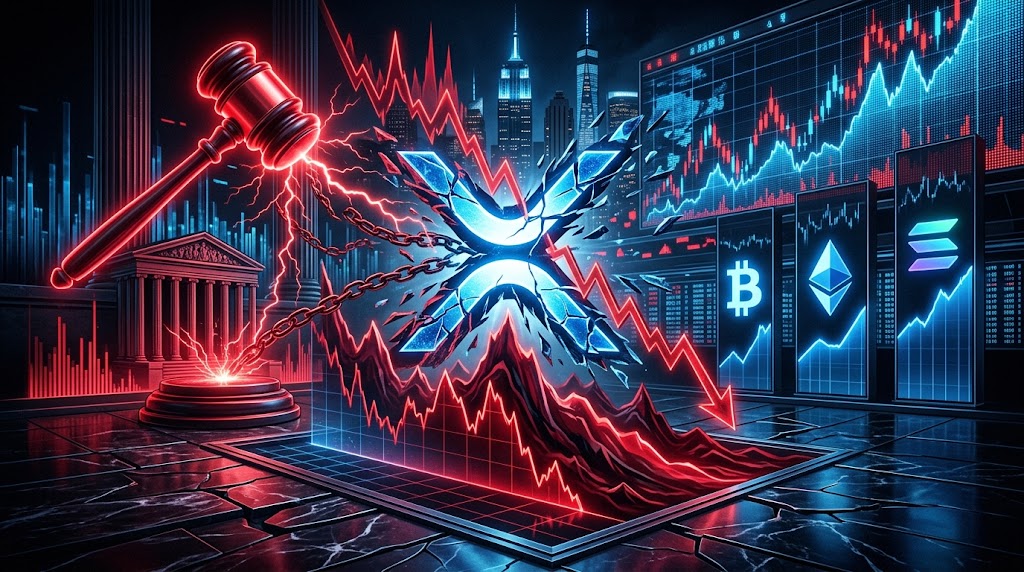
The legislative deadlock surrounding the federal measure known as the CLARITY Act triggered a 7.1 billion dollar contraction in XRP market capitalization. As detailed in the official United States congressional testimony, the lack of bipartisan support stalled the anticipated integration of digital assets into regulated financial market infrastructure.
This 8.14 percent daily drop pushed the token down to 1.29 dollars. The price movement substantially exceeded pullbacks recorded by Bitcoin, Ethereum, and Solana, exposing a pronounced vulnerability to direct legislative shifts that dictates how this network is valued relative to decentralized alternatives.
Trading volume surged 45.1 percent to 6.64 billion dollars over twenty-four hours. Commercial litigation attorney William Arthur Morgan noted that the asset depends on holistic regulatory certainty far more than other major cryptocurrencies across the sector.
Morgan contends that institutional players require explicit federal banking rules before deploying substantial liquidity into cross-border corridors. The SEC acknowledged in an official southern district judicial order that programmatic secondary sales did not constitute investment contracts, creating an initial legal precedent for secondary markets.
Conversely, Ripple Labs Chief Legal Officer Stuart Alderoty maintained that XRP already operates on firm legal ground. He highlighted that the 2023 summary judgment and joint SEC and CFTC findings recognized the token as a digital commodity.
Technical Architecture and Institutional Settlement Dependencies
Unlike permissionless smart contract networks such as Ethereum, Ripple was architected to serve supervised financial institutions. Under the official distributed consensus protocol specification, unique node list validators operate under rigorous Byzantine fault tolerant parameters, prioritizing transaction finality and deterministic ledger progression over experimental composability.
The December 2020 regulatory enforcement action provides essential context for this heightened sensitivity. When the SEC filed its complaint, American digital asset exchanges removed the asset from trading, excluding it from a liquidity expansion that benefited Bitcoin.
That prolonged courtroom conflict shaped institutional sentiment for years. While Solana expanded its ecosystem through decentralized exchange protocols, Ripple’s commercial growth remained anchored to judicial determinations regarding whether secondary transfers could proceed without federal regulatory penalties.
Institutional conservatism remains evident whenever statutory progress slows. This pattern materialized clearly during the fund management portfolio liquidation event when major global investment banks trimmed structured fund holdings.
Traditional asset managers avoid ambiguous regulatory perimeters. When federal proposals stall, such as the comprehensive digital asset legislative text proposal, institutional risk committees curtail allocation mandates to avoid potential supervisory scrutiny and custodian compliance complications.
During these periodic institutional pullbacks, private capital pools attempt to absorb downside pressure. Strategic whale holdings balance accumulation defense frequently emerges around established technical support thresholds to prevent structural breakdowns.
Cross-border settlement via On-Demand Liquidity requires banking participants to hold lean capital reserves. Without explicit legislation exempting bridge transactions from burdensome securities rules, treasury departments freeze pilot programs and postpone live deployments on the ledger.
Analytical Counterpoints and Market Liquidity Dynamics
An alternative market perspective argues that XRP price volatility stems from speculative leverage imbalances rather than unique legal vulnerability. Derivatives market metrics show that liquidation cascades on offshore exchanges trigger sharp drawdowns whenever negative political headlines emerge from Washington.
This counterpoint holds weight because more than sixty percent of spot transactions take place outside the United States. Traders across Asian hubs such as Tokyo and Seoul frequently execute orders without reference to legislative committee procedures on Capitol Hill.
Order book depth on offshore venues often thins during macro risk events. When automated stop-loss algorithms execute simultaneously, price declines accelerate rapidly, even among market participants who possess no detailed understanding of the specific congressional amendments under consideration.
The regulatory overreaction thesis would be invalidated if future legislative delays produce price volatility identical to Bitcoin and Solana. If the token continues experiencing eight percent swings during periods devoid of policy developments, technical order flow must be considered the primary driver.
Nevertheless, empirical observations demonstrate that institutional custodians will not scale banking integration without formal statutory exemptions. The asset carries a structural discount as long as lawmakers leave jurisdictional boundaries between federal agencies unresolved.
While Solana and Ethereum derive utility from autonomous transaction execution and decentralized protocols, Ripple designed its value proposition around institutional compliance. This structural alignment ensures that federal legislative developments serve as the decisive factor in capital allocation models.
The 45.1 percent surge in daily volume highlights capital rotation toward Bitcoin during regulatory setbacks. Traders treat the leading asset as a non-sovereign hedge against policy gridlock, while shedding assets whose utility depends directly on formal banking adoption.
The price reaction to the CLARITY Act delay is therefore not an isolated anomaly, but a repricing mechanism in an institutionally dependent market. Until clear statutory definitions emerge, XRP will continue to exhibit outsized beta relative to the broader digital asset complex.
Should the United States Senate leave comprehensive crypto market structure legislation unaddressed across the coming two quarters, 30-day realized volatility for XRP will remain at least 2.2 times higher than Bitcoin, sustaining negative net institutional fund flows throughout the period.
This article is for informational purposes only and does not constitute financial advice.