Why 24/7 Could Become Crypto’s Biggest Challenge to Traditional Markets
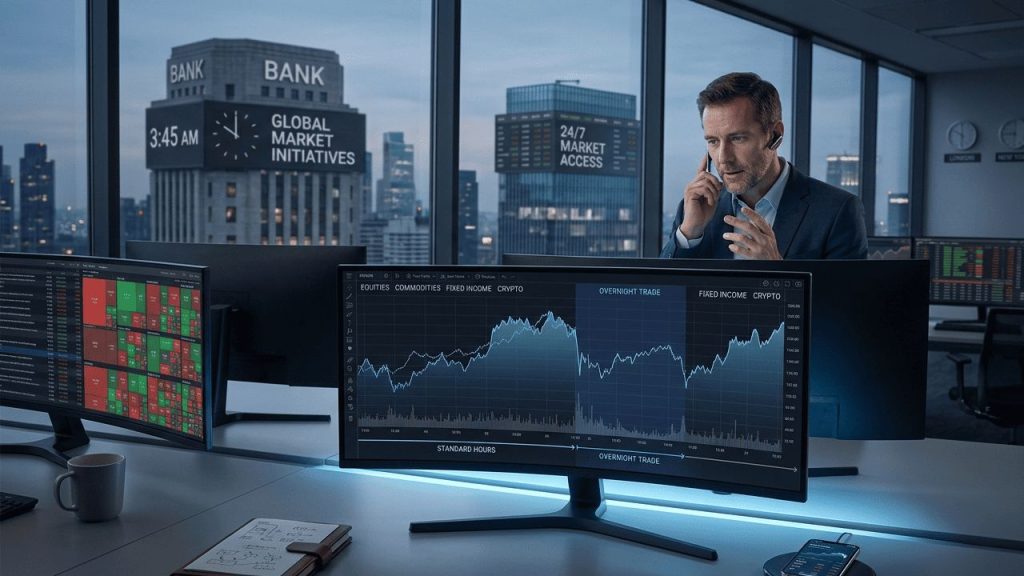
24/7 trading is fast becoming one of crypto’s biggest challenges to traditional financial markets. Unlike past pressure points like lower fees or faster settlement, continuous trading exposes a structural weakness that legacy exchanges can’t fix with simple upgrades.
The shift is forcing a full rebuild of market infrastructure, investor expectations, and regulatory frameworks all at once, analysts say.
Why This Pressure Point Hurts More Than Others
All the competitive challenges that cryptos offered to traditional finance could have been met with minor modifications.
Faster settlement times, low transaction costs, and different types of assets could be integrated without disturbing basic systems. Continuous trade does not fall into this category.
Traditional exchanges are built around fixed sessions, overnight clearing, and settlement cycles paced for human operations.
Reconciling trades and refreshing risk models typically happens during downtime between sessions. Removing that downtime means rebuilding infrastructure rather than adding a feature layer.
This is why 24/7 trading stands apart as a challenge. It does not compete with traditional finance on price or convenience alone.
It challenges the operational assumptions those markets were originally engineered around, decades ago.
Investor Expectations Are Shifting Ahead of Regulation
Once traders experience always-on access, closed markets start to feel outdated rather than standard.
That shift became visible during the West Asia crisis earlier in 2026, when traders turned to the Hyperliquid decentralized exchange to trade oil and gold while traditional venues stayed shut.
Julia Hoggett, chief executive of the London Stock Exchange, said retail investors are now used to trading whenever they choose, not only during standard hours.
Her comments came as LSE announced plans for a separate 24/7 trading platform, launching in the first half of 2027 with ETFs tied to U.S. and U.K. stocks.
eToro’s Elad Lavi described the shift in similar terms, noting that crypto changed how retail investors think about reacting to breaking news.
Once that expectation spreads, closed sessions look increasingly like a design flaw rather than an accepted market norm.
Price Discovery Gaps Give Crypto Funds a Direct Edge
Trading gaps outside standard hours create measurable costs for traditional markets, not just inconvenience.
Overnight, price discovery ceases, and post-close news events often lead to sharp adjustments when markets open the next day. That volatility can give crypto-native funds a potential advantage.
Crypto hedge funds built for continuous markets already run real-time data systems, automated execution, and always-on risk management.
Those same tools are now being redirected toward equities, commodities, and fixed income, where liquidity pools dwarf crypto markets alone.
Tokenization is widening this gap further. Tokenized stocks and commodities can be traded on decentralized platforms around the clock. Coinbase and Kraken have also expanded their offerings to include round-the-clock trading products, putting additional pressure on legacy exchanges.
Incumbents Are Forced to Adapt Because of Capital at Stake
It is estimated that about two trillion dollars of capital is involved in this move to continuous trading.
Tokenized equities already move billions in monthly volume, making the trend difficult for exchanges to treat as optional.
Even the largest incumbents are conceding ground. CME Group, the world’s largest derivatives platform, received approval for 24/7 crypto trading, though its oil futures plans hit regulatory obstacles.
CME CEO Terrence Duffy told regulators that the market will demand continuous access regardless of exchange preferences.
Nasdaq, Cboe, and NYSE are all reportedly considering or targeting expanded trading hours, with some plans extending toward continuous or near-continuous trading.
When the biggest players start adapting rather than resisting, that shift suggests the challenge is structural rather than temporary.
Regulatory questions around oversight and systemic risk remain unresolved, but the push toward longer trading hours is becoming increasingly difficult for traditional markets to ignore.