Bad debt in DeFi proves automated protocols cannot eliminate traditional credit
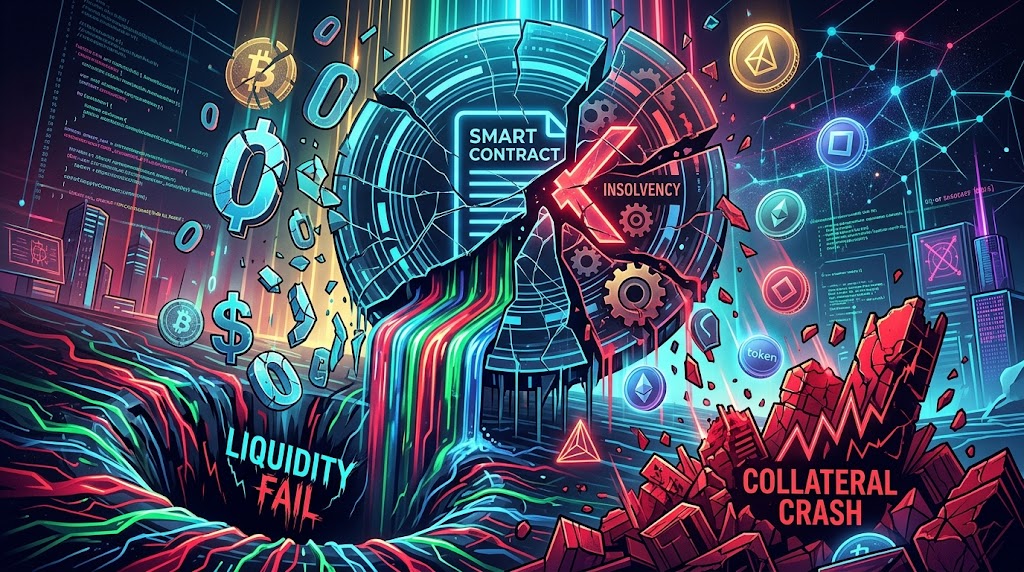
Decentralized lending protocols promise deterministic code execution without traditional human financial intermediaries. However, the recurring emergence of bad debt in decentralized protocols demonstrates that programmability does not eliminate fundamental credit insolvency risks when collateral asset prices decline faster than automated liquidation systems can execute on-chain.
The widespread assumption that permanent overcollateralization guarantees protocol solvency loses credibility during severe market stress. This structural challenge matters today because lending platforms increasingly accept volatile tokens with limited secondary depth, compounding unhedged deficit exposures across the broader decentralized credit ecosystem.
Under automated borrowing architectures, when a borrower’s collateral value drops below a designated threshold, the smart contract initiates an auction. If the underlying price drops rapidly before settlement occurs, outstanding loan liabilities exceed the recovered collateral, leaving unbacked debt balances permanently in the pool.
A comprehensive Bank for International Settlements research report published in 2023 established that leverage and liquidity mismatches in decentralized protocols mirror structural vulnerabilities found in commercial banking. Without centralized deposit insurance, uncollected debt burdens are borne directly by liquidity providers who supply capital to lending pools.
While traditional debt contracts allow for judicial reorganizations or renegotiations, algorithmic protocols record defaulted positions as permanent deficits. These uncollectible liabilities remain trapped within the smart contracts, dragging down net protocol revenue and reducing lending yields for passive depositors who supply capital.
Liquidation Mechanics and Solvency Frictions
In an empirical study on DeFi liquidations conducted by Imperial College researchers, on-chain data revealed that blockchain network congestion and high transaction fees frequently delay liquidation executions. These bottlenecks leave undercollateralized loans underwater because external liquidators lack financial incentives to clear them during rapid price drops.
Liquidators rely on fixed discount spreads to generate profit. If gas fees exceed the potential margin gained from seizing declining collateral, no rational actor executes the contract call, leaving the remaining loan balance entirely unbacked inside the decentralized lending pool.
Furthermore, a Federal Reserve stability research paper published in July 2022 detailed how automated liquidation cascades amplify spot price downturns. Fire-sale dynamics create negative feedback loops where forced collateral dumping depresses prices further, generating widespread defaults across multiple protocols simultaneously.
This mechanism mirrors the portfolio insurance failures observed during the 1987 equity crash in traditional finance. In both environments, deterministic sell algorithms overwhelmed available secondary market liquidity, demonstrating that automated execution cannot substitute for genuine balance sheet depth when panic selling begins.
Advocates of decentralized credit point out that ledger transparency allows market participants to audit balance sheets continuously. While this openness provides a significant structural advantage over traditional shadow banking opacity, transparency alone cannot ensure immediate execution during sharp liquidity withdrawals across secondary markets.
When participants observe an underwater loan position on-chain, their dominant incentive is to withdraw liquidity before pool deficits materialize. This bank-run dynamic rapidly depletes secondary exchange liquidity, worsening slippage for liquidators and guaranteeing additional bad debt accumulation within the protocol.
Banking Parallels and Risk Mitigation
To contain these systemic contagion channels, decentralized money markets increasingly isolate volatile assets into isolated pools. Segregated models such as institutional fixed yield stable vaults protect prime lending pools from toxic collateral contagion by ring-fencing credit risk within isolated compartments that shield core capital.
Following historical financial crises, traditional regulators mandated countercyclical capital buffers and loan-loss provisions. Decentralized protocols have introduced similar safety modules, accumulating protocol revenue to cover shortfall events and backstop insolvent accounts through automated treasury recapitalizations during severe market drawdowns.
However, backstop mechanisms that rely on auctioning native governance tokens face acute reflexivity risks. In broad market downturns, selling newly minted governance tokens to cover uncollateralized loan deficits depresses token prices, diminishing the protocol’s ultimate capacity to recapitalize itself effectively.
As structural integration between decentralized and traditional markets progresses, protocols are incorporating tokenized real-world assets into collateral pools. This evolution requires sophisticated off-chain credit evaluations, moving beyond purely programmatic liquidations toward comprehensive institutional risk management frameworks.
Managing loan-to-value caps and supply limits now requires dynamic algorithmic adjustments tied directly to secondary decentralized exchange depth. This transition shifts protocol risk management from static governance voting toward real-time quantitative liquidity monitoring that adjusts borrow limits automatically.
This analysis would be invalidated if zero-latency execution environments eliminated block confirmation delays entirely, allowing programmatic liquidations to clear fractional orders without market slippage even during spot asset declines exceeding fifty percent within minutes.
Until distributed markets provide continuous liquidity buffers that scale proportionally with total borrowed volume, decentralized credit protocols will continue to accumulate uncollateralized balances whenever spot asset volatility outpaces network throughput and liquidator profitability margins.
If protocol designs fail to incorporate dynamic debt ceilings based on real-time market depth, technical insolvency rates in decentralized lending pools will expand beyond existing safety reserves during upcoming macroeconomic liquidity contractions.
Long-term maturity in programmable finance does not stem from claiming that smart contracts eradicate credit risk, but from implementing comprehensive prudential buffers that acknowledge bad debt as an intrinsic reality of credit intermediation.
This article is for informational purposes only and does not constitute financial advice.