Smart Contract Audits in DeFi Are No Longer Enough for Security
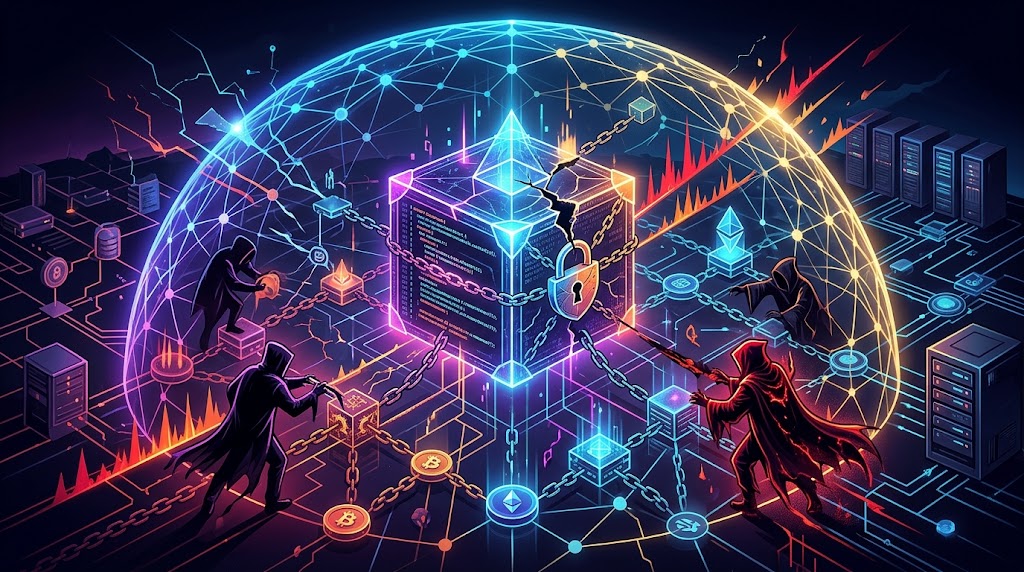
The market assumed for years that exhaustively auditing smart contracts guaranteed the absolute security of a DeFi protocol. However, recent incidents demonstrate that mathematical perfection in the code remains useless if the external underlying infrastructure is completely exposed to multiple operational attack vectors.
The recent Kelp DAO incident forced a reassessment of real operational risk. A system with invulnerable contracts can collapse catastrophically if critical vulnerabilities exist within remote procedure calls, validators, or centralized infrastructure providers feeding the network.
Historically, attackers exploited technical errors like reentrancy or flash loan manipulation. Today, malicious attacks heavily target middleware layers. Financial losses generated by external non-code vectors already dominate the global statistics documented inside the annual report on critical vulnerabilities, changing security priorities.
The ecosystem operates upon a modular technological stack. For any transaction to execute successfully on the blockchain, it must cross user interfaces, domain resolvers, network nodes, and data oracles, all possessing independent structural vulnerabilities requiring isolated technical evaluations.
A recurring critical point of failure lies within Remote Procedure Call providers. Network consensus decentralization becomes entirely irrelevant if most decentralized applications direct their operational traffic through a node infrastructure management system hosted on the exact same centralized corporate cloud servers.
If this communication pipeline fails or suffers technical alterations, it paralyzes the entire audited application. Users instantly lose access to their funds even though the main chain smart contracts function with absolute mathematical normality and complete execution efficiency.
Domain name system and frontend level attacks represent another heavily underestimated threat. A protocol can boast multiple top-tier technical audits, but if an attacker successfully hijacks the web domain, they can reroute user signatures toward fraudulent addresses using altered visual interfaces.
Private key custody and multisignature schemes constantly introduce human vulnerabilities. Social engineering and phishing directly compromise administrative access, completely bypassing any cryptographic or mathematical barriers established during the initial protocol design phase before the main network deployment.
The systemic dependence on external data oracles exacerbates the operational problem. Manipulating price feeds off-chain allows attackers to drain internal liquidity. Solving this requires implementing a robust design based on a distributed oracle network architecture that independently validates external data inputs.
The consensus layer and active validators also introduce severe risk vectors. When underlying network security fails, the financial impact propagates rapidly, physically demonstrating that technical interdependence generates systemic fragility across all high-liquidity decentralized financial ecosystems currently operating globally.
Operational Limits of Comprehensive Scrutiny
The contrarian perspective firmly argues that expanding deep security evaluations toward every external provider makes software development prohibitively expensive for new startups. Those defending the standard historical model argue that third-party infrastructure interruptions merely represent temporary non-systemic operational risks rather than core flaws.
According to this analytical perspective, a temporary failure in a node or visual frontend only causes transient denial of service, never the definitive permanent loss of capital safeguarded inside the underlying smart contract operating on the primary network.
This specific argument holds technical validity for emerging teams with limited initial capital choosing to leverage existing infrastructure. By utilizing a shared security model from external validators, they maximize speed to market, assuming large providers maintain vastly superior defensive mechanisms overall.
However, this limited risk thesis is completely invalidated by modern financial restaking primitives. In these highly complex systems, the defective behavior of an external operator directly triggers automatic financial slashing penalties upon user capital securely deposited inside the primary contracts.
The institutional adoption of the DeFi ecosystem strictly demands comprehensive operational guarantees. A corporate treasury or hedge fund will never inject massive capital if the protocol cannot demonstrate absolute resilience against denial of service attacks, oracle corruption, or user interface hijacking.
This operational reality forces security firms to evolve quickly. Reviewing native code lines is no longer enough; they must now execute complete penetration simulations evaluating the structural robustness of network servers, domain registries, and peripheral database environments.
The financial market will begin demanding exhaustive end-to-end certification standards. Creating decentralized insurance policies and hedging mechanisms against external service provider failures emerges as a critical subsector designed to mitigate these operational risks existing outside the primary execution environment.
The decentralized financial architecture heavily transitions from a zero-trust structural model toward a minimized but strictly verified dependency. Mathematical contract guarantees fundamentally require an equally validated perimeter environment to sustain high-frequency financial operations securely over extended periods.
The True Cost of End-to-End Security
This structural transition ultimately redefines the operational cost of creating decentralized applications. Software developers must allocate significant financial budgets not only for code audits but for continuous real-time monitoring, node forensic analysis, and geographic redundancy covering all critical external infrastructure.
True technological resilience is never a static state achieved after a single technical review. It demands a highly dynamic defense mechanism addressing the unpredictable operational interactions between the centralized application protocol and the globally distributed network environment supporting it.
If perimeter vulnerabilities persist as the absolute primary cause of structural value extraction, institutional users will demand transparency dashboards showing the live operational status of oracles, nodes, and active custodians. Off-chain infrastructure opacity actively destroys the fundamental decentralized value proposition.
If institutional capital adopts strict operational compliance frameworks, the financial protocols that simultaneously audit their contracts and certify their entire external infrastructure stack will capture the vast majority of market liquidity during the next market cycle.
This article is for informational purposes only and does not constitute financial advice.