
What Will Happen in 2027 With Crypto Hacks?
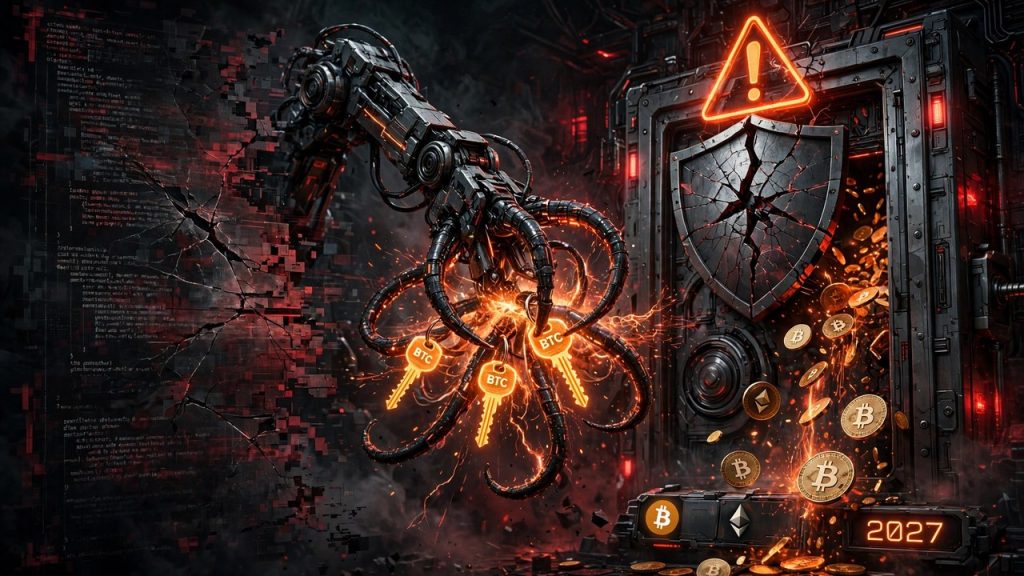
For years, the crypto sector assumed that rigorous smart contract audits would suffice to stop on-chain theft. However, crypto hacks in 2027 will be driven by credential theft and automated attacks targeting centralized platforms.
Evidence gathered between 2025 and late 2026 in the Chainalysis 2026 Crypto Crime Report supports this trajectory. Attackers no longer hunt for complex mathematical bugs when they can directly compromise human access.
The core thesis is straightforward: as base protocols mature, criminal syndicates focus their resources on high-liquidity bottlenecks. Next year, the most vulnerable targets will be centralized exchanges, institutional custodians, and decentralized application interfaces.
This shift matters now because institutional capital flows into permanently connected infrastructures. No static code audit protects a corporate treasury when an employee signs a malicious transaction from a compromised workstation.
Official records confirm the severity of this transition. According to the FBI Internet Crime Report published in 2026, losses linked to cryptocurrency fraud and theft exceeded $11.37 billion during 2025.
That statistical surge proves that operational security lags far behind trading volume. Whereas cross-chain bridge exploits dominated in 2021, today the weakest link resides in internal permission management.
The pace of extraction had already triggered early alarms when digital asset thefts surpassed the 2024 total before June 2025 ended. That inflection point signaled unprecedented professionalization among state-sponsored hacking groups.
Damage concentration across a handful of massive breaches reinforces this diagnosis. In October 2026, the Chainalysis investigation into the Binance hack documented the theft of $6.4 billion after internal terminals were compromised.
That breach far exceeded the $1.5 billion attack suffered by Bybit in February 2025. Both incidents share an identical operational blueprint: the subversion of administrative controls outside the blockchain.
Why Custodians and Interfaces Will Lead Risk in 2027
From an economic standpoint, attacking audited decentralized contracts yields diminishing returns for criminal syndicates. Exploiting a novel logic flaw requires months of technical research to capture only a fraction of available liquidity.
By contrast, compromising a single DevOps engineer’s machine allows attackers to drain multi-chain hot wallets within minutes. Economic asymmetry favors the attacker whenever custody relies on centralized human workflows.
This fragility stood out in global Web3 security metrics, where North Korea-linked theft and poor key security accounted for most of the $3.6 billion lost in 2025.
By 2027, the second critical exposure point will be software supply chains and front-end applications. Widespread adoption of delegated smart accounts expands the attack surface across every third-party integration.
A malicious package inserted into a developer library can redirect funds without altering the underlying contract. User interfaces will become prime targets as institutional users authorize increasingly complex transactions.
Furthermore, autonomous software agents will transform execution speed over the coming year. Automated tools will conduct tailored social engineering and disperse stolen assets across dozens of networks before manual alerts trigger.
Banking history offers an exact parallel in events between 2010 and 2016. Once banks hardened their core servers, criminals targeted employee credentials to manipulate the SWIFT interbank messaging system.
That pivot culminated in the $81 million Bangladesh Bank heist in 2016. The crypto industry is undergoing that exact migration from technical perimeter defense toward operational identity.
Limits of This Projection and Alternative Scenarios
A competing view argues that 2027 will mark a sharp drop in net stolen value due to rapid asset-freezing capabilities. Proponents highlight growing coordination between stablecoin issuers and blockchain forensics firms.
This counterargument rests on solid empirical ground. Following the October 2026 breach, issuers froze roughly $2.8 billion within twenty-four hours, proving that real-time traceability blocks mass monetization.
Additionally, institutional adoption of multi-party computation and hardware security modules with mandatory time delays reduces the impact of a compromised terminal. When anomalous withdrawals require geographically separated approvals, criminal incentives drop sharply.
Nevertheless, these safeguards remain concentrated among a small tier of regulated custodians. Thousands of mid-sized venues, aggregators, and corporate treasuries still operate hybrid architectures with single points of operational failure.
This thesis would be invalidated if in 2027 losses across decentralized protocols run by autonomous agents exceed thefts at centralized platforms. A systemic flaw in AI-managed contracts would reverse the current trend.
For investors and operators, the takeaway is direct: auditing smart contracts is no longer enough to guarantee platform solvency. Evaluating a counterparty requires scrutinizing key governance, vendor isolation, and withdrawal velocity limits.
If major exchanges and custodians fail to deploy phishing-resistant cryptographic controls before the second quarter of 2027, credential compromise attacks will account for more than 70% of stolen capital that year.
This article is for informational purposes only and does not constitute financial advice.