
The Jensen Huang Effect and Decentralization’s Illusion: Why AI and Crypto Still Rely on Messianic Leaders
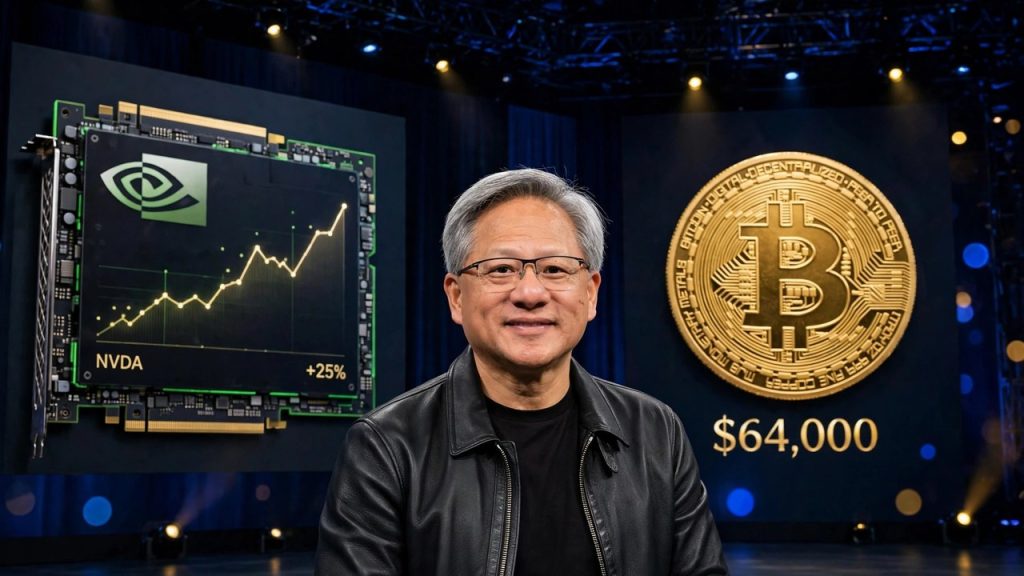
The unanimous reinstatement of Jensen Huang as Nvidia chief executive, just eleven days after his departure, reveals that modern capital relies on messianic leaders. According to Nvidia corporate filings with the SEC, governance across major technology firms still orbits tightly around individual founders.
This episode matters today because it undermines claims of institutional autonomy across both Wall Street and digital asset markets. Following news of Huang’s return, Nvidia shares surged more than twenty-five percent and lifted Bitcoin back above 64,000 dollars.
The technology industry frequently promotes an image of resilient corporate structures and unstoppable algorithms. Yet the brief absence of a single executive proved enough to inject systemic uncertainty across artificial intelligence supply chains and correlated crypto markets.
When the trajectory of infrastructure valued in the trillions hinges on one person returning to the helm, markets face a single point of failure. Even reported political pressure from the White House underscores how heavily modern technological stability depends on personalistic intervention.
The Historical Weight of Founder Dependence
Understanding the scale of this vulnerability requires examining how American technology markets have evolved over recent decades. Data from the Nasdaq Composite index tracked by the Federal Reserve highlights growing market concentration inside companies steered by prominent founders.
This dynamic echoes earlier market cycles dominated by figures like Steve Jobs at Apple or Elon Musk at Tesla. In each instance, equity valuations moved beyond discounted cash flows to embed an emotional premium tied directly to executive continuity.
The immediate spillover into cryptocurrencies confirms that digital markets still lack genuine macroeconomic independence. As explored in our analysis of the crypto domino effect after Jensen Huang’s exit, traders continue treating Bitcoin as a high-beta technology proxy.
That tight correlation challenges the foundational premise behind distributed ledger networks. In the original Bitcoin whitepaper authored by Satoshi Nakamoto, the core objective was eliminating trusted intermediaries through verifiable cryptographic rules and decentralized consensus.
Nevertheless, daily trading behavior demonstrates that market participants still look toward human figureheads for directional conviction. Whenever an executive announcement in Silicon Valley moves tens of billions across digital assets, claims of monetary sovereignty warrant closer scrutiny.
A credible counterpoint does exist and deserves fair examination. Proponents of founder-led governance argue that complex technological transitions require centralized strategic vision, rapid execution, and geopolitical negotiating leverage that diffuse committees rarely achieve.
That argument carries operational validity inside capital-intensive industries such as advanced semiconductor manufacturing. Designing next-generation compute architectures demands multi-billion-dollar commitments years ahead of revenue, an environment where founder conviction often outperforms conventional corporate bureaucracy.
Our critique of structural fragility would be invalidated if major technology firms sustained valuation multiples through planned leadership transitions without sharp volatility. It would likewise fail if Bitcoin maintained independent price trends during liquidity shocks tied to artificial intelligence equities.
From Silicon Valley to Crypto Cult Leadership
The deeper issue is that the blockchain industry has not fully escaped its own personalistic habits. Even though protocols run on open-source code, substantial media attention and capital allocation still cluster around prominent founders and vocal evangelists.
Even across networks built for open programmability, as outlined in the technical Ethereum whitepaper, roadmap debates and protocol upgrades are frequently framed around influential personalities. Markets routinely reward individual charisma ahead of rigorous technical auditing.
This contradiction weakens decentralized finance whenever it claims superiority over legacy institutions. If a digital ecosystem requires a recognizable spokesperson to reassure capital allocators, then decentralization becomes a marketing slogan rather than an operational safeguard.
Overcoming this trap requires shifting real authority away from individuals and toward verifiable collective governance mechanisms. As argued previously, decentralized autonomous organizations should replace crypto cult leaders through transparent rules, auditable treasuries, and automated checks.
As long as market participants react reflexively to every executive shuffle on Wall Street, the promise of true financial autonomy remains unfinished. Genuine industry maturity will arrive when networks withstand both the absence of their creators and external corporate shocks.
Ultimately, investors mistake charismatic leadership for structural resilience. Recognizing that distinction helps capital allocators manage concentration risk and avoid portfolios built around the indefinite tenure of a single individual.
If the rolling ninety-day correlation between Bitcoin and semiconductor equities remains above 0.60 over the next two quarters, market data will confirm that crypto valuations remain anchored to corporate leadership cycles in the United States.
This article is for informational purposes only and does not constitute financial advice.