BlackRock Bitcoin ETF records $527 million in outflows as BTC drops below $75,000
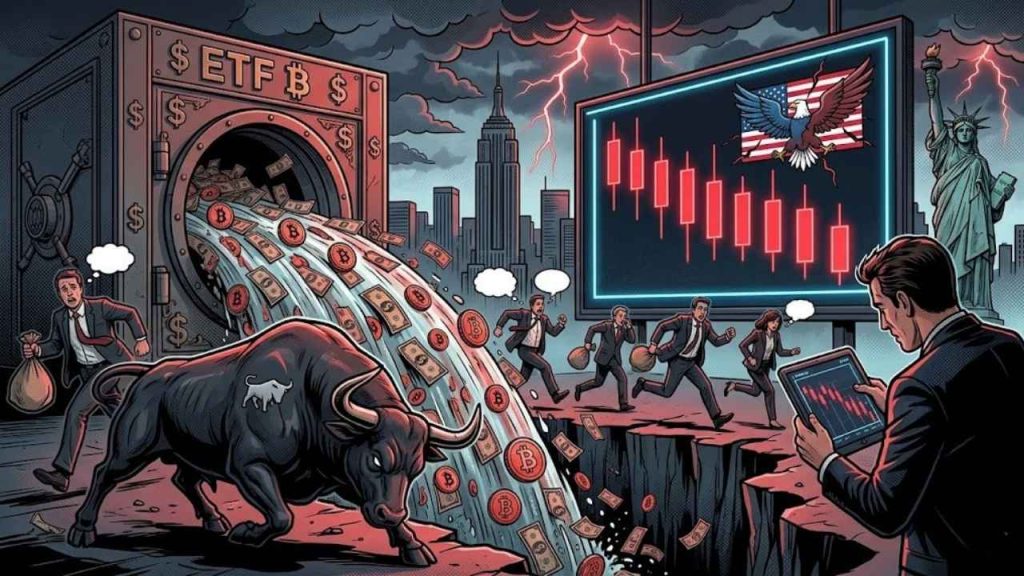
On Wednesday, May 27, 2026, spot Bitcoin exchange-traded funds listed in the United States concluded the trading session with $733.4 million in net withdrawals. The capital distribution activity was directly led by the trust managed by asset manager BlackRock, during a trading day where the price of the crypto asset rapidly declined below the $75,000 mark across major spot markets.
The BlackRock investment vehicle accounted for total outflows of $527.8 million during the market’s operating hours. This volume of institutional liquidations represents the second-largest daily capital outflow for the fund since its commercial authorization by US regulators. The figure was positioned just half a million dollars away from its all-time high of withdrawals, which was set at $528.3 million on Jan. 30 of this year.
The behavior of outflows during Wednesday’s session deepened a pattern of continuous selling across Wall Street trading platforms. US funds have accumulated a streak of eight consecutive trading days operating with negative capital flows. By consolidating the metrics from this ongoing operational series, the ecosystem composed of the US Bitcoin ETFs shows a liquidity subtraction amounting to a figure close to $2.6 billion.
The magnitude of these sustained liquidations throughout May altered the structure of the annual balance for these regulated investment instruments. Currently, the spot fund market shows an accumulated annual performance in negative territory, with $596 million in net outflows. This metric completely nullifies the substantial capital inflows that asset managers managed to report during the initial months of 2026.
The statistical record provided by the SoSoValue platform documents that the month of May concentrated cumulative withdrawals in the order of $2.1 billion in total. This volume of share distribution positions the current month as the thirty-day period with the highest liquidations in the financial calendar of the year so far.
Corporate liquidity factors and support levels
Despite the amount of capital withdrawn over the course of Wednesday, May 27, the day’s activity failed to surpass the mark of the trading session with the worst results in the industry’s history. The documented records regarding the volume of daily institutional flows indicate that the largest daily contraction occurred on Nov. 13, 2025. On that trading date, issuers collectively registered an outflow of $866.7 million, a loss that extended across almost all listed products.
People/analysts should pay more attention to the hard data that suggests where Bitcoin may move next, and less to models that supposedly tell you where it ought to be.
From our report published a week ago (link in the post below): pic.twitter.com/vAvKRsOWc9
— Julio Moreno (@jjcmoreno) May 28, 2026
The acceleration in the cancellation of ETF shares runs parallel to signals of modification in the structure of large-scale corporate demand. The research firm 10x Research structured an analysis of accumulation dynamics, pointing to a weakening of interest from major institutional buyers. In a recently published market technical update, specialists warned of financial pressures on the network’s largest corporate holder.
The technical analysis warns that Strategy, the publicly traded company that custodies the largest amount of digital currency units in its treasury, faces compliance deadlines for its corporate obligations related to dividend payments in the coming months. The obligation to guarantee funds for this purpose limits its options to continue operating as a participant with constant demand in the acquisition of reserves in the short and medium term.
The need to generate cash to cover debt commitments and dividend distributions aligns with the communications issued by the board of directors on previous dates. In mid-May 2026, Michael Saylor, central figure and co-founder of Strategy, openly addressed the market regarding the technical possibility of selling part of the safeguarded holdings, which would mark a departure from his well-known perpetual retention policy.
During his presentation on the company’s finances, the executive indicated that maintaining strict discipline under the concept of never selling the positions under any circumstances could ultimately have a negative impact on the very ecosystem of assets that the corporation dedicated itself to accumulating and custodying. This modification in the treasury management doctrine adds an additional factor to the increase in liquidity available for institutional sale.
Faced with the contraction of demand in exchange-traded instruments and the pullback in quotes below $75,000, risk managers establish new price references. Analysts belonging to the CryptoQuant platform concluded in their market evaluations that the $70,000 block has the capacity to function as the coin’s next major level of technical support, provided that the selling pressure maintains the constancy observed over the previous eight trading sessions.
This article is for informational purposes only and does not constitute financial advice.