Uzbekistan launches crypto mining zone with tax exemptions through the year 2035
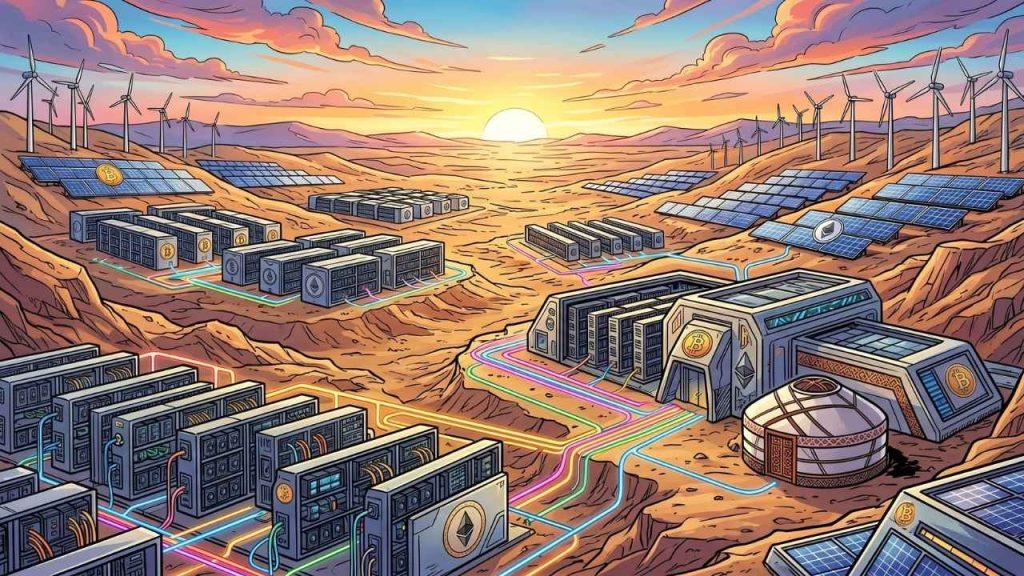
Uzbekistan officially launched this Monday the creation of “Besqala Mining Valley,” a special zone dedicated to crypto mining located in the Republic of Karakalpakstan. The presidential decree signed last Friday establishes a supervised framework that allows companies to sell digital assets on foreign platforms. According to the official document, registered entities will be able to operate with various energy sources, provided that the proceeds obtained flow through local banks within the national financial system.
This initiative arises under a strict control regime by the National Agency for Perspective Projects (NAPP). Legal entities that obtain resident status in this zone will be exempt from taxes until January 2035, according to the text of the presidential decree. In exchange for these fiscal benefits, companies must pay a monthly fee equivalent to 1% of their gross income generated from mining activities to the directorate.
The choice of Karakalpakstan is neither casual nor purely technical, but rather responds to a regional economic urgency. A United Nations Development Programme (UNDP) report published in 2025 describes this territory as an area with high poverty rates and limited development in the industrial sector. By incentivizing digital infrastructure, the government seeks to mitigate the impact of the local socio-economic crisis by attracting external capital that would otherwise ignore the country’s periphery.
Uzbekistan relaxes energy requirements to attract massive foreign investment
From a market perspective, this move represents a pragmatic shift in Tashkent’s energy policy regarding digital assets. This framework aligns with recent efforts to integrate tokenized securities and stablecoin payments starting in 2026. In 2023, the NAPP had mandated that mining activity be carried out exclusively through the use of solar energy, a restriction that limited the sector’s growth. The new legal framework now allows an energy mix including hydrogen and grid electricity, although companies opting for the public grid will face significantly higher tariffs than others.
This change suggests that the government has prioritized foreign exchange collection and activity formalization over strict sustainability goals. By requiring that the proceeds from foreign sales return to Uzbek accounts, the State seeks to strengthen its foreign currency reserves and improve the traceability of funds. Industry analysts point out that this measure is a response to the capital flight observed in previous years, when mining operations functioned in a regulatory gray area.
The Besqala Mining Valley project is integrated into a broader development plan that already includes other technological sectors. In November 2025, the government established a tax-free zone for data centers and AI in the same geographic region. For artificial intelligence projects exceeding 100 million dollars, Uzbekistan offers full duty exemptions until the year 2040, projecting to attract investments above 1 billion dollars by the end of the current decade.
Unlike traditional economic zones, the supervision of Besqala falls directly under the Council of Ministers of Karakalpakstan. This level of local governance seeks to streamline administrative procedures, although it maintains the obligation to report every direct contract for asset exchange. The strategy seems designed to compete directly with neighboring jurisdictions that have tightened their mining laws due to power supply issues, as has recently occurred in Kazakhstan.
In the next eight weeks, official bodies must submit the corresponding amendments to the tax code to harmonize these exemptions with general law. The success of this free zone will depend on the stability of the national power grid during winter demand peaks. Investors will closely monitor the implementation of grid tariffs to determine if operational profitability compensates for the strict control over currency liquidation required by the Central Bank of Uzbekistan.
This article is for informational purposes and does not constitute financial advice.