
What Are the Best DeFi Protocols for RWAs and What Does Each Contribute
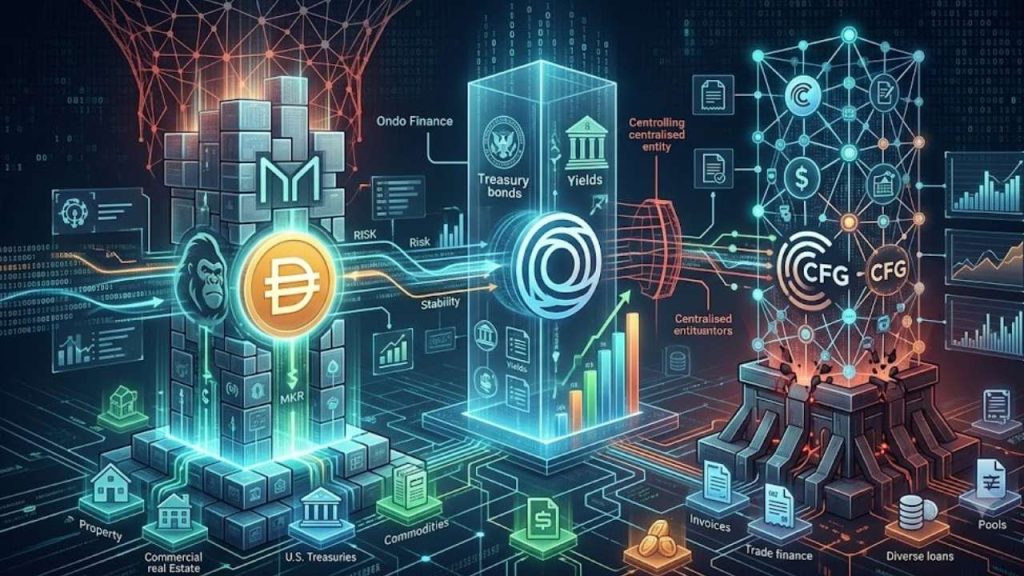
The integration of real-world assets into decentralized finance structurally transforms the markets. Capital seeks secure yield returns, abandoning speculative cycles to demand traditional fiat instruments operating natively on the blockchain network infrastructure without relying on inflationary protocol emissions.
The current narrative posits that tokenization will absorb global institutional liquidity. This is based on empirical evidence comprehensively presented in a Federal Reserve report, which analyzes in detail how immediate settlement and robust programmability actively optimize corporate capital efficiency across global markets.
Evaluating which protocols lead this sector requires examining their operational models. MakerDAO, Ondo Finance, and Centrifuge apply different architectures to transfer physical world risk to smart contracts, facing highly complex regulatory and technical challenges at every single infrastructure level.
MakerDAO established the current standard by radically diversifying its internal reserves. The transition to United States Treasury bonds is described in the MakerDAO technical documentation, demonstrating a design oriented toward protecting its economic ecosystem’s stability against sudden market downturns.
This strategy guarantees that MakerDAO generates consistent revenue regardless of algorithmic volatility. The protocol acts as a corporate bridge, capturing yield margins from the traditional system to back the DAI stablecoin against adverse market scenarios efficiently and securely.
However, the overall profitability of the broader ecosystem suffers significant periodic corrections. Recent market data reflects a severe drop in DeFi protocol fees, underscoring the absolute urgency of integrating institutional revenue streams that remain completely detached from native cryptographic speculation and volatility.
Ondo Finance addresses this institutional demand with a diametrically opposed methodology. Instead of issuing a decentralized stablecoin, it offers a token that represents the direct yield of sovereign assets and very short-term exchange-traded funds operating within the United States.
The viability of this model depends on exhaustive identity verification processes. These legal procedures are detailed in the Ondo Finance operational structure, ensuring that value transfers comply strictly with international anti-money laundering regulations to attract rigorous corporate investment funds.
This approach generates an intense debate regarding the true decentralization of the system. Strict compliance blocks retail users, distancing the protocol from open access principles, but providing the legal certainty that corporate fund managers require imperatively before allocating capital.
Private Credit Architectures and Institutional Risk
Centrifuge expands the spectrum by integrating direct private credit markets. This system allows corporations to finance commercial invoices using decentralized liquidity, structuring debt into specific risk tranches to satisfy different institutional investment profiles while operating directly on public ledgers.
The financial engineering behind this on-chain securitization is clearly explained in the Centrifuge official whitepaper. The design isolates risk through special purpose vehicles, protecting decentralized liquidity providers against potential corporate defaults during severe economic downturns affecting traditional commercial borrowers.
Historically, technological adoption in finance requires prolonged maturation processes to succeed. During the year 2020, growth depended on inflationary token emissions. Currently, infrastructure survival demands profitability extracted directly from traditional corporate and sovereign debt markets without relying on pure speculation.
This level of technical development requires constant external financing to operate securely. As the debate over DeFi security at a critical juncture shows, venture capital influence pushes developers toward enterprise architectures capable of undergoing conventional legal audits and maintaining strict corporate compliance.
The opposing view profoundly questions the utility of this technological convergence. Critical analysts point out that reliance on fiat financial systems reintroduces the risk of state censorship, destroying the confiscation resistance that blockchains initially promised to deliver globally.
This argument holds factual validity in the face of judicial interventions. If the banking custodian receives a freezing order, the linked tokens lose their real backing, instantaneously nullifying the theoretical advantages of composability in decentralized finance operations and smart contracts.
The institutional dominance hypothesis also faces clear macroeconomic vulnerabilities ahead. A prolonged environment of interest rates near zero would eliminate current financial incentives, destroying the organic demand for tokenized Treasury bonds on public network infrastructures abruptly and shifting capital elsewhere.
Operationally, liquidity management for these assets requires efficient auxiliary routing infrastructures. Trading institutional volumes necessitates advanced routers and aggregators to execute massive block orders without causing severe price distortions in the decentralized secondary market environments where these tokens trade daily.
Deep liquidity fragmentation remains problematic across modern fragmented ecosystems. If corporate treasuries cannot liquidate million-dollar positions instantaneously due to a lack of market depth, they will entirely avoid exposing their capital to distributed ledger infrastructures despite the promised operational efficiencies.
Each protocol addresses a specific institutional need within the financial capital market. MakerDAO offers indirect overcollateralized stability, Ondo Finance provides regulated sovereign yield, and Centrifuge builds the rails to finance corporate private debt using global settlement architectures optimized for institutional scale.
The inherent cost of these three models remains centralized trust delegation. Unlike a traditional automated market maker, tokenization requires handing over control to physical custodians, legal audit firms, and specific governmental jurisdictions around the world to ensure proper regulatory alignment.
This architecture permanently alters the systemic risk map of the entire sector. The structural single failure point shifts from computer code vulnerabilities toward the operational solvency of the commercial bank physically storing the underlying fiat asset backing the digital issuance.
Operational Implications and Long-Term Viability
The integration of tangible assets imposes hybrid technical security standards. Developers face the challenge of reconciling the absolute transparency of distributed ledgers with the financial privacy that corporations demand to operate massive credit accounts without exposing their internal business strategies.
Definitive institutional adoption depends on predictable regulatory frameworks on a global scale. Corporations will avoid deploying massive capital until legislators clearly define the legal nature of tokens representing debt instruments in traditional financial markets without lingering jurisdictional ambiguities.
The market monitors the capacity of these platforms to withstand legal pressures. Uncompromised transparency in physical custody will determine which protocols manage to capture the operational volume necessary to survive inevitable central bank rate adjustments in Western economic zones.
If the yield of tokenized assets remains one percentage point above core inflation for twelve months, the migration of institutional liquidity toward decentralized credit infrastructures will accelerate significantly, consolidating the hybrid financial model globally. This article is for informational purposes only and does not constitute financial advice.