Drift Protocol suffers 280 million dollar exploit through Solana specific feature abuse
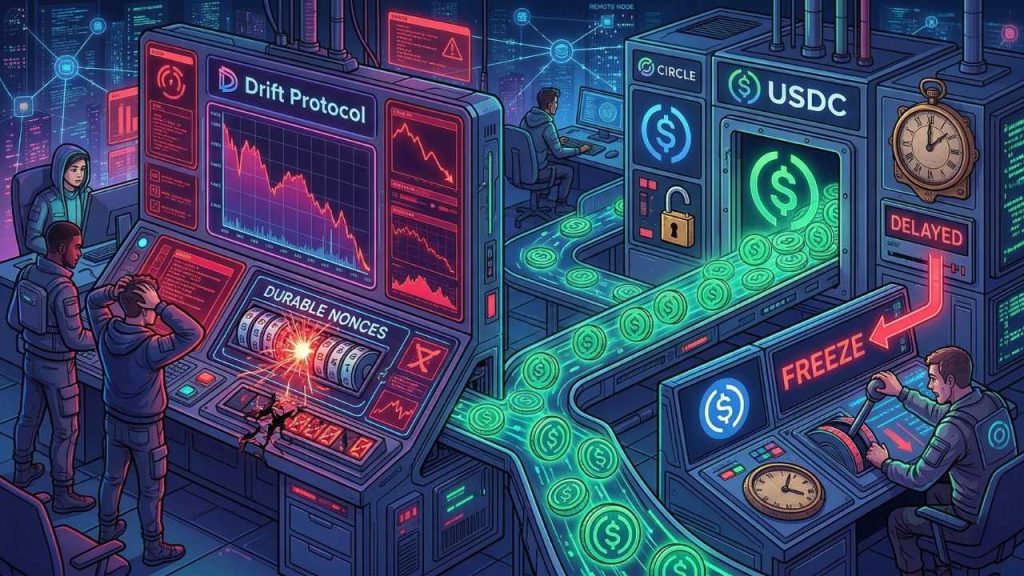
The decentralized exchange Drift Protocol confirmed this Thursday a massive exploit of approximately 280 million dollars, according to the preliminary report published on its official X account. The attackers leveraged a Solana network mechanism to execute pre-signed transactions, successfully draining liquidity in an event that has jeopardized the security of the DeFi ecosystem.
The detected vulnerability does not reside in a conventional programming error, but in the malicious use of the network’s durable nonces feature. This functionality allows transactions to bypass the standard expiration window, facilitating an execution of administrative commands without proper prior authorization. According to the nonces mechanism, the attacker managed to manipulate pre-approved signatures to empty the platform’s vaults.
Solana’s technical architecture under the institutional microscope
Unlike the re-entry attacks common in Ethereum, the leveraging of durable nonces allows for pre-signing critical operations offline. This feature, originally designed to facilitate institutional custody and multisig, became a tool to evade the protocol’s time-based controls. Given that the attackers possessed administrative credentials, the execution speed prevented any kind of immediate or effective defensive response.
The magnitude of the theft at Drift Protocol has revived the debate over the responsibility of centralized stablecoin issuers. Various analysts point out that Circle had a six-hour window to block the stolen funds before their final transfer. The fact that the attacker managed to convert assets into USDC highlights the systemic vulnerability when protocols depend on external assets.
This incident bears parallels to the attacks suffered by the Solana blockchain during the 2022 bear cycle, where design complexity was the primary entry vector. While in previous years exploits focused on smart contract logic, today we see a transition toward structural attacks that manipulate native functions. This criminal evolution suggests that developers must audit not only their code but also interactions with the base layer.
Can decentralized protocols mitigate the risk of delayed execution?
The on-chain data reveals that the perpetrator has already exchanged a large part of the loot for Ether, using cross-chain bridges to hinder tracking. This rapid movement capability evidences a technical sophistication that exceeds current emergency protocols. Despite constant surveillance, liquidity fragmentation allows funds to disperse before authorities can intervene.
Circle’s inaction following the attack on Drift Protocol has been harshly criticized by prominent figures such as ZachXBT, who questions the lack of corporate ethics. Although the company claims it requires requests from law enforcement, the delay in administrative response allowed the capital flight. This defensive stance could force a review of regulatory frameworks, such as the one proposed by the controversial GENIUS Act.
Looking ahead, the market must watch for the implementation of security patches that limit the scope of durable nonces in high-liquidity environments. Institutional investors will closely observe how Drift Protocol manages fund recovery and whether there is a robust compensation plan for liquidity providers. The resilience of the Solana network will depend on its ability to balance technical flexibility with the security of its core applications.