Is it a good idea to invest in tokenized oil amidst the war?
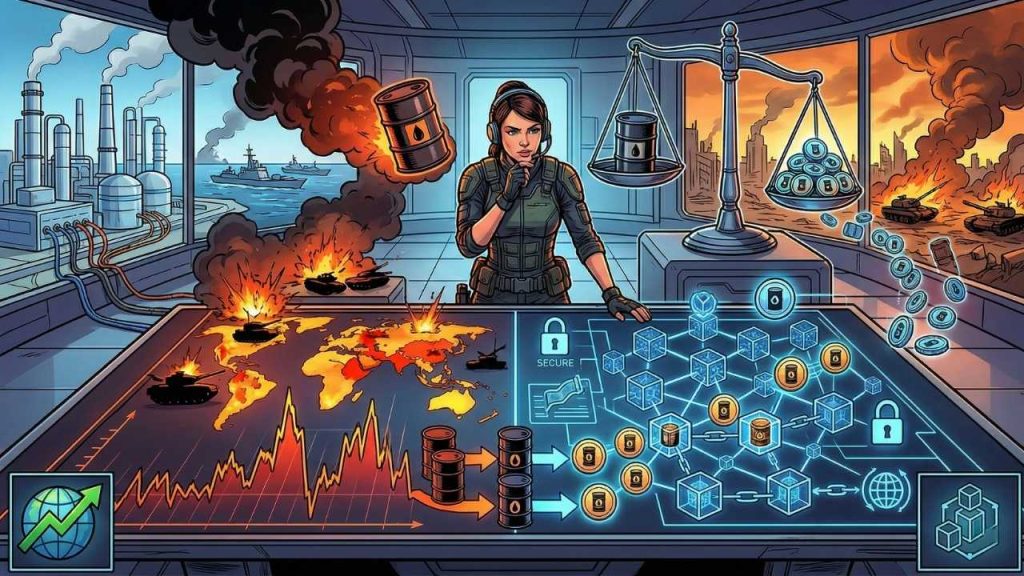
The current international war scenario has reactivated interest in traditional commodities as a financial refuge. However, true innovation does not lie solely in the physical barrel. Investing in tokenized oil allows operators to capture market value without the burdens of conventional and opaque financial infrastructure.
Many analysts suggest that volatility is an insurmountable risk in times of armed conflict. Nevertheless, the digitalization of real assets offers unprecedented transparency. Under this prism, financial technology transforms a rustic asset into a precision tool for portfolios seeking immediate liquidity and cryptographic security.
Blockchain efficiency vs. logistical friction
The competitive advantage of this model lies in the elimination of unnecessary intermediaries. By utilizing the blockchain architecture, settlement times are reduced from days to seconds. This fact allows investing in tokenized oil to be a viable option even for smaller capital through fractional ownership.
Far from being a coincidence, the rise of rwa tokenization responds to a need for efficiency. While traditional futures markets close on weekends, crypto assets operate non-stop. This constant availability ensures that prices reflect geopolitical situations immediately, without artificial delays caused by banking schedules.
Physical backing and smart contract security
Each token represents a specific unit of crude, usually one barrel, kept in certified facilities. The validity of this proposal depends on the robustness of the smart contracts managing the issuance. Consequently, investing in tokenized oil requires verifying that the assets have reserve audits regularly published on official portals.
Confidence in these systems is based on the immutability of digital records. While crude prices fluctuate due to OPEC production decisions, the digital asset holder maintains the certainty of ownership. This direct control over the investment mitigates traditional counterparty risks in environments of high political uncertainty.
Historical comparison: Oil crises and digitalization
If we observe events like the 1973 crisis, access to the energy market was restricted to large conglomerates. Back then, information flowed slowly and prices suffered severe distortions. Today, investing in tokenized oil democratizes access to a market that has historically been exclusive to financial elites.
Unlike the 1979 oil shock, where physical hoarding was the only defense, digital liquidity prevails today. EIA crude inventory statistics demonstrate that supply remains sensitive to conflicts. However, the ability to move capital toward digital assets allows for a much more agile response to any supply interruptions.
Regulatory risks and technological vulnerabilities
It is necessary to recognize that this ecosystem is not free of critical challenges. Critics of decentralization argue that the lack of a uniform legal framework could compromise asset recovery. Under this scenario, investing in tokenized oil carries a technological risk that investors must weigh against potential capital gains.
In other words, a failure in the protocol code could result in definitive losses. Although OECD reports on financial digitalization highlight the benefits, they also warn about cybersecurity. Therefore, diversification remains the best defense against failures in the infrastructure of decentralized networks.
Perspectives on institutional flows and global adoption
The entry of large investment funds into the digital asset space changes the rules of the game. Institutions like BlackRock in its tokenization report indicate that the future of finance is programmability. This suggests that investing in tokenized oil will stop being a niche practice to become a market standard.
At the same time, the integration of stablecoins facilitates entering and exiting commodity positions. If capital flows toward these assets maintain their upward trend, we will see a reduction in price spreads. This environment favors the stability of secondary markets and improves the final profitability for the proactive and well-informed investor.
If daily trading volumes on regulated platforms exceed historical liquidity thresholds over the next six months, the viability of this asset will be fully confirmed. The correlation between war conflicts and increased energy demand suggests that investing in tokenized oil is a logical strategy. Success will depend on the integrity of the protocols used and the evolution of the international legal framework.