The future of privacy cryptocurrencies depends on their technical and institutional integration
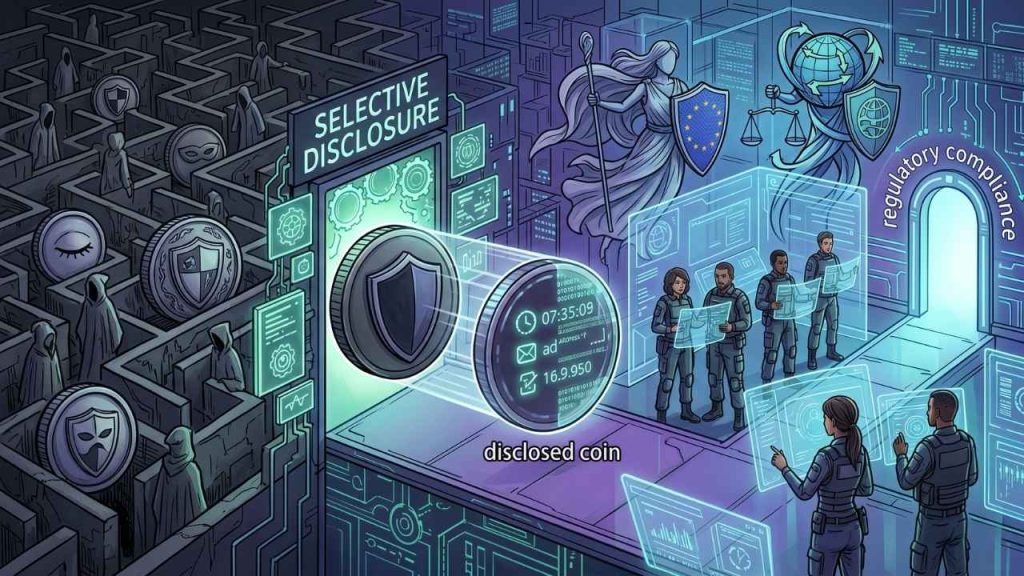
The relevance of privacy cryptocurrencies is undergoing a structural transformation where absolute anonymity is giving way to the programmability of sensitive information. The ecosystem has understood that technical privacy is no longer an ideology but compliance necessary for the survival of decentralized protocols. This thesis holds that the privacy niche will not disappear; instead, it will integrate into hybrid infrastructure layers capable of satisfying both individual users and institutional transparency requirements.
The relevance of this debate in April 2026 is based on the full implementation of the MiCA Regulation in Europe, whose regulation on markets in crypto-assets imposes severe restrictions on trading platforms operating with assets that have built-in anonymization features. While the dominant narrative suggests these technologies are destined for ostracism due to delisting pressures on major platforms, technical reality indicates a shift toward zero-knowledge proofs as an institutional security standard.
The transition from anonymity to selective disclosure
The central data point supporting this evolution comes from the updated guidance for virtual assets issued by the Financial Action Task Force (FATF). According to Recommendation 15, service providers must mitigate risks from assets that prevent traceability, which has forced projects like Zcash to propose shielded asset structures with auditing mechanisms for authorized third parties. This ability to reveal specific data without exposing all financial activity redefines the utility of these tools in the professional market.
In this scenario, the differential analysis block lies in the distinction between anonymity (inability to identify an actor) and privacy (control over what information is shared). Standard media coverage often confuses both concepts, but the technical architecture of new protocols allows administrative granularity that was previously non-existent. Projects that formerly operated as “black boxes” are now developing bridges to regulated stablecoins, seeking to solve the lack of liquidity they suffered after the regulatory purges of 2024 and 2025.
This integration is clearly seen in the emergence of Layer 2 solutions and programmable privacy protocols that attract institutional capital. The adoption of assets like USDCx appears on Aleo evidences that the industry does not seek dark anonymity, but a settlement infrastructure that protects corporate trade secrets. Without this layer of protection, companies cannot operate on a public blockchain where their treasury strategies and supplier payments remain exposed to global competition.
Historical evolution and the centralized liquidity dilemma
If we compare the current cycle with the 2013-2014 period, when Monero and the first CryptoNote developments emerged, the structural difference is the interdependence with the traditional financial system. Back then, privacy cryptocurrencies operated in a legal vacuum that allowed for organic growth based on censorship resistance. Today, the Electric Coin Co strategic roadmap reflects the need to adapt the Zcash protocol toward interoperability and compliance functions, marking a definitive break with the purism of the past.
The necessary counterpoint to this view is defended by sectors that believe any concession in technical privacy invalidates the original purpose of these assets. They argue that introducing viewing mechanisms creates systemic vulnerabilities that could be exploited by malicious actors or authoritarian governments. Under this logic, a privacy coin that allows audits ceases to be private to become a surveillance tool with extra steps, losing its competitive advantage over traditional banking systems.
However, this stance ignores that the lack of compliance bridges has led to a reduction in liquidity of over 60% for assets that have not adapted their disclosure standards. Regulators are right to point out that lack of transparency facilitates money laundering, but they fail to recognize that cryptos next battle is privacy as a fundamental user right. The thesis holds because technology has advanced enough to allow mathematical proofs of legality without revealing account balances.
Is coexistence between regulation and cryptography possible?
The viability of this niche will depend on its ability to demonstrate that Privacy Enhancing Technologies (PETs) are compatible with fraud prevention. It is not about eliminating privacy, but about encoding compliance rules directly into the protocol immutably. The market no longer rewards total opacity, but the certainty that financial data will not be used for social engineering attacks or corporate espionage on open networks.
This paradigm shift is what will allow the sector to escape technical marginality. If institutions can perform high-value transfers with the certainty that their on-chain activity will not be analyzed by arbitrage bots, the demand for programmable privacy will far exceed the current supply. The maturation of the sector requires accepting that privacy is an infrastructure service and not simply a mechanism to evade basic financial controls.
If the volume of shielded transactions on networks implementing selective disclosure exceeds 15% of the total stablecoin volume in the next twelve months, privacy will consolidate as a standard feature of the ecosystem. Conversely, if regulated entities continue to block the flow of capital toward these protocols despite compliance improvements, the privacy sector could be reduced to a niche infrastructure with no macroeconomic impact.
This article is for informational purposes and does not constitute financial advice.