RWA Vaults: The Next Crucial Financial Stage of Active Asset Tokenization
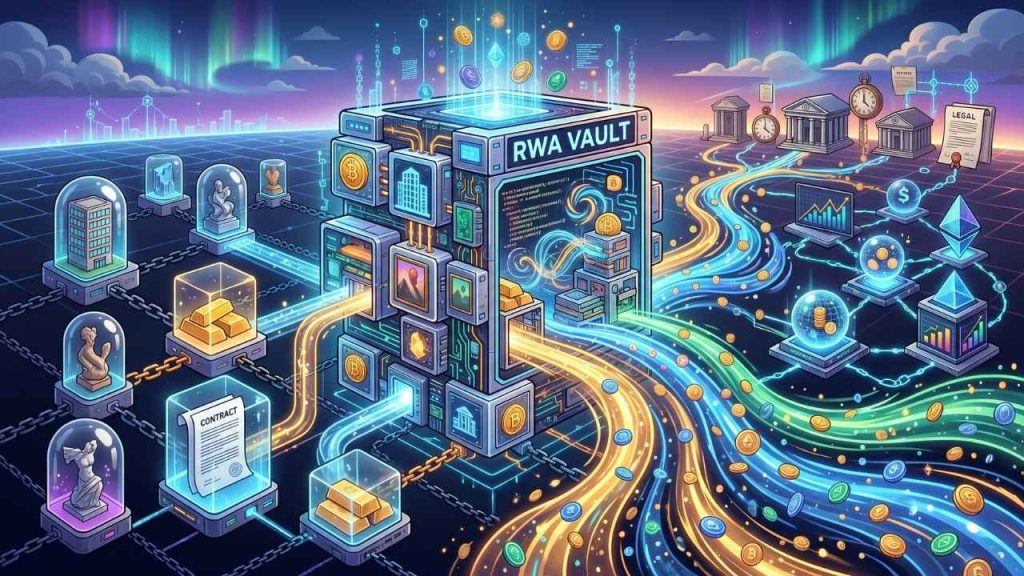
The tokenization of traditional assets is undergoing a structural transition toward automated yield products. The use of smart contracts to create programmable compound yield vaults is replacing passive digital representations. This evolution is clearly projected in the Boston Consulting Group on-chain tokenization study.
The market demands capital efficiency. The dominant narrative is no longer just registering a bond on a blockchain, but utilizing that asset as liquid collateral to extract continuous value and liquidity within decentralized protocols.
Understanding this technological evolution requires defining the underlying infrastructure clearly. Analysts researching basic concepts about what RWAs are in crypto note that initial issuances generated static tokens. Now, a vault operates as an automated fund managing capital flows without intermediaries.
The primary differentiator lies in the strict management of cash flow. A research paper regarding financial stability from the United States Federal Reserve details how representations of traditional assets demand precise settlement and value transfer mechanisms that completely eliminate exhausting manual reconciliation.
Historically, the banking sector structured liquidity through closed trust funds with restrictive operating hours. The vault model reproduces this asset pooling dynamic, but strictly enforces continuous settlement and deterministic execution around the clock.
This infrastructure enables the seamless integration of highly complex assets into the ecosystem. This generates institutional use cases that expand market boundaries, such as the technical projection of stock tokenization, where corporate dividends accumulate directly in user vaults without operational delays.
Smart contract architecture allows the direct redistribution of fiat interest on-chain. The deployment of BlackRock’s institutional fund serves as a practical example, documented in the official press release of the BUIDL fund, where shares maintain a stable value while distributing tokenized daily dividends.
Direct Integration With DeFi Strategies
The next technical component involves utilizing these advanced vaults as financial lego bricks. A token representing a share in a Treasury vault can be deployed as robust collateral to secure instant loans.
Yield compounding thoroughly transforms decentralized treasury management globally. Lending protocols accept vault shares as premium collateral because their underlying asset generates constant interest. This dramatically increases borrowed capital efficiency, offsetting financing costs with the passive yield derived from government bonds.
The development of these asset vaults faces severe institutional skepticism due to the structural limitations of the physical market. There is an inherent incompatibility between a secondary market that never closes and deferred traditional settlement.
The contrarian view accurately argues that tokenizing an illiquid asset within a smart vault does not resolve its fundamental lack of liquidity. During acute market stress episodes, massive capital withdrawal would face the exact same settlement frictions hindering corporate finance.
This technical criticism remains completely valid. If a DeFi platform demands immediate liquidations to maintain loan solvency, and the primary vault cannot sell the underlying bonds over the weekend, the entire system might face insolvency.
The viability of this transition strictly requires bidirectional adaptation. The RWA vault thesis would be invalidated if international regulations impose strict transfer controls prohibiting token composability, or if off-chain custodians categorically deny previously scheduled automated liquidations within the core smart contracts.
To actively mitigate severe liquidity risks, developers build robust reserve buffers directly into the smart contract architecture. This fraction of stablecoin capital smoothly absorbs minor withdrawals, guaranteeing continuous operability under normal conditions.
The development of programmatic vaults also allows segmenting specific risk profiles through distinct tranches. Institutional investors can provide capital to secured fixed-rate vaults, while crypto-native users willingly assume the underlying yield volatility to capture profit margins above the historical average.
The global mortgage markets of the nineteen eighties utilized a highly similar tranche model to distribute default risk. Current tokenization securely programs these mathematical mechanisms with completely transparent and virtually infallible automatic digital liquidations.
The macroeconomic implications of this architecture strongly suggest a fundamental reconfiguration of capital cost. RWA vaults establish a verifiable on-chain risk-free benchmark rate, forcing native decentralized protocols to offer yields surpassing the fiat underlying to attract institutional liquidity providers successfully.
Standardization of Core Financial Infrastructure
Widespread corporate adoption strictly requires homogeneity across smart contracts. Implementing universal programming standards for tokenized vaults facilitates rigorous code auditing and rapid technical integration by highly conservative traditional wealth managers.
This essential standardization actively fosters the creation of derivative markets based on RWA yields. By separating principal capital from future interest through decentralized contracts, participants can securely speculate or hedge against central bank interest rate fluctuations utilizing purely digital infrastructures.
Corporate lending platforms benefit significantly by accessing an immutable digital transaction ledger. Blockchain transparency accurately allows auditors to verify physical world reserves in real time using cryptographic proofs of underlying assets without relying on substantially delayed monthly operational reports.
If financial regulators approve distributed ledger-based interbank settlement frameworks, the standardization of traditional asset vaults will inevitably displace legacy trusts in nominal volume. This technical absorption of wholesale liquidity will force global banks to run treasuries through decentralized interfaces before 2030.
This article is for informational purposes only and does not constitute financial advice.