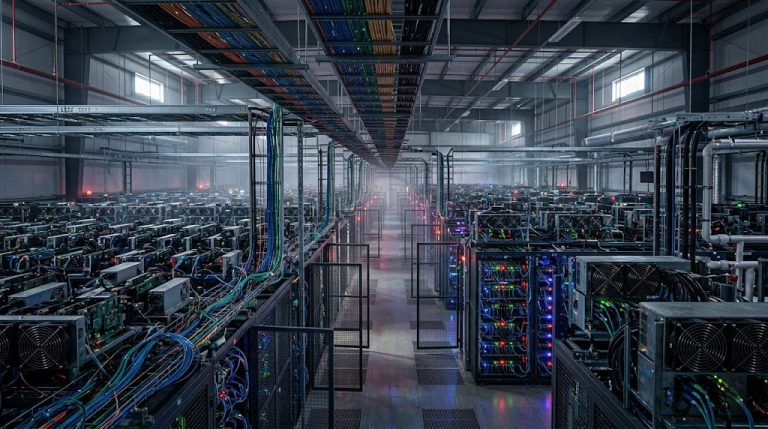
What Happens When Bitcoin Miners Sidelined Capacity Returns to Crush Margins?
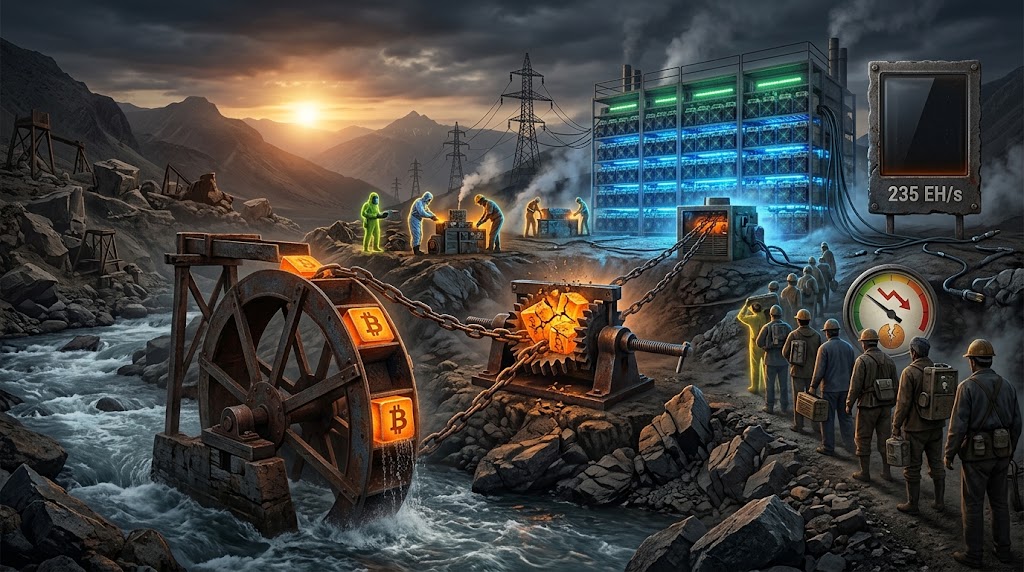
The recent recovery in mining revenue masks a severe structural bottleneck across the network. Approximately two hundred thirty-five exahashes per second of specialized mining capacity sits completely idle, representing nearly twenty percent of the global application-specific integrated circuit hardware currently available to mine Bitcoin.
Prevailing market sentiment assumes that higher Bitcoin prices automatically secure durable operator margins. However, this massive overhang of latent computational power ensures that any sustained rebound in miner revenues faces an immediate operational ceiling.
During August, dollar-denominated hashprice gained twenty-four percent to reach thirty-nine dollars per petahash per day. This revenue relief tracked Bitcoin’s price appreciation from sixty-two thousand to seventy-eight thousand dollars, granting temporary breathing room to operators squeezed by post-halving margin compression.
Despite that relief, fleets consuming twenty-five to thirty-eight joules per terahash generated approximately forty-five dollars per megawatt-hour on average, falling below the industry benchmark power cost of forty-eight dollars.
A significant portion of this inactive hashrate stems from tactical curtailment within Texas. Facilities reduce consumption throughout the summer to evade high demand tariffs tied to the four coincident peak transmission charges overseen by ERCOT during the hottest operating intervals of the year.
Once that regulatory summer window closes in September, operators face strong economic incentives to switch machines back on. When that power re-enters the market, returning hashrate immediately dilutes block subsidy rewards for everyone else.
Difficulty Mechanics and the Self-Limiting Rebound
Satoshi Nakamoto’s consensus design operates indifferently to the financial distress or power curtailment of individual miners. The protocol enforces block production stability via the mathematical proof of work difficulty retargeting algorithm, recalibrating computational requirements every two thousand sixteen blocks to preserve the ten-minute target.
In August, network blocks arrived at an average pace of nine minutes and thirty-four seconds. That accelerated tempo triggered a positive difficulty adjustment of one point thirty-one percent, early proof of returning competition.
Historical performance underscores this recurring autumn phenomenon across prior mining cycles. Between 2022 and 2025, network difficulty climbed by approximately ten percent across October as machines sidelined during summer heat waves reconnected simultaneously to capture post-summer wholesale electricity rate reductions.
A similar dynamic played out following the 2021 mining ban in China. While remaining operators enjoyed fleeting profit windfalls, the rapid redeployment of displaced machines quickly restored competitive equilibrium and compressed operating margins.
Competition for high-voltage energy infrastructure introduces another structural dimension to fleet economics. Multiple publicly traded operators have initiated a pivot toward high performance compute and artificial intelligence workloads, dedicating substantial power capacity to long-term enterprise hosting agreements instead of pure hashing.
Facilities that permanently reconfigure their electrical substations for graphic processing units effectively withdraw capacity from Bitcoin mining. This structural shift permanently removes part of the sidelined hashrate overhang from competing for block rewards.
Depressed transaction volume exacerbates the vulnerability of higher-cost operations across the sector. Without substantial fee spikes, an excessive reliance on block transaction fees exposes miners to severe cashflow pinches whenever difficulty rises without a matching expansion in spot cryptocurrency market prices.
During August, average fee collections slipped below zero point zero three bitcoins per block. This subdued on-chain activity leaves miners with minimal revenue buffers when network difficulty adjustments begin absorbing sidelined capacity.
Structural Counterpoints and Margin Risk Asymmetry
An opposing viewpoint argues that the scale of reactivation risk is overstated by top-down capacity models. Proponents of this view assert that a substantial fraction of the dark hashrate comprises obsolete ASICs with efficiencies worse than thirty-five joules per terahash.
This critique holds merit because energizing outdated machines remains economically irrational unless Bitcoin surpasses ninety thousand dollars or operators secure power contracts well below three cents per kilowatt-hour.
Furthermore, the thesis of an aggressive margin squeeze would break down if spot Bitcoin prices rally significantly faster than operators can energize dormant machines. A rapid price surge would expand gross dollar revenues enough to outpace difficulty dilution.
Macroeconomic policy and environmental oversight also constrain operational flexibility across the industry. Government agencies tracking comprehensive cryptocurrency mining electricity consumption data highlight growing grid reliability scrutiny, which could severely limit how rapidly dormant large-scale facilities obtain transmission authorization to resume continuous baseload operations.
Highly leveraged mining enterprises now face a perilous operational calculation. Reactivating depreciated fleets into rising difficulty without derivative price protection risks converting temporary operating cash flow into severe accounting losses.
The operational divide between well-capitalized institutional miners and debt-burdened private operators continues to widen. While tier-one firms deploy next-generation hydro-cooled units, marginal competitors remain trapped beneath an overhang of dormant machines that suppresses sector-wide margins on every price rebound.
If Bitcoin trades sideways near eighty thousand dollars while more than half of the estimated two hundred thirty-five idle exahashes reactivates before November, hashprice will likely retreat toward thirty-two dollars per petahash, triggering renewed operational stress across higher-cost facilities.
Smoothed hashrate trends and the upcoming difficulty adjustments will reveal whether this sidelined capacity returns to cap mining margins or whether capital constraints force permanent retirement.
This article is for informational purposes and does not constitute financial advice.