Why blockchain could return medical data ownership to patients and ensure sovereignty
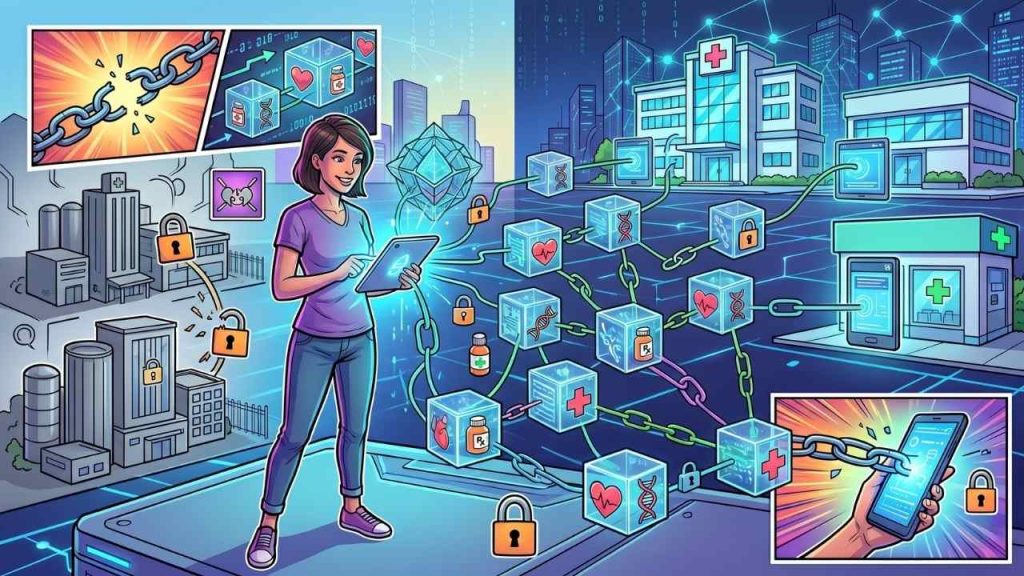
The fragmentation of clinical records generates critical inefficiencies in global healthcare systems. Currently, information resides in disconnected institutional silos, limiting individual access and increasing operational costs. Implementing decentralized architectures allows users to exercise real sovereignty over medical data through advanced cryptographic security proofs.
This transition is urgent due to the exponential increase in cyberattacks against traditional healthcare infrastructures. Distributed ledger technology provides a robust framework where decentralized clinical record management is viable, eliminating expensive bureaucratic intermediaries that slow down information portability across institutions.
Institutions act today as custodians but regularly operate as owners of sensitive patient information. According to the official report published on the U.S. Department of Health and Human Services platform, data breaches expose millions of records annually, highlighting vulnerabilities in contemporary centralized networks.
Implementing distributed ledgers facilitates the secure exchange of medical histories without compromising user privacy. This efficiency model is comparable to how blockchain as a key tool for SMEs transparently optimizes complex administrative processes across various modern commercial sectors.
Modern patients demand immediate portability of clinical results to obtain second medical opinions. However, the lack of common technical standards among health corporations blocks this possibility. The regulatory framework proposed in the European Health Data Space seeks to grant citizens direct digital control over their health information.
Current centralization facilitates unauthorized surveillance and secondary commercialization of sensitive clinical profiles. Many users are unaware that their data is sold to third parties for pharmaceutical purposes. Blockchain introduces transparent cryptographic mechanisms to reverse this systemic power imbalance.
Moving from physical to digital records improved operational legibility but consolidated private institutional monopolies. Just as the development of intellectual property and blockchain aims to return autonomy to original authors, the healthcare sector requires decentralized tools to restore biological ownership to individual patients.
The use of Decentralized Identifiers allows validating medical credentials without exposing sensitive personal data openly. This decentralized architecture promotes a notable reduction of infrastructure vulnerabilities, decreasing the attack surface available to external malicious actors seeking to breach centralized clinical storage systems.
Technical challenges of healthcare decentralization
Critical positions exist that seriously question the practical viability of implementing blockchain networks in public medical management. Various technological analysts argue that direct storage of extensive clinical records is costly and inefficient. This perspective is valid if we consider direct recording of heavy high-resolution radiology images.
However, hybrid architectures effectively resolve this structural limitation. The reference technical document published by the National Institute of Standards and Technology demonstrates how decentralized ledgers record only hashes and access metadata, keeping heavy medical files on encrypted external servers.
Another complex regulatory debate involves the right to be forgotten enshrined in global privacy laws. The inherent immutability of blockchain contradicts the legal requirement to delete personal data upon user demand. This contradiction would completely invalidate the central thesis if direct storage were applied.
Nevertheless, using smart contracts with revocable cryptographic keys solves this legal dilemma. If the patient decides to revoke access to their information, destroying the associated key renders external data completely unreadable, fulfilling the legal principle of data erasure.
Transitioning toward this ecosystem requires multiple hospital institutions to adopt unified cryptographic standards on a global scale. Currently, medical centers lack financial incentives to share data with direct competitors. Decentralization introduces a governance scheme where information legitimately belongs to the evaluated individual.
Eliminating institutional intermediaries reduces operational costs linked to the manual reconciliation of fragmented clinical files. Medical auditing processes and private insurance claims are streamlined through automated smart contracts, optimizing the allocation of available financial resources.
Decentralization also promotes clinical research development based on direct informed consent. Researchers can request access to specific data cohorts directly from patients, offering transparent compensation without corporate intermediation. This mechanism accelerates the discovery of high-precision personalized medical treatments.
Despite operational advantages, digital sovereignty demands a high degree of technical responsibility from the citizen. Losing private cryptographic keys would permanently prevent access to personal medical histories, representing a critical risk during unforeseen emergency medical situations.
Implications for the future of medical sovereignty
To mitigate these custody risks, social recovery protocols based on selected trust networks are being developed. These systems allow restoring decentralized patient identities without relying on a central corporate entity. The evolution of healthcare software must prioritize final user experience design.
The adoption of decentralized records will advance as government agencies establish standardized technical compliance frameworks. Traditional centralized database architectures are proving obsolete against sophisticated cybersecurity threats that attack global hospital servers on a daily basis.
The patient’s full patient control over information will redefine the doctor-patient relationship in the short term. Healthcare professionals will access a complete, accurate, and real-time clinical picture, regardless of the hospital center where previous diagnostic studies were performed.
The technological integration of layer-two solutions will allow processing millions of medical data transactions with negligible network fees. This technical advance will eliminate economic barriers historically associated with large-scale blockchain deployment in public health institutions.
If Western health ministries implement infrastructures based on decentralized identifiers before the end of the next three years, incidents of duplicated laboratory tests and errors due to incomplete clinical records could be noticeably reduced in primary care centers.
This article is for informational purposes only and does not constitute financial or professional medical advice regarding institutional data record management.