Will the Clarity Act Be Approved in 2026? We Analyze the Current Market Scenario
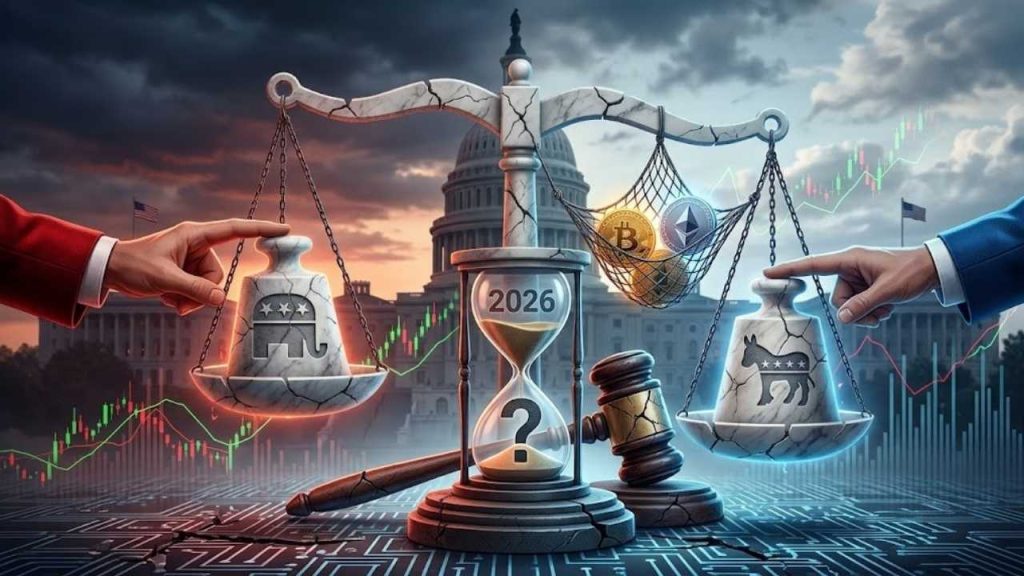
The probability of passing the bill known as the Clarity Act in the Senate during 2026 has decreased drastically. According to a Galaxy firm research report, what seemed like a safe procedure to establish regulatory guidelines now faces severe legislative calendar exhaustion.
This stagnation alters the dominant narrative that projected accelerated institutional adoption for the third quarter. It matters now because companies operate under an uncertainty that hinders capital allocation, while lawmakers prioritize electoral debates over the definition of modern financial markets.
The firm’s analysts recently reduced the probability of successful ratification of this legislation to fifty percent, citing specific calendar constraints and a lack of progress.
The firm’s head of research specified that the main obstacle is not the substance of the legislation, but legislative logistics. A project of this magnitude requires consensus among committees, floor debates, and text reconciliation, processes that take several weeks.
Adding to this scenario are external executive pressures that severely complicate the agenda. President Donald Trump warned he will not sign priority housing legislation unless the SAVE Act passes, further compressing the available space to debate the Clarity Act.
These political tensions are deeply intertwined with how crypto regulations split Congress, showing how electoral tactics and the executive’s commercial interests end up delaying the modernization of the American financial system at a critical moment of global expansion.
Historically, during midterm election years, the United States Congress rarely approves complex financial reforms during the fall. Lawmakers return to their districts to run campaigns, leaving zero operational margin for projects without expedited approval prior to the summer recess period.
The market reflects this loss of confidence through on-chain indicators and predictive platforms. Currently, data from the Polymarket prediction market shows that contracts regarding the ratification of the Clarity Act in 2026 have dropped to a forty-eight percent probability.
National Security and Opposing Arguments
The view opposing accelerated approval maintains that the current draft contains severe national security risk omissions. Critics argue that establishing a permissive environment without strict controls would facilitate sanctions evasion and the financing of illicit organizations on an international scale.
An official Senate Banking Committee announcement detailed that the Clarity Act fails by not requiring basic customer identification measures from decentralized platforms.
This counterpoint is valid because the American financial structure bases its hegemony on strict capital flow control. If regulators allow exceptions for decentralized services, money laundering risks would neutralize any benefit derived from technological innovation or institutional investment attraction.
The thesis of an imminent legislative approval would be completely invalidated if the Democratic bloc in the Senate demands incorporating extensive money laundering amendments. This would force a total restart in the legislative text reconciliation cycle, eliminating viability this year.
The implications of this delay force technology companies to operate under supervision through enforcement actions instead of formal laws. The lack of jurisdictional clarity between the Securities and Exchange Commission and the Commodity Futures Trading Commission will continue without resolution.
An APCO Worldwide sector report suggests the industry must treat the provisional guidelines of regulatory agencies as the definitive rulebook while waiting for formal legislation.
Current political dynamics contrast notably with initial industry expectations. Some sector players and lawmakers even projected much more aggressive schedules earlier this year, going so far as proposing to approve the Clarity Act by April, a projection that proved logistically unfeasible.
The absence of clear market rules in the short term only benefits competing financial centers in Europe and Asia, where regulatory frameworks are already implemented and operational. Companies based in the United States will continue allocating significant budgets to legal defense.
This capital flight to foreign jurisdictions with greater legal certainty demonstrates that legislative inaction has a measurable economic cost. Such uncertainty directly affects the long-term competitiveness of the national technological infrastructure against its main global peers in decentralized finance.
Consequences for Financial Infrastructure
Without defined jurisdictional demarcation in the law, centralized exchange platform operators face substantially higher operational costs. The constant need to comply with overlapping federal regulations fragments market liquidity and noticeably increases the cost of all asset transactions for end users.
Furthermore, developers and stablecoin issuers continue to operate in a gray legal area that severely restricts their ability to integrate with the traditional banking system. This fundamental limitation prevents the market from maturing toward more efficient institutional settlement models.
Comprehensive consolidation and maturation of the technology sector require a unified, transparent, and highly predictable regulatory framework. Until Congress resolves these deep fundamental regulatory discrepancies, institutional trading volume will remain structurally stagnant below its true potential for economic expansion.
Committee discussion progress demonstrates a basic consensus on the need to establish regulations. However, political will clashes directly against the procedural reality of a bicameral system saturated by short-term electoral priorities and budget disputes that currently monopolize the debate.
Venture capital firms are actively reevaluating their operational strategies. The ongoing lack of legislative approval forces financial funds to quickly diversify their capital investments toward international markets that already offer clear regulations.
If the Senate does not schedule a conclusive floor vote before the imminent August legislative recess, the proposal will lose its operational viability window, and market structure resolution will likely shift to the 2027 parliamentary cycle, keeping institutional volumes stagnant.
This article is for informational purposes only and does not constitute financial advice.