Can an AI-controlled wallet really be secure against its financial autonomy?
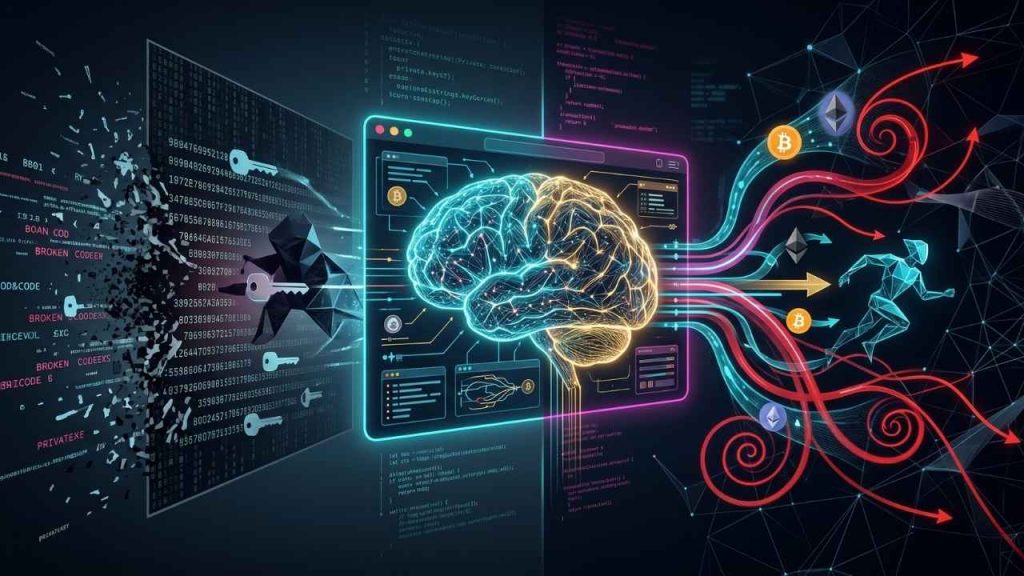
AI-controlled wallets promise a radical simplification of the Web3 ecosystem by delegating transaction signing to autonomous agents. However, this new category of structural risks demands a paradigm shift: security no longer depends solely on protecting the user’s private keys.
The central problem lies in the transfer of financial sovereignty from the human user to language models with stochastic behaviors. This operational autonomy redefines traditional custody by prioritizing technical convenience over direct and constant supervision of funds.
To understand this shift, it is imperative to consult the official documentation from the Coinbase Developer Platform on Agentic Wallets, which details how agents can hold funds. This infrastructure allows software to execute on-chain transactions independently, removing the need for manual human interaction.
Historically, crypto security centered on cold storage and multi-signature setups to prevent unauthorized access. Today, the focus shifts toward the governance of permissions that a user grants to an intelligent agent to operate.
In this context, it is observed that Coinbase’s agentic wallets pose a structural risk due to their ability to make financial decisions without prior filters. The risk of an instruction being misinterpreted by the AI model exceeds the probability of a key hack.
The implementation of these wallets is often based on the account abstraction technical standard, formally known as Ethereum’s EIP-4337. This protocol allows for the programming of complex execution rules, facilitating AI management of assets under predefined logical conditions.
This technical advancement enables the automation of yield farming strategies and high-frequency trading with significantly lower latency. Nevertheless, total automation introduces an expanded logical attack surface where vulnerabilities are found in the agent’s code.
On the other hand, the Solana network has shown massive adoption of these systems, confirming that Solana and Pay.sh consolidate the agent economy through the integration of instant micro-payments. This infrastructure removes entry barriers for users who do not wish to manage blockchain complexity.
Despite the efficiency advantages, the absence of a human verification layer in every movement generates legal uncertainty. If an agent makes a financial error, the traceability of responsibility between the developer and the user becomes blurred.
According to the technology convergence report published by a16z Crypto on AI and Web3, future security will depend on the robustness of guardrails. These limits must be immutable to prevent an agent from being manipulated through prompt injection attacks.
The counterpoint to this critical view holds that AI wallets are, in fact, safer than human-managed ones. Proponents argue that agents do not suffer from fatigue, are not susceptible to social engineering scams, and execute orders with precision.
This stance is valid in controlled environments where risk parameters are strictly defined through audited smart contracts. In these cases, the agent acts as a purely technical executor of human will expressed through mathematical code rules.
However, the thesis of absolute security would be invalidated if a critical vulnerability is discovered in the inference models. If the agent’s logic can be externally altered, the wallet becomes a vehicle for massive and instantaneous capital loss.
The elimination of human supervision is the ultimate goal for protocols seeking maximum efficiency. But this goal ignores that financial systems require pause mechanisms during “black swan” events that AI might not properly identify.
Comparatively, the transition is similar to the move from manual vehicles to autonomous driving systems in the automotive industry. The risk is no longer individual driving error but the systemic failure of the algorithm controlling all movements.
To mitigate these risks, the industry is developing “behavioral oracles” that monitor the activity of AI wallets. These systems act as a firewall that blocks transactions that deviate drastically from historical spending or investment patterns.
Data from the Solana Foundation in its State of the Network indicates that agent transaction volume grew exponentially in 2026. This growth pressures developers to create security standards that are interoperable across different networks and models.
The real security of an AI-controlled wallet will not come from hiding the private key but from transparency. A secure architecture must allow real-time audits of the instructions the agent receives and the actions it intends to execute.
Ultimately, the average user’s trust will depend on the stability of deterministic guardrails that limit the AI’s capacity for action. Without these barriers, mass adoption will be slowed by the justified fear of losing control over assets.
If the integration of zero-knowledge proofs (ZK-proofs) is standardized to validate agent actions, AI wallet security will exceed traditional custody within the next twenty-four months due to the reduction of human operational error.
This article is for informational purposes and does not constitute financial advice.