RWAs and Sustainability: Tokenization of Carbon Credits and Green Infrastructure
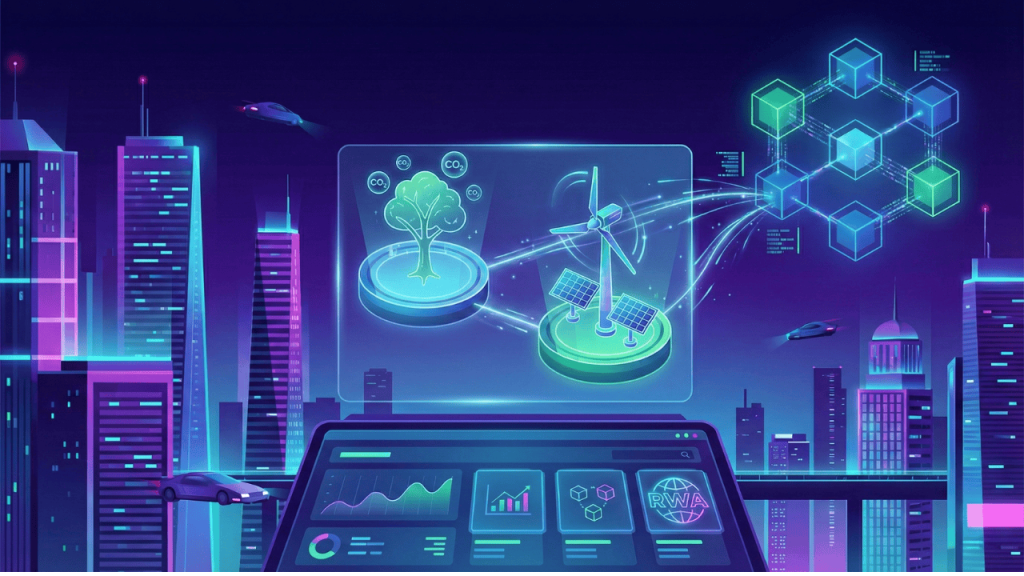
The convergence between decentralized finance and Real World Assets (RWA) has ceased to be a theoretical experiment to become the pillar of the new regenerative economy. In 2026, the digitalization of tangible assets seeks not only operational efficiency but also to resolve the crisis of trust that has historically hampered environmental markets. Absolute traceability is now the minimum requirement for any impact investment aiming to capture large-scale institutional capital.
Understanding what are RWAs in crypto is the first step to deciphering how blockchain technology is rescuing the carbon credit market. Far from the opacity of manual registries, tokenization allows every ton of $CO_2$ avoided or captured to be verifiable in real-time. Transparency mitigates fraud risk in a sector that, until recently, lacked unified global auditing standards.
Restructuring the Carbon Market
Under this lens, green infrastructure benefits from unprecedented liquidity. The fragmentation of assets, such as solar farms or reforestation projects, allows institutional and retail investors to access markets that were previously exclusive to large private equity funds. Access to green capital has been democratized, allowing financing to reach project executors in emerging markets directly.
According to the Organisation for Economic Co-operation and Development (OECD), the annual investment needed in sustainable infrastructure must reach record figures to meet climate goals. In fact, reports on sustainable development finance underscore that innovative financial mechanisms are crucial to closing the investment gap. Sustainable investment grows exponentially thanks to the reduction of intermediaries and the automation of payment flows.
Green Infrastructure and Financial Resilience
Infrastructure tokenization is not just a matter of environmental ethics; it is a strategy for financial resilience. Green assets typically show low correlation with traditional equity markets, acting as a hedge during periods of high inflation. Real diversification through RWAs offers constant cash flow derived from energy sales or ecosystem services, anchoring digital value to physical productivity.
Data from the International Energy Agency (IEA) reflect that renewable energy capacity has seen historic growth of 50% recently, generating a massive inventory of assets ready to be tokenized. By converting these facilities into tradable digital assets, the illiquidity risk that traditionally penalized long-term infrastructure is eliminated. Liquidity transforms fixed infrastructure into a dynamic and transparent asset class.
The Challenge of Standardization
However, intellectual honesty requires us to acknowledge that tokenization is not a silver bullet. The main risk lies in the “oracle”—the connection between the physical data (the tree planted or the energy generated) and the token on the network. If the source data is incorrect or manipulated, blockchain will only serve to propagate the error more efficiently. Oracle rigor remains essential to avoid digital greenwashing.
Additionally, critics warn that excessive fragmentation could lead to unnecessary volatility in assets that should be stable. If tokenized carbon credits are traded under purely speculative logic, the price could decouple from real ecological impact, harming the viability of the underlying projects. Environmental price stability must be protected through robust governance mechanisms.
The Integration Hypothesis
The underlying reality suggests that the green RWA market will reach maturity when tokenization becomes invisible to the end user. The integration of carbon credits into corporate balance sheets through DeFi protocols will be the standard for social responsibility. The future is hybrid and green, combining the legal certainty of the physical world with the agility of the digital one.
If the European Commission and other regulatory bodies consolidate their legal frameworks for digital assets (such as MiCA), allowing banks to custody green RWAs without excessive capital penalties, we will see trillions of dollars migrate toward sustainable infrastructure in the next 24 months. Consequently, tokenized carbon credits will cease to be a niche asset and become the reserve currency of global sustainability.