
Airdrops, Points, and Incentives: Real Growth or Fictional Economy?
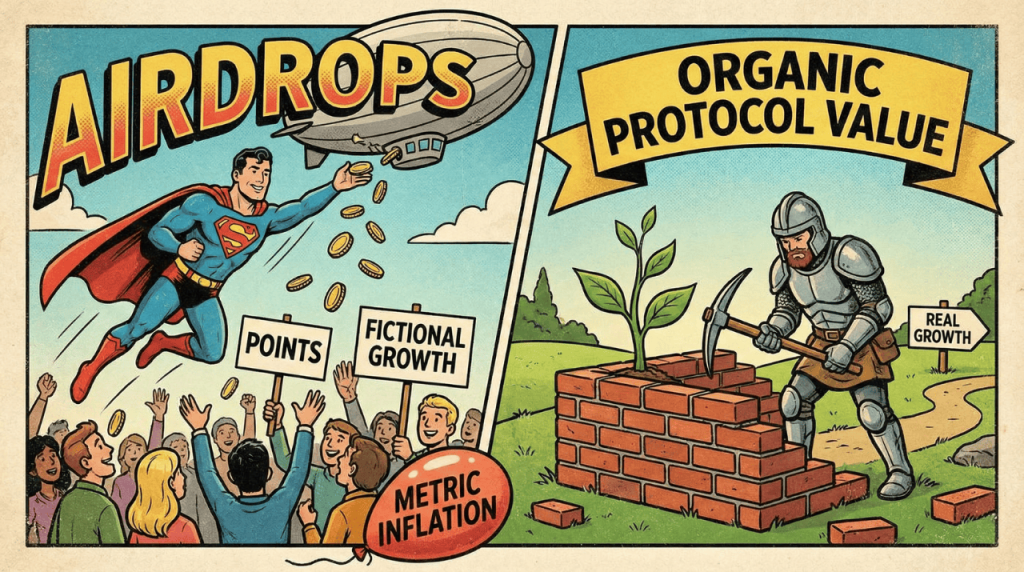
The crypto-asset industry is undergoing a profound identity crisis, where success is measured through the architecture of artificial incentives. What originally emerged as an elegant decentralization mechanism today manifests as a metric inflation machinery. Points programs and mass distribution events have created a synthetic growth ecosystem, where mercenary capital distorts protocol operations, hiding the lack of a genuine product-market fit.
From this perspective, the narrative claiming that the airdrops fever is the driver of mass adoption must be rigorously questioned. Everything points to a temporary liquidity feedback loop in exchange for massive long-term value dilution. This dynamic erodes real user loyalty and sets unsustainable profitability expectations in a macroeconomic environment where capital is no longer a free resource for emerging platforms.
The exhaustion of this model aligns with an institutional maturation of the sector that demands organic retention metrics over ephemeral volumes. The core structure suggests that protocols are buying time instead of building utility. Far from a coincidence, the market is beginning to distinguish between captured value and merely emitted value, punishing those projects that fail to surpass the initial incentive phase with a solid user base.
The Mirage of Data and Mercenary Capital
A protocol’s validity is typically measured by its total value locked (tvl). However, these figures are easily manipulated through programmed incentives that attract volatile liquidity. On-chain evidence demonstrates that a significant fraction of activity does not come from users with long-term intent, but from large-scale automated entities. These farms execute sybil farming strategies to extract maximum value without providing stability to the ecosystem.
This phenomenon occurs because the airdrops model has become a purely extractive transaction for most participants. The user does not seek technical utility, but rather immediate incentive arbitrage granted by the development team. According to data from the Nansen report on Arbitrum retention, wallet engagement drops drastically after distribution, revealing a lack of genuine interest in governance or product use.
Concurrently, points programs function as an indefinite launch extension, allowing projects to retain liquidity under ambiguous promises. This constitutes a form of technical and financial debt that the secondary market must eventually absorb. The daily active user metric is irrelevant if not filtered by capital origin, as the crypto sector often attempts to replicate free money through the issuance of assets lacking real organic demand.
The lack of transparency in accounting for these users generates a dangerous data bubble that venture capital firms use to inflate their books. Paper valuations rarely survive contact with real market liquidity once incentives cease. In other words, a financial house of cards is being built where retail investors act as support for an infrastructure that has yet to prove its ability to generate fee-based revenue.
Historical Perspective: From 2020 Elegance to 2024 Chaos
It is imperative to look back to understand the degradation of this business model. In 2020, the Uniswap launch set a precedent for organic governance distribution to its real users. According to its foundational Whitepaper, the intention was to decentralize a digital public good, not to inflate metrics for aggressive funding rounds. However, the evolution toward extreme yield farming has perverted this initial logic of reward for use.
In 2022 and 2023, we saw the rise of “quest” campaigns forcing users to perform circular transactions without value. This trend bears alarming similarities to the 2017 ICO bubble burst. The difference is that today’s manipulation is much more sophisticated, utilizing concepts like rwa tokenization to justify billion-dollar valuations for projects operating exclusively under a reward scheme.
The saturation of airdrops as a sole exit strategy has created a financial bottleneck. Available market liquidity is scarce for so much issued paper, causing newly launched tokens to suffer severe corrections of over 90% in their first months. From this lens, founders are prioritizing short-term hype over sustainability, leaving the community with assets whose selling pressure is structurally inevitable.
Divergence Analysis: A Necessary Evil for Bootstrapping?
An objective view cannot ignore that the sector faces a structural problem of initial liquidity. Proponents of this system see points as legitimate bootstrapping tools to reach critical mass. Without aggressive incentives, a technically superior protocol would hardly compete with established giants. It is argued that incentives allow for testing network resilience under real and massive stress load conditions.
A scenario exists where this model is validated: when the protocol manages to convert at least 10% of mercenary users into recurring ones. If the technology is sufficiently disruptive, the initial incentive is simple fuel for an engine that will eventually run on its own. However, this argument loses weight in the face of extreme friction with the community observed in recent launches that ignored transparency in their selection criteria.
Cases detailed on the Starknet Provisions portal show that poorly designed incentives destroy reputations of years in just hours. If the only value of a product lies in the gift, the product lacks intrinsic value and is doomed to commercial failure. Market maturity demands that the protocol’s real utility begins to be the determining factor for retention, finally displacing points speculation.
Conclusion: The Future Validation Scenario
Market dynamics suggest the current model is reaching a point of diminishing returns. Consequently, the future success of protocols will depend on their ability to generate real value beyond token issuance. The market will begin to severely penalize artificially injected activity, favoring those projects that demonstrate positive cash flow coming from services demanded by real users.
If capital flows persist above annual token issuance, we can speak of healthy growth. Otherwise, we face a zero-sum economy where capital merely rotates seeking the next incentive. The future of airdrops will depend on implementing on-chain reputation over quantity metrics, filtering out malicious actors to protect true digital ecosystem contributors.
Only then will asset distribution return to what it promised: a community empowerment tool. It must stop being a simple exit mechanism for venture capitals seeking liquidity at the expense of the retail investor. Sustainability is the only path toward massive and stable adoption, where a protocol’s value is based on its code and service, not the fiction of its promotional numbers.