
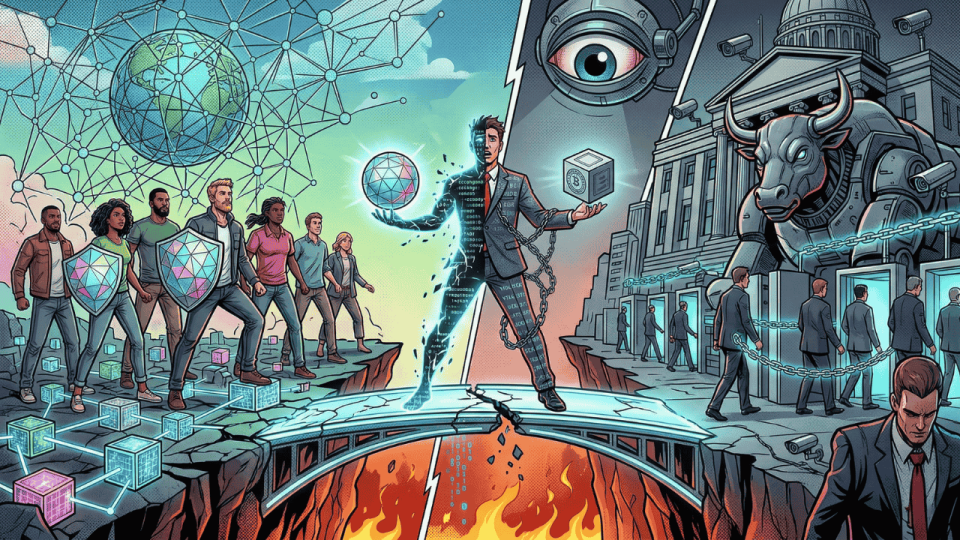
The digital asset industry is undergoing a structural identity crisis that transcends mere price volatility. The phenomenon of Initial Public Offerings (IPOs) of native companies in the sector is not simply a financial milestone; it represents the culmination of a dialectical tension between Satoshi Nakamoto’s original manifesto and the traditional markets’ need for liquidity. While heavyweights like Circle or Kraken prepare their landing on New York trading floors, the narrative of individual financial sovereignty faces the relentless scrutiny of the Securities and Exchange Commission (SEC).
Everything points to the fact that the quest for this “ultimate legitimacy” acts as a double-edged sword. On one hand, access to institutional capital provides a veneer of maturity necessary for mass adoption. On the other, integration into the fiat system forces these entities to dismantle the pillars of privacy and autonomy that defined their foundations. The underlying reality suggests that the price of entering the S&P 500 is not paid in dollars, but in the erosion of technical decentralization and the adoption of a conventional corporate surveillance architecture.
The Regulatory Corset and the Business Model Metamorphosis
When a crypto company decides to initiate the IPO process, it tacitly accepts that its code is no longer the law; the law is the commercial code and the guidelines of federal agencies. This transition implies a radical transformation of its operational structure. To comply with the Sarbanes-Oxley Act, companies must implement internal controls that often clash with the transparent yet pseudonymous nature of blockchain. This is not a minor adjustment, but a restructuring of the corporate DNA to satisfy investors who prioritize quarterly predictability over disruptive innovation.
Under this prism, institutional flows act as a factor of domestication. Industry data shows that publicly traded companies tend to restrict their offerings of staking or yield farming services for fear of being classified as issuers of unregistered securities.
Consequently, the end user ceases to be a participant in a decentralized network and becomes a banked client of a platform that must report every suspicious movement to the Financial Crimes Enforcement Network (FinCEN). This transition from “protocol” to “financial institution” marks a clear boundary where technical utility is subordinated to regulatory compliance.
The Lesson of Coinbase and the Shadow of Volatility
Coinbase’s 2021 listing was presented as the industry’s “Netscape moment.” However, its stock market trajectory has served to illustrate the dangerous correlation between the health of the sector and Wall Street’s macroeconomic sentiment. Far from being a coincidence, the performance of the COIN stock has functioned as a leveraged beta risk indicator relative to Bitcoin. This indissoluble link raises a fundamental question: can a crypto company be valued by its operational fundamentals, or will it always be a puppet of Federal Reserve liquidity cycles?
Analysis of quarterly earnings reports reveals that diversification into custody services and subscription revenue is a desperate attempt to decouple from reliance on trading fees. Nonetheless, the structure of an IPO demands perpetual growth that is often incompatible with prolonged bear markets. In other words, shareholder pressure for constant dividends can push these companies to make short-term decisions that sacrifice protocol security or the ethics of decentralization in favor of immediate profitability.
The Historical Parallel with the Dot-com Bubble
Financial history often rhymes, and the current frenzy for crypto IPOs bears disturbing similarities to the late 1990s. Back then, internet infrastructure companies sought legitimacy through accelerated public offerings, only to discover that traditional corporate structures were not prepared for the speed of the web. If we observe the collapse of the dot-com bubble in 2000, it becomes clear that access to public capital does not guarantee the survival of an innovative business model if it is stifled by government control and bureaucracy.
In parallel, the arrival of companies like Circle, the issuer of USDC, to the public market, represents a milestone in rwa tokenization. However, looking at past events such as the regulation of brokerage firms after the 2008 crisis, it is evident that the State does not allow the existence of “shadow banks” without imposing draconian supervision.
The reality suggests that crypto IPOs are the vehicle through which the traditional financial system absorbs and neutralizes the threat represented by the original decentralized architecture, turning digital insurgents into pillars of the establishment.
Institutionalization as a Necessary Evil
It is imperative to recognize that there is a school of thought, supported by hedge fund managers and market analysts, that defends the IPO as the only path to maturity. According to this stance, without SEC oversight and the transparency of public audits, the sector would remain in a “wild west” state prone to systemic collapses like that of FTX. They argue that the loss of a certain ideological identity is a fair price for stability and the protection of the retail investor. Under this scenario, centralization would not be a surrender, but a pragmatic evolution toward “crypto-efficiency.”
If this thesis were correct, IPOs would act as a bridge allowing trillions of dollars from pension and insurance funds to flow into the ecosystem. If institutional legitimacy succeeds in reducing the cost of capital for developers and stabilizing the global payments infrastructure, then the sacrifice of absolute decentralization could be considered a strategic success. However, this argument is invalidated if excessive regulation ends up stifling the innovation that made the sector attractive in the first place, leaving behind an empty shell of what was once an alternative financial system.
The Crossroads of the Decentralized Future
The tension between corporate structure and the crypto ideal will be resolved through market action and the regulatory response in the coming months. If capital flows into mining and service IPOs persist above $5 billion annually during the next cycle, the industry will have completed its transition to a highly regulated financial services sector. In this context, user sovereignty will be replaced by the legal certainty of the investor, shifting the development of true decentralization toward the deep layers of non-commercial open-source protocols.
Ultimate legitimacy through Wall Street seems inevitable for large platforms, but this does not imply the death of crypto identity, but rather its bifurcation. There will be a “clean,” listed, and supervised ecosystem, and an underworld of decentralized finance (DeFi) that will continue to operate outside the reach of SEC circulars. The question that remains is whether these companies, once turned into stock market giants, will become the new gatekeepers of the system or if they will manage to maintain a balance where sovereign technology and capital coexist without canceling each other out.
