
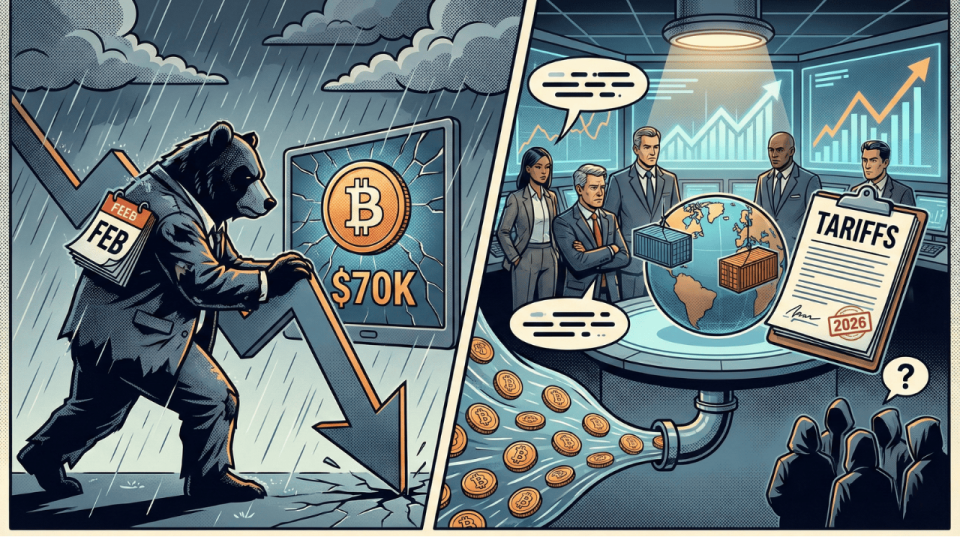
The narrative of perpetual optimism has collided head-on with macroeconomic arithmetic. The sentiment of capitulation defining the mercado bajista de febrero is not an isolated event but the result of a convergence of external pressures testing digital assets. While the fear and greed index plunges into extreme fear, investors are divided between those who see $70,000 as a floor and those who anticipate a correction toward much deeper technical support levels.
Everything points to the current downturn being a necessary purge of systemic leverage. Structural dynamics suggest that the mercado bajista de febrero does not represent the end of the adoption cycle but a recalibration against aggressive global trade policy. Far from being an irrational crash, the drop below $70,000 reflects an adjustment in risk premiums amid tariff uncertainty and tightening global liquidity conditions.
The Data Imperative: Deleveraging and Tariffs
The current decline cannot be understood without analyzing the international trade environment. The implementation of new tariff rates has generated a supply shock that pushes inflation upward. According to the IMF World Economic Outlook, trade barriers are reshaping capital flows, forcing investors to reduce exposure. Under this lens, the mercado bajista de febrero is a direct response to a flight to dollars.
Concurrently, data from spot Bitcoin etfs shows a slowdown in net inflows. According to records from the Securities and Exchange Commission (SEC), the temporary disinterest of investment funds during this mercado bajista de febrero has removed the buying support. This lack of pressure, combined with a deleveraging process where billions in positions were liquidated, suggests that the market structure was excessively overstretched and required a deep correction.
Historical Context: From 2021 to 2026 Maturity
Financial history often rhymes, though it rarely repeats exactly. The mercado bajista de febrero shares unsettling parallels with the mid-2021 correction, when the market suffered a 50% contraction. However, in 2026, the catalyst is not a mining ban but the integration of the crypto ecosystem into the global balance sheet. The volatility we observe today is, simply, the price of institutionalization.
It is instructive to recall the November 2022 crash, an event analyzed in the Fed Financial Stability Report. Unlike that winter, where distrust was internal, the mercado bajista de febrero is driven by macro factors. While the price has fallen, the network infrastructure and record hash rate show a robustness that did not exist in previous cycles. Therefore, the current panic seems more linked to price than to blockchain fundamentals.
Risk Analysis: The Prolonged Winter Scenario
It would be intellectually irresponsible to ignore the possibility that the mercado bajista de febrero is the prelude to a negative secular trend. Detractors argue that in a fragmented trade world, assets requiring high liquidity will suffer disproportionately. If geopolitical tensions lead to a permanent trade closure, the opportunity cost of holding Bitcoin versus bonds with positive real yields could become prohibitive for institutional capital.
In other words, if inflation exceeds 3% due to tariffs, the mercado bajista de febrero could extend throughout the year, turning into a period of stagflation. In this scenario, liquidity would drain from defi protocols and yield farming would lose its appeal against low-risk traditional instruments, invalidating the narrative of Bitcoin as a hedge against a stronger U.S. dollar.
Resolution and Accumulation Perspectives
Financial logic suggests we are facing a transfer from weak hands to strong hands. The mercado bajista de febrero is fulfilling its biological function: cleansing the system of speculators to allow for a solid accumulation base. While the drop is painful, it is the necessary scenario for large asset managers to rebalance their portfolios toward more attractive entry levels.
Consequently, the following vision is posed: if the $62,000 support holds through the monthly close and the fear index begins to reverse, the mercado bajista de febrero will consolidate as the best institutional accumulation opportunity of the three-year period. The sector’s resilience will not be measured by avoiding the fall, but by its speed of recovery once the noise dissipates. Blockchain remains the base technology, even if the price is, for now, a hostage to geopolitics.
