
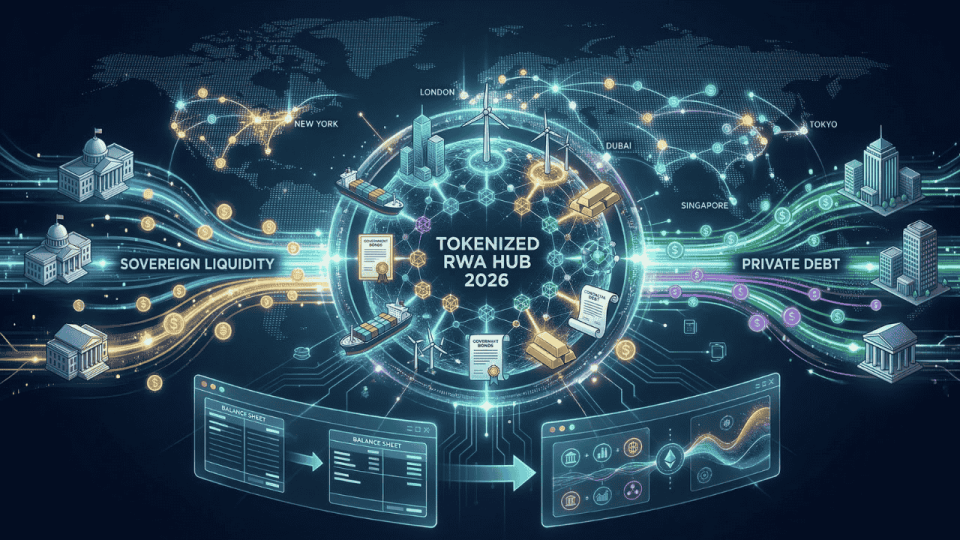
The narrative of Real-World Assets (rwa) has transcended its speculative phase to consolidate as the backbone of the financial ecosystem in 2026. Everything points to the fact that integrating tangible guarantees on-chain is no longer an option but an operational necessity for major funds. The underlying reality suggests we are facing the largest capital migration in market history, giving rise to the best RWA projects.
Under this prism, the convergence between institutional liquidity and on-chain transparency has created an unprecedented environment of trust. While the sector faced technical skepticism, the milestone of seeing tokenized real estate in Hong Kong has validated the model’s scalability. Consequently, projects that successfully bridge regulatory compliance with deep liquidity are leading the charge today.
Ondo Finance and the democratization of sovereign yield
Ondo Finance has emerged as the definitive bridge between traditional capital markets and the efficiency of decentralized finance. By the end of the first quarter of 2026, the protocol has surpassed 2.5 billion dollars in assets under management. Its ability to package U.S. Treasury bonds into accessible formats has transformed treasury management for global investors everywhere.
In other words, Ondo offers more than just exposure; it provides an immediate settlement infrastructure through products like usdy. This stability is crucial in an environment where the Federal Reserve maintains close surveillance over digital assets. Reality suggests that capital seeks high-quality shelters that operate with the native agility of blockchain technology.
In parallel, Ondo’s expansion into emerging markets has been a catalyst for mass adoption in regions with high inflation. Integrating its assets into platforms like Binance has allowed millions of users to access institutional-grade yields. Far from being a coincidence, this strategy has positioned the project as the de facto standard for interest-bearing stablecoin liquidity.
Securitize and the BlackRock BUIDL institutional standard
The partnership between Securitize and BlackRock’s BUIDL fund represents the definitive turning point for institutional tokenization. Surpassing 2 billion dollars in capital in 2026, this vehicle has proven that the institutional market prefers regulated instruments. The total transparency offered by the network allows regulators a real-time oversight of underlying collateral at all times.
Securitize’s importance lies in its strict compliance with SEC frameworks, facilitating the entry of conservative capital into the space. According to reports from Fidelity Digital Assets, the tokenization of money market funds is the cycle’s most successful application. This model allows institutional cash to be productive 24/7 without traditional banking bottlenecks.
In this environment, Securitize is not just an issuance platform but a guarantor of financial interoperability. The ability to use BUIDL tokens as collateral in regulated lending protocols has multiplied capital utility. Such synergy between traditional finance and distributed technology is what allows the financial infrastructure to be more resilient.
Centrifuge and the engine of on-chain private debt
Centrifuge remains the undisputed leader in private credit tokenization, connecting real financing with crypto liquidity. Its focus on assets such as invoices, real estate loans, and now green infrastructure and carbon credits has diversified ecosystem risk. In 2026, the protocol has facilitated billions in direct financing to global companies.
Centrifuge’s value proposition lies in its ability to disintermediate traditional credit markets, significantly reducing operational costs. By using advanced oracles for real-time asset verification, the protocol guarantees transparency that far exceeds banking systems. Thus, investors can monitor their portfolio performance with a granularity previously impossible to achieve.
Furthermore, collaboration with high-fidelity asset management platforms has allowed its business model to scale. Projects like the Franklin Templeton FOBXX fund underscore the viability of these public record models. The underlying reality suggests that private credit will be the engine of growth for the real-world assets industry.
The historical context of digital asset evolution
To understand the success of 2026, we must remember the skepticism surrounding early tokenization initiatives in 2017. Back then, the lack of legal frameworks and extreme volatility prevented similar projects from achieving real institutional traction. It wasn’t until the 2020 cycle that the technological infrastructure began to mature to support professional flows.
The 2022 trust crisis acted as a purifying filter, eliminating models based solely on empty speculation. During that period, investors learned that security lies in tangible backing rather than complex circular algorithms. Today, in 2026, the industry has adopted Federal Reserve principles on financial stability to build its foundations.
This historical evolution demonstrates that the market has moved from a “digital casino” phase to one of economic utility. If we compare current volumes with those from four years ago, market depth has multiplied exponentially. Consequently, current rwa projects are the result of nearly a decade of learning, mistakes, and constant technical refinement.
Risk analysis and the counter-argument scenario
Despite the prevailing optimism, the tokenization of real-world assets faces structural challenges that cannot be ignored. The risk of a data oracle failure could lead to incorrect valuations of underlying assets, triggering cascading liquidations. In such a scenario, the alleged safety of physical backing disappears in the face of a critical technical vulnerability.
Additionally, there is a latent tension between promised decentralization and the need for centralized regulatory control for physical assets. While transparency is high, the ability to seize underlying assets by national authorities remains a reality. This contradicts the censorship resistance thesis that originally drove the development of blockchain technology.
Finally, dependence on traditional market interest rates is the major macroeconomic risk factor. If Treasury bond yields fall drastically, the attractiveness of tokenized assets decreases compared to other alternatives. Reality suggests that the success of these projects is intrinsically linked to the health of the traditional global economy.
Conclusion: The future of productive store of value
The consolidation of Ondo, Securitize, and Centrifuge marks the beginning of an era where capital never sleeps and is always productive. If the institutional integration trend persists through the rest of 2026, we will see a total merger of financial markets. The tokenization of the global economy is no longer a futuristic hypothesis but a present operational fact.
Nevertheless, the long-term survival of these projects will depend on their ability to manage a changing regulatory risk. If flows toward these protocols remain steady, capital efficiency will improve drastically across all sectors. Only those projects prioritizing collateral integrity and total transparency will remain as leaders of the new financial order.
