
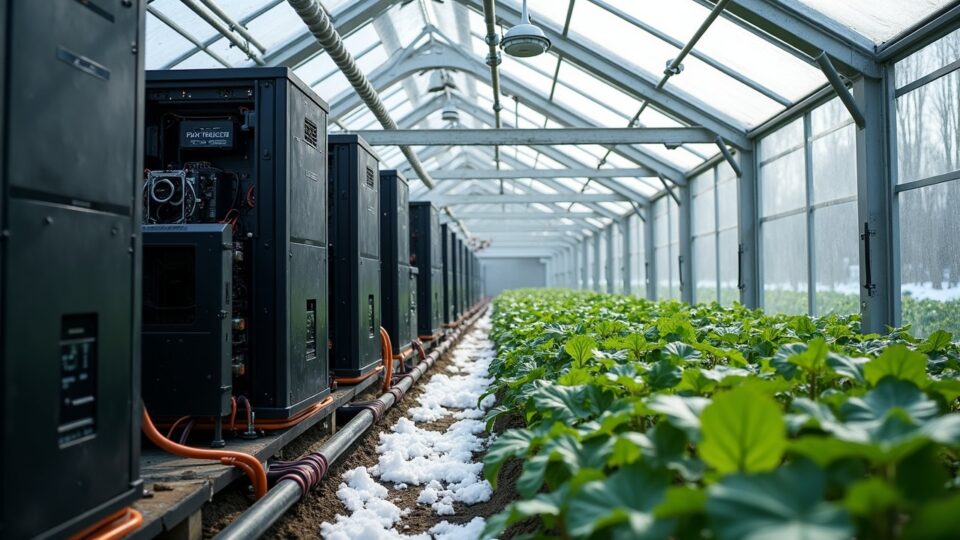
The province of Manitoba, Canada, has become the setting for an innovative agricultural experiment today. A new pilot project seeks to validate whether mining heat reuse from Bitcoin can transform food production locally. This initiative integrates digital infrastructure with commercial farming in extreme cold climate conditions.
Through this partnership, they aim to turn a previously wasted thermal byproduct into a valuable resource. Energy sustainability and operational efficiency are the fundamental pillars of this ambitious and unique trial.
Under the strategic direction of Nangeng Zhang, CEO of the technology firm Canaan, the project has officially started. The collaboration with Bitforest Investment has allowed for the deployment of 3 megawatts of capacity. It is a 24-month proof of concept study in total duration. This period will serve to collect critical data on the stability of the entire system. Therefore, the market closely observes this circular economy model applied on a large industrial scale.
In the facilities, 360 units of specialized Avalon series servers have been successfully installed. These devices use advanced liquid cooling technology to capture the generated thermal energy effectively. Unlike traditional air systems, this method allows for higher and more stable heat capture for industrial processes. Hence, mining heat reuse integrates directly into the water-based heating infrastructure of the greenhouse. This technical approach maximizes the yield of every watt consumed during the validation of blockchain transactions.
Technical innovation allows preheating water to high temperatures with Avalon servers
Furthermore, the system operates through a highly efficient closed-loop heat exchange mechanism. Residual heat is transferred to the intake water, raising its temperature above 75 degrees Celsius. In this way, it is possible to reduce dependency on fossil fuel boilers during the cold winter months. The company estimates that nearly 90% of consumed electricity is transformed into useful thermal energy. Also, this integration allows tomato crops to maintain a constant and healthy temperature throughout.
Likewise, improved thermal efficiency drastically reduces operating expenses for local mining operators. By recovering heat, the profitability of marginal facilities could improve significantly in cold regions. On the other hand, farmers access a cheaper and more ecological supplemental heating source than traditional methods. This financial symbiosis creates a resilient business model against the volatility of global energy prices. So, the economic impact benefits both industrial sectors simultaneously and directly.
How does mining benefit the sustainability of agricultural production in Canada?
However, the project in Manitoba is not an isolated case in the global industry. Various operators are exploring mining heat reuse for district heating networks and drying processes. In Europe, similar tests have been conducted in public pools and residential districts with positive results. Nevertheless, implementation in Canadian greenhouses presents unique technical challenges due to sub-zero temperatures. In this manner, the success of this pilot will set a precedent for Arctic agriculture.
Finally, the future of Bitcoin mining seems linked to its capacity for local integration. If the model proves commercially viable, it could scale to much larger and more complex industrial applications. Miners will stop being seen as simple electricity consumers and become infrastructure partners. We will likely see new modular facilities designed specifically for thermal recovery across the northern hemisphere. The balance between digital profitability and environmental sustainability will define the next decade of the sector.
