
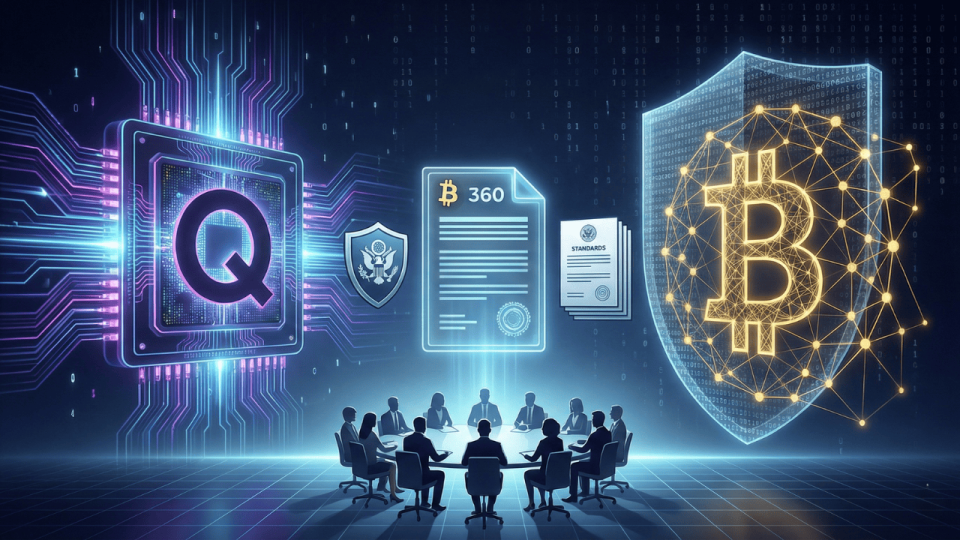
The “Quantum Apocalypse” narrative has resurfaced with cyclical virulence, acting as a recurring tool to inject fear into digital asset markets whenever price consolidates at key levels. The premise is terrifying in its simplicity: a machine with sufficient logical Qubits and error correction could break the ECDSA (Elliptic Curve Digital Signature Algorithm), exposing Bitcoin’s private keys and collapsing the network in a matter of hours.
However, clearing the fog of media sensationalism and placing the magnifying glass on the protocol’s architecture reveals a diametrically opposite reality. Far from paralysis, the Bitcoin ecosystem is advancing toward “crypto-agility” designed to neutralize this threat long before it materializes industrially.
This column argues that quantum computing is not an inevitable extinction event for Bitcoin, but a foreseeable and manageable engineering milestone. While the mathematical threat is real—Shor’s algorithm can theoretically factor large integers—current consensus and ongoing developments suggest the network possesses the tools to evolve.
The true risk lies not in future hardware, but in the capacity for human coordination and governance required to implement security patches in time without fracturing the community.
The Engineering of Defense: BIP-360 and Lattice-Based Cryptography
To understand the robustness of the defense, it is imperative to analyze the technical foundations already being laid, beyond mere speculation. The development community is not improvising; it is standardizing complex solutions. A central piece of this defensive strategy is the BIP-360 technical proposal, hosted in the official Bitcoin improvement repository. This document defines the P2MR (Pay-to-Merkle-Root) output type, a mechanism allowing funds to be committed to a Merkle root rather than a direct public key.
Under this prism, the security of funds ceases to depend exclusively on vulnerable elliptic curves and shifts to rely on hash functions, which are inherently resistant to quantum attacks (only marginally affected by Grover’s algorithm).
P2MR obfuscates the public key under cryptographic layers until the exact moment of spending, exponentially raising the network’s resistance. It is not a simple patch; it is a paradigm shift in how digital ownership is structured against adversaries with superior computing capabilities.
Global Standards and Institutional Validation
Parallelly, Bitcoin does not operate in a technological vacuum. The cryptography that will protect the network in the coming decade aligns strategically with the most advanced national defense efforts. The NIST (National Institute of Standards and Technology) Post-Quantum Cryptography program has recently established standards FIPS 203, 204, and 205. These documents validate lattice-based algorithms, such as ML-DSA (Dilithium), that are compatible with the Bitcoin developers’ long-term vision.
The convergence between government security standards and open-source development suggests an institutional maturity that critics often ignore. If the Federal Reserve and the global banking system migrate toward these standards, Bitcoin will simply follow that upgrade path, integrating quantum-resistant signatures via a Soft Fork.
Market Noise vs. On-Chain Reality
Bitcoin’s history is a chronicle of resilience against supposedly lethal threats, from the mining ban in China to the civil wars over block size in 2017. In every cycle, fear (FUD) precedes technical understanding. Renowned analysts and industry figures, like Ki Young Ju, have noted in a statement on quantum computing that the noise surrounding these threats often disconnects from fundamental data and development reality. This type of narrative functions more as market noise designed for weak hands rather than a fundamental sell signal.
The transition to quantum resistance will be gradual and politically complex, similar to the implementation of SegWit or Taproot, which took years to activate. It will not happen overnight, and that deliberate slowness is, paradoxically, the system’s greatest guarantee of stability: in Bitcoin, speed is the enemy of security.
The “Satoshi Coins” Paradox and Inaction
However, minimizing the risk to zero would be intellectually irresponsible. There is an attack vector that technology alone cannot solve: the human factor and historical immutability. European bodies like ENISA warn about the attack strategy known as “harvest now, decrypt later.” The ENISA institutional report details how a lack of proactive migration leaves historical data encrypted with current standards vulnerable.
In Bitcoin’s specific case, this presents an existential dilemma regarding “zombie” addresses from the Satoshi Nakamoto era (2009-2010). These addresses use the P2PK (Pay-to-Public-Key) format, where public keys are already visible on the blockchain. If a functional quantum computer appeared, those millions of BTC would be immediately vulnerable.
Here arises the political conflict: Should the network perform a fork to “burn” or lock those coins and save the protocol, breaking the principle of “code is law”? While the protocol can be updated for future transactions via BIP-360, the network cannot force inactive users to move their funds without breaking consensus. The true vulnerability is not the code, it is the inertia of early users.
Conclusion
Everything points to quantum computing acting as a forced catalyst for Bitcoin’s next major upgrade, not its executioner. The existence of advanced technical solutions demonstrates a capacity for anticipation, not reaction.
The underlying reality suggests that if development flows continue to align with NIST standards and the necessary political consensus is achieved to implement defenses like P2MR before 2030, Bitcoin will maintain its status. Consequently, the quantum danger must be reclassified: it is not an apocalypse, it is the ultimate stress test that will validate the asset’s antifragility against modern physics.
