
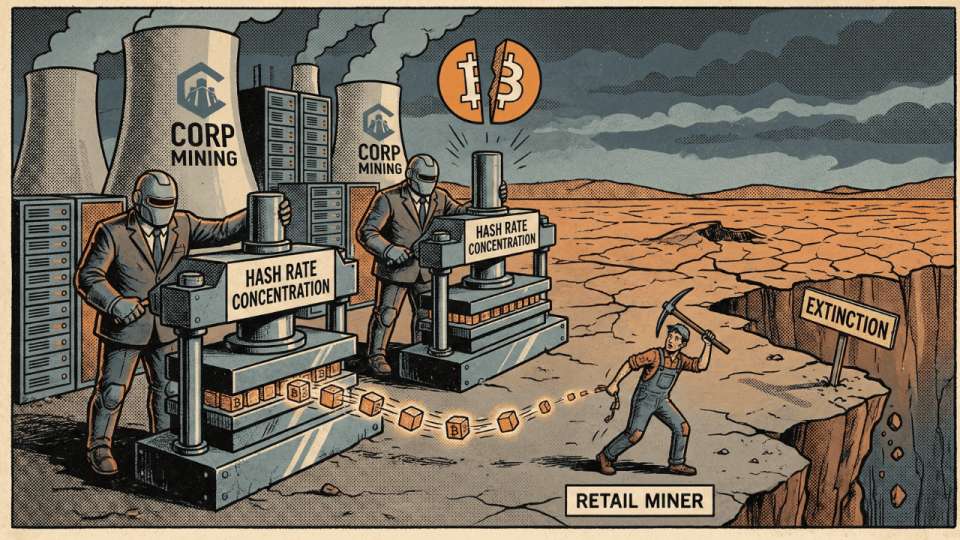
The foundational narrative of cryptography promised a decentralized network sustained by individuals operating from their home garages. Far from being a coincidence, the underlying reality suggests a massive structural shift where institutional capital has relentlessly monopolized the daily production of blocks across the entire digital ecosystem.
The recent reward cut has done nothing but drastically accelerate this severe Darwinian purge. Everything points to modern mining demanding unattainable energy efficiency levels for mid-sized operators, transforming the entire ecosystem into an exclusive playground for massive financial giants directly backed by Wall Street.
Margin Collapse and hash rate concentration
The mathematics of the network are truly ruthless when daily block rewards are halved. The profitability index, rigorously tracked by the Luxor Hashrate Index, clearly evidences that the production costs per coin now vastly exceed the absolute survival thresholds of any retail-level mining operation today.
Under this prism, small-scale facilities are inevitably capitulating to absolutely unsustainable electricity bills. The rigorous metrics from Glassnode regarding the network show a massive disconnection of older equipment, confirming that technological obsolescence is immediate without a constant flow of fresh institutional capital injections.
This profound asphyxiation does not discriminate, but it strikes with much greater brutality against those lacking economies of scale. Independent miners face retail electricity rates, while corporate giants negotiate wholesale power purchase agreements, creating an insurmountable competitive gap in the current margin-compressed and highly aggressive market.
Consequently, the hash price has rapidly become a critical metric that only massive corporations can sustain long-term. The digital network has become completely unforgiving, forcing highly inefficient independent operators to liquidate their treasury reserves quite simply to keep their aging machines running profitably today.
The Corporate Oligopoly Funded by Wall Street
The real battle for network control no longer occurs in isolated data centers, but within massive public stock markets. Recent official filings with the SEC from leading corporations demonstrate that the concentration of computational power is a highly deliberate and fiercely executed corporate growth strategy.
These public megacorporations currently enjoy a massive asymmetrical financial advantage: they can constantly issue stock to temporarily fund deficit-running operations. In other words, access to stock market liquidity allows them to easily absorb operational losses that would instantly bankrupt any private competitor operating without open credit.
Concurrently, the highly aggressive acquisition of much smaller struggling rivals has become the absolute norm within the sector. Corporate mergers rapidly accelerate hash rate concentration at an alarming rate, ensuring that rewards from extracted blocks flow directly into the solid balance sheets of publicly traded companies.
This inevitable hyper-financialization of the ecosystem essentially transforms validation hardware into a mere underlying financial asset. Massive institutional investors now indirectly control protocol security, meaning that the rigor of corporate capital absolutely dictates the strict operational rules of the entire decentralized global network without question.
The Illusion of Global Energy Decentralization
If we carefully review the margin crisis of the 2017 cycle, the rapid transition toward industrial equipment already anticipated this monopoly. That era consolidated the manufacturers, but the exhaustive Reuters analysis on the industry strictly confirms that the current entry barrier is exponentially higher for everyone today.
The historic massive migration of computing equipment following the severe Asian bans of 2021 also greatly accelerated this forced institutionalization. The rigorous figures from the Cambridge Centre for Alternative Finance demonstrate exactly how the geography of global mining quickly aligned with jurisdictions boasting extremely high financial capital.
Far from equitably democratizing access to the digital protocol, technical evolution has created insurmountable massive energy fiefdoms. The old promises of a uniformly distributed network clash against harsh physical reality, where proximity to cheap electrical sources remains an exclusive privilege of massive industrial mega-facilities worldwide.
In other words, the evolution of global mining geography confirms that hash rate concentration is a truly structural phenomenon. Recent history clearly proves the network naturally favors deep resource accumulation, consolidating an economic model of absolute winners where medium actors are simply wiped off the board.
Residual Resistance and Marginal Arbitrage
Those who fervently defend the financial viability of the retail operator argue that capturing surplus energy offers a small lifeline. It is undeniable that the use of flared gas or isolated renewable sources allows certain small actors to operate with positive margins under highly specific geographical conditions.
This novel micro-energy approach could potentially sustain isolated financial niches if the capital costs of latest-generation hardware drop abruptly in secondary markets. However, the immense scale of corporate dominance strongly suggests that these marginal actors will never again significantly influence the fundamental security of the network.
It is absolutely imperative to recognize that major institutional operators are also aggressively cornering the unconventional renewable energy sector. The romantic narrative of the independent green miner pales when giants with multimillion-dollar budgets deploy thousands of machines alongside remote oil wells, erasing retail competitive advantages entirely.
While a massive macroeconomic collapse in global energy prices could temporarily relieve the struggling private sector, the underlying structural dynamics heavily favor consolidation. The code’s strict inherent efficiency rewards extreme operational scale, making survival outside of Wall Street a truly pure and unquestionable statistical anomaly today.
Capital Efficiency as the Ultimate Judge
The complex international transaction validation ecosystem has irremediably mutated into a highly specialized, capital-intensive global heavy corporate industry. True survival in this profoundly hostile environment demands governmental-level power purchase agreements and massive infrastructure deployments that directly rival the traditional public utility companies of the modern financial world.
If this constant hash rate concentration ultimately surpasses the critical threshold of seventy percent of the global network during the next twelve months, physical decentralization will be confirmed as a myth. Would you be interested in a highly detailed analysis of how energy financial derivatives currently shield these corporate giants’ operations?
