
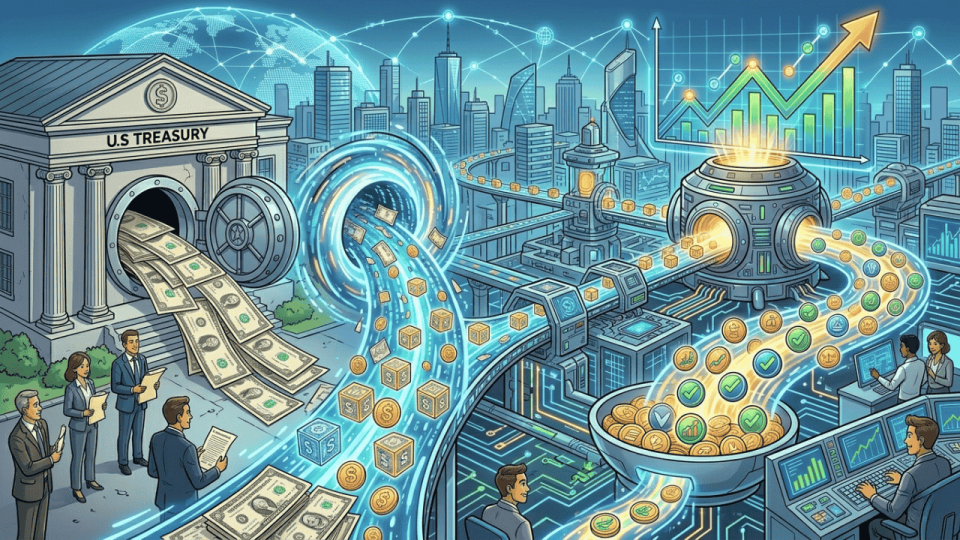
The financial architecture of 2026 has moved past the era of circular yields and speculation based on volatile assets. Everything points to the fact that the maturity of decentralized markets did not come from native innovation, but from the absorption of the most liquid debt instruments on the planet: US Treasuries.
Viewed through this lens, the narrative that once defended crypto autarky has collapsed in the face of real world asset (RWA) efficiency. The underlying reality suggests that institutional capital no longer seeks high-risk yield farming, but rather the risk-free rate tradable 24 hours a day on-chain.
The Awakening of RWA and the Search for Secure Yield
Far from being a coincidence, the rise of tokenized assets responds to a need for stability following the extreme volatility of previous cycles. The reality is that the market has validated the model of funds like BlackRock BUIDL, which has demonstrated how the tokenization of traditional financial assets can scale massively today.
Consequently, tokenized Treasuries act as the ultimate collateral, allowing DAO treasuries and retail investors to access sovereign yields. In other words, a bridge has been created where the yield of the US dollar feeds the blockchain infrastructure directly and efficiently for all participants.
This trend is reinforced by the entry of heavyweights, as evidenced by Ripple and VC firms investing in OpenEden. This investment is not just a technological bet, but a strategic move to dominate sovereign debt distribution across both permissioned and public blockchain networks.
Operational Efficiency: Beyond Simple Speculation
At the same time, the technical advantage of tokenization over the traditional T+2 system is indisputable for any modern asset manager. According to reports from McKinsey & Company, the capacity for instant settlement drastically reduces counterparty risk and operational costs. It is a fundamental paradigm shift.
In other words, a tokenized treasury bond is not just a debt title; it is a programmable and fractionalized unit of account. This feature allows bonds to be used as collateral in lending protocols, elevating capital utility to levels that traditional banking simply cannot reach at this moment.
While it is true that the technology is robust, current growth would not be possible without Franklin Templeton’s analysis on on-chain funds. Their FOBXX fund has served as the gold standard to prove that regulation and the blockchain can coexist without insurmountable friction for institutions.
The Mirage of Decentralization and the Regulatory Shield
However, this conquest of DeFi by traditional assets raises a fundamental conflict with the original philosophy of cryptocurrencies. The underlying reality suggests that we are facing the mirage of decentralized Wall Street, where hegemony is held by companies operating under strict compliance with SEC rules.
Under this prism, companies like Ondo Finance lead the sector not because of their decentralization, but for their ability to offer legal certainty to investors. Consequently, capital prefers to sacrifice absolute sovereignty in exchange for a legal protection that anonymous protocols simply cannot provide yet.
In other words, bond tokenization is the Trojan horse that allows regulators to enter the DeFi ecosystem. This integration means that the architecture of debt now requires regulatory compliance as mandatory for any protocol aspiring to handle significant global liquidity volumes from traditional markets.
From the 2022 Crisis to the 2026 Resurgence
To contextualize the current scenario, it is mandatory to remember the collapse of synthetic yield models seen during the 2022 crypto winter. That traumatic event wiped out trust in yields generated by inflationary token emissions without any backing from real tangible value.
Subsequently, the industry understood that to survive it needed to anchor itself to the real economy, starting the RWA era. Compared to 2022, the 2026 market is an environment where transparency and tangible backing are the only requirements to attract the necessary institutional liquidity.
Today, convergence is total, and tokenized bonds represent a substantial portion of the total value locked on main networks. This historical evolution proves that blockchain technology’s resilience is strengthened when it serves as the settlement layer for the most reliable assets in modern history.
The Risks of Digital Re-hypothecation
From a perspective of intellectual honesty, critics warn that sovereign debt tokenization introduces new systemic risks to the blockchain. A recent report from the BIS (Bank for International Settlements) warns about the dangers of the interconnection between traditional finance and crypto markets.
While efficiency improves, a failure at a traditional custodian or an asset freeze by court order could paralyze entire DeFi protocols. This dependence on the external legal system invalidates the thesis of absolute censorship resistance that many crypto advocates still try to sustain with deep fervor today.
Under this prism, tokenized Treasuries could be victims of their own success, creating an excessive centralization of collateral in the hands of a few issuers. If these issuers fail or face regulatory hurdles, the tokenized money market funds could trigger a devastating domino effect on liquidity for on-chain users.
The Verdict of Financial Integration
Reality suggests that Treasury tokenization is not a passing fad, but the pillar of the new global financial architecture. If interest rates remain stable and custody infrastructure continues to mature, real-world assets will dominate 80% of the yield found within the DeFi ecosystem.
If the volume of tokenized bonds exceeds 20 billion dollars before the end of the year, we will have witnessed the definitive end of the speculative era. Conversely, if critical failures in token interoperability emerge, the market could return toward purely synthetic yield models once again.
Ultimately, the success of these instruments depends on continued trust in the dollar as the global reserve unit. As long as the US Treasury maintains its solvency, tokenized bonds will remain king, providing the security necessary for DeFi to become the foundation of the future financial system.
