
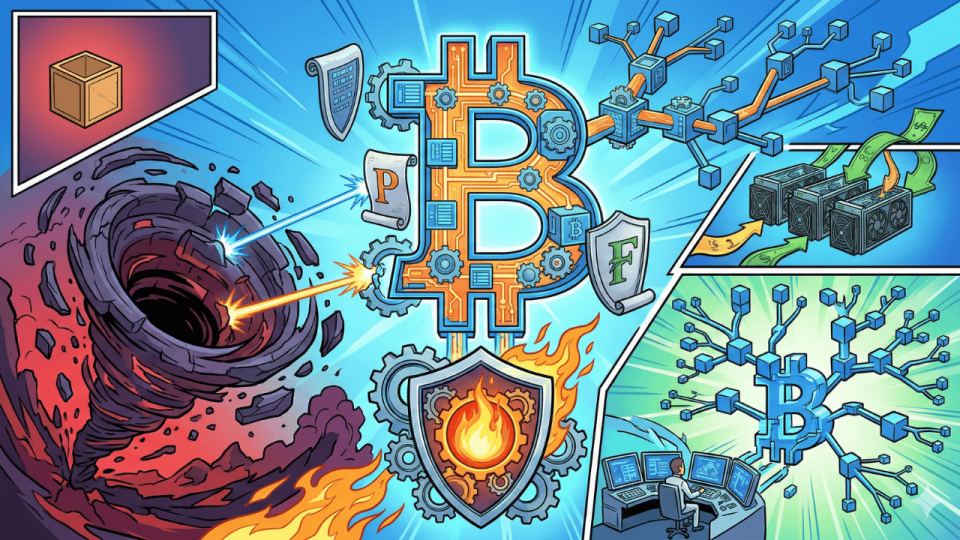
There is an apocalyptic narrative that cyclically resurfaces in traditional financial circles and, curiously, on the periphery of the crypto ecosystem. It is the fear of the post-subsidy “death spiral”: the idea that once the issuance of new Bitcoins (currently 3.125 BTC per block) becomes insignificant or vanishes, miners will mass-unplug their machines, leaving the network unprotected and vulnerable to 51% attacks.
This linear and simplistic view ignores the underlying reality of economic incentives and game theory. Mining is not a charity; it is a critical infrastructure industry transitioning from a “gold rush” (bootstrapping) model to a “toll collection” model for absolute settlement security.
Under this prism, the depletion of rewards is not an unforeseen design flaw, but an essential deflationary feature programmed from day one. Satoshi Nakamoto not only anticipated this but designed it as the system’s maturity mechanism.
Far from being a coincidence, periods of high congestion, driven by innovations like Inscriptions and second-layer protocols, have offered us an empirical preview of this future: a market where block space is the most scarce and valuable digital real estate on the planet.
The Mathematical Transition: From Subsidy to Fee Market
To understand the viability of a network sustained purely by fees, we must refer to the foundational source. In section 6 of the original Bitcoin Whitepaper, Nakamoto explicitly states: “The incentive can also be funded with transaction fees. Once a predetermined number of coins have entered circulation, the incentive can transition entirely to transaction fees and be completely inflation free.” The thesis I defend here is that Bitcoin is evolving to become a High-Value Settlement Layer, similar to a global RTGS (Real-Time Gross Settlement) system, but permissionless.
The analysis of the “Security Budget” is fundamental. Experts in macroeconomics and market structure, as detailed in the comprehensive analysis on Fee-Based Security Modeling, demonstrate that it is not necessary for fees to replace the subsidy 1:1 in BTC terms, but in purchasing power (USD) terms.
If the network value appreciates sufficiently, a transaction fee of $50 or $100 is trivial to settle a $10 million transfer. Network security is maintained if the cost of attacking it remains prohibitively higher than the potential gain, an equation that holds true even with moderate transaction volumes if the underlying asset is valuable.
Mining Industrialization and Energy Integration
The vision of miners unplugging their rigs because profitability drops by 10% is anachronistic. Mining has ceased to be a hobbyist activity to become an institutional industry vertically integrated with energy generation. Large public mining companies and sovereign funds entering the sector do not operate with time horizons of weeks, but of decades.
According to aggregated data and industry analysis, such as those presented in Galaxy Digital research reports, the trend is towards extreme efficiency and the utilization of stranded energy. Miners act as buyers of last resort for electrical grids, monetizing surpluses that would otherwise be wasted. In this scenario, the marginal cost of production drops drastically. When the block reward is insignificant, miners will continue to operate not just for fees, but because they will have become grid stabilization service providers, where Bitcoin mining is a cross-subsidy mechanism for their energy infrastructure operations.
Historical Context: The Lesson of the “Block Size War”
It is impossible to understand the future of fees without analyzing the civil conflict of 2017, known as the “Block Size War.” The community’s decision to keep blocks small (limiting space supply) was a decentralization preservation measure that had a critical side effect: it guaranteed a perpetual auction market.
If block space were infinite, its price would tend to zero, and without subsidy, network security would collapse. By restricting supply, Bitcoin ensures there will always be competition to be included in the next block. Institutional investment thesis reports, such as Bitcoin First Revisited by Fidelity Digital Assets, reinforce the idea that block space scarcity is what grants Bitcoin its “settlement finality” property. In a digital world of infinite abundance, verifiable scarcity is the only asset worth paying a premium for.
Variance Instability and “Selfish Mining”
It would be intellectually dishonest to ignore the mathematical risks of this model. There is a body of academic research, led by Princeton University in their seminal paper on The Instability of Bitcoin Without the Block Reward, arguing that a purely fee-based model introduces dangerous variance.
Without a fixed subsidy to buffer, miners could be incentivized to perform “selfish mining” or “undercutting” attacks, attempting to rewrite recent blocks to steal juicy fees from a previous block instead of working to extend the chain.
While this risk is theoretically valid, in practice it is mitigated by two factors: protocol ossification and off-chain incentives. Large mining actors have billions of dollars in physical infrastructure (ASICs, transformers, data centers).
Attacking the network to gain some extra fees in the short term would destroy trust in the asset that feeds them, devaluing their own long-term investment. Game theory suggests that Rational Cooperation will prevail over opportunistic attacks when there is so much physical capital (“Skin in the game”) at stake.
The Network as a Global Vault
The disappearance of block rewards will not be a sudden event, but an asymptotic curve giving us decades to adapt. What we will see is not a death, but a gentrification of Layer 1. Coffee transactions and micropayments will permanently migrate to higher layers (Lightning, Ark, Liquid), while the base chain will consolidate as the supreme security vault for interbank, state, and corporate settlement.
If demand flows for censorship-resistant assets continue their historical trajectory, transaction fees will be more than sufficient to fund an impenetrable wall of cryptographic energy. Put another way, when the last Satoshi is mined, Bitcoin will not have ended; it will have completed its construction. Mining will cease to be a distribution mechanism to become, purely and exclusively, a global security service.
