
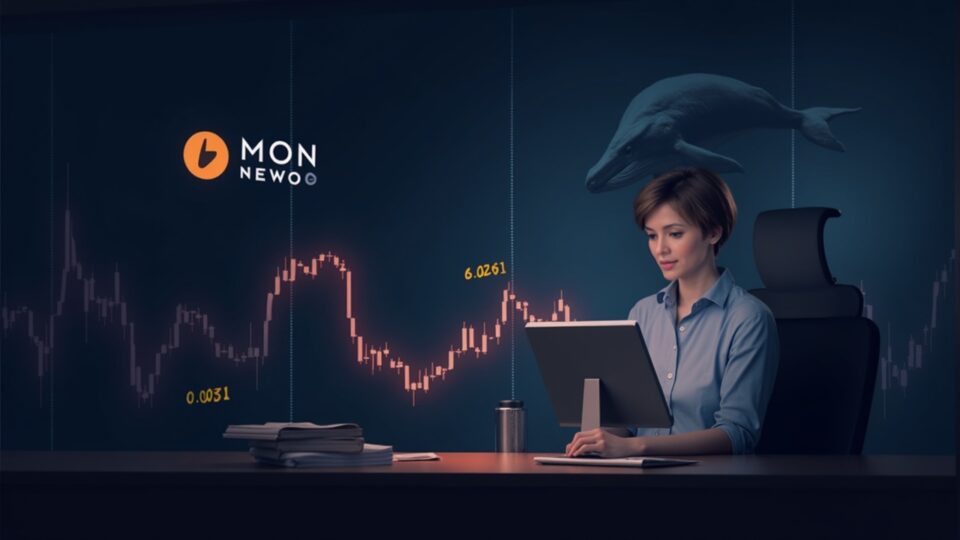
Extreme short positioning and a nascent technical setup have created conditions where bearish bets on Monad could invert into the buying pressure that drives a rapid 40% advance. The thesis rests on concentrated short interest, a developing cup-and-handle chart pattern and thin post-launch liquidity that together could amplify forced covering and whale-driven buys.
Data from trading flows indicate a heavy buildup of short positions in MON, creating a large pool of potential forced buyers if price turns. Monad launched with a total supply of 100 billion MON and roughly 10.8% initially unlocked and circulating, producing a relatively low float against an initial market capitalization near $298.38 million.
That constrained circulating supply, combined with observed volatility—initial surges of 40%–80% followed by corrections of 11%–47%—raises the probability that margin calls and liquidations will generate outsized market orders. Forced covering occurs when short sellers must buy to close positions; in a thin market, these market orders consume available ask liquidity and can push prices sharply higher.
Technical trigger, whale tactics and reflexivity
The technical catalyst identified by analysts is a cup-and-handle pattern. The cup-and-handle is a bullish continuation pattern where a rounded decline and recovery (“cup”) is followed by a short consolidation (“handle”) that precedes a breakout.
Key technical thresholds cited place the breakout around $0.031 with intermediate targets near $0.039 and $0.044, a move consistent with roughly a 40% advance from resistance. Large market participants may accelerate that move: whales aware of extreme short interest can initiate targeted buys to trigger the breakout, anticipating that short covering and momentum flows will amplify their position.
Such coordinated buying, followed by retail FOMO and algorithmic momentum responses, can create a self-reinforcing cascade that extends price action beyond the initial squeeze.
A notable element of the narrative is vocal bearish commentary from prominent figures. Arthur Hayes, BitMEX’s co-founder, warned publicly that Monad could “send Monad to zero,” and forecast a potential 99% crash, a statement that appears to have helped validate bearish positioning and contributed to the concentrated short exposure.
The convergence of heavy shorts, a recognizable cup-and-handle setup with defined breakout targets, and a low circulating float makes a rapid short squeeze scenario plausible for Monad.
