Russia Detects $129 Billion in Crypto Flows and Accelerates New Regulation
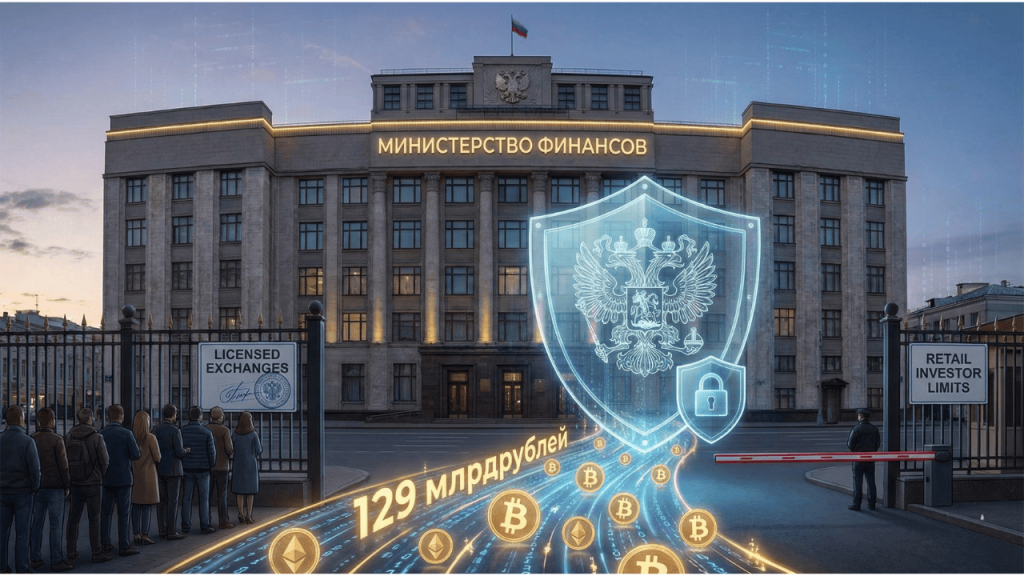
The Russian Ministry of Finance has revealed an annual transaction volume of $129 billion in digital assets, a figure that forces prioritizing cryptocurrency regulation in Russia. As Deputy Minister Ivan Chebeskov confirmed to the official agency TASS, citizens currently trade 50 billion rubles daily, consolidating a parallel market of immense proportions that operates entirely outside state supervision.
Under this scenario, official estimates suggest that annual turnover exceeds 10 trillion rubles, a volume of capital that rivals the main financial sectors of the Eurasian country. This massive informal adoption has set off alarms in the Kremlin, as the majority of these flows are executed through unregulated channels outside fiscal visibility, posing systemic risks to monetary sovereignty and the effectiveness of economic policies.
The gray market exceeds state forecasts
Consequently, the Central Bank and the Ministry of Finance have accelerated the drafting of a comprehensive bill that could be presented to the State Duma this very March. The proposed regulation seeks to establish a legal framework where licensed exchanges and brokers manage all operations to eliminate opacity. Unlike the corporate accumulation strategy seen in Japan, Russia focuses on controlling the massive retail flow that already operates de facto.
Delving deeper into the analysis, this move represents a Copernican shift regarding the prohibitionist stance of previous years, pragmatically recognizing that market volume is uncontrollable without legal channels. Blockchain offers technical traceability, but without regulated gateways, the state loses tax collection capacity. Officials highlight that the $129 billion figure is not speculative, but rather reflects real and daily use by millions of Russians seeking savings alternatives against ruble volatility.
Will the State Duma be able to pass the law this spring?
On the other hand, the proposed legislation introduces a critical distinction between qualified and unqualified investors, imposing strict limits on the latter to mitigate financial risks. While institutional investors would have broader access, retail investors would face annual caps on their operations, a measure designed to protect family savings. This segmentation seeks to align the crypto landscape with the financial stability guidelines of the Central Bank of Russia, which has been warning about the systemic risks of the unregulated sector for years.
Additionally, the regulatory push coincides with Russia’s need to integrate these assets into its formal economy to evade international sanctions. Pressure on the traditional financial system forces the search for alternative liquidity and settlement channels, which explains Deputy Minister Chebeskov’s urgency to approve the legal framework during the spring 2026 session, thus facilitating cross-border trade under state supervision.
Finally, the success of this initiative will depend on the government’s ability to incentivize users to migrate from opaque P2P platforms to licensed environments. If cryptocurrency regulation in Russia proves too restrictive, there is a risk that the black market will deepen; however, the promise of legal certainty could attract institutional capital that has so far remained on the sidelines due to a lack of clarity.