Can Blockchain Return Control of Intellectual Property to Creators?
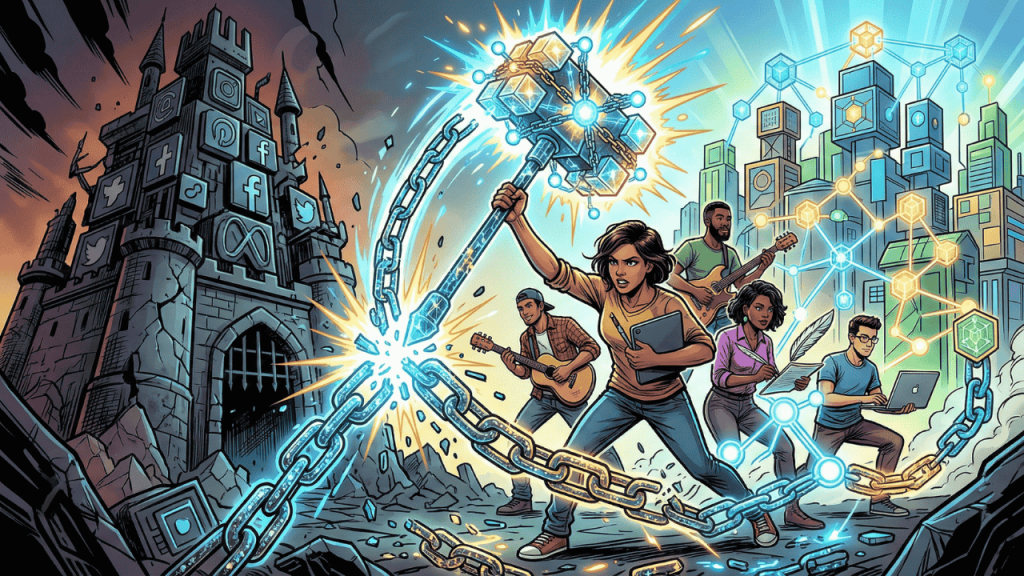
The current architecture of the commercial internet, or Web2, was built upon an original sin: the absence of a native ownership layer. For the past two decades, content creators have operated under a model of digital feudalism where the value generated is disproportionately captured by intermediaries who dictate the rules of monetization and distribution. Everything points to the fact that blockchain technology is not just a financial alternative, but the critical infrastructure to redesign the relationship between authorship and economic reward.
The underlying reality suggests that the traditional Intellectual Property (IP) system is broken in the face of the speed of digital replication. While copyright laws take years to adapt to technological changes, decentralized protocols offer a “code is law” solution that allows for the absolute traceability of the asset. The central thesis is not simply that blockchain is a better registry, but that it is the only mechanism capable of returning scarcity and direct control to those who originate intellectual property in an environment of infinite abundance.
Immutability as a Shield Against Corporate Exploitation
The primary benefit of the technology is the creation of an authorship record that is, by definition, censorship-resistant and tamper-proof. In the current model, a platform can unilaterally demonetize or remove a creator’s work. By linking IP to a blockchain, a granular title of ownership is established that resides on a distributed network, not a private server. According to the World Intellectual Property Organization (WIPO), the use of distributed ledgers enables more efficient rights management, drastically reducing litigation and registration costs.
Under this prism, smart contracts act as autonomous enforcement agents. Imagine a musical work whose ownership is fragmented among the composer, the lyricist, and the performer. Instead of waiting months for a management society to collect and distribute royalties, the protocol can execute royalty distribution automation in real-time whenever the work is consumed or licensed. Consequently, the creator ceases to be a passive recipient of what the platform decides to pay and becomes the architect of their own business model, eliminating the opacity that defines the current entertainment industry.
Programmability: The End of “Lost Value” in the Secondary Market
Historically, an artist lost track and benefit of their work once it was sold for the first time. Blockchain technology solves this structural problem through asset programmability. Through tokenization, it is possible to insert clauses that guarantee an economic share in every future transaction. This ability to capture value in secondary markets represents an unprecedented economic revolution; a creator’s long-term success translates directly into recurring income without depending on constant new releases.
In other words, blockchain allows IP to behave like a liquid and dynamic financial asset. Recent data on the market for nfts and digital rights shows that creators who retain technical control of their smart contracts perceive up to 90% more direct income compared to traditional distribution channels. Far from being a coincidence, this efficiency is due to the elimination of unnecessary administration layers that usually devour the artist’s operating margin. In parallel, this fosters a direct “creator-to-fan” relationship where intermediation is technical rather than editorial.
The Napster Trauma and the Evolution Toward Sovereign Protocols
To understand where we are going, we must look back. In the early 2000s, the phenomenon of Napster and peer-to-peer (P2P) file sharing was interpreted by the industry as an existential threat. The response was the Digital Millennium Copyright Act (DMCA), a legalistic solution that, while protecting IP, ended up handing total control to streaming platforms that today pay fractions of a penny per play. The historical lesson is clear: distribution technology always outpaces the law, and the only way to protect the creator is through an ownership technology that is equally agile.
If we compare the 2001 music industry crisis with the current emergence of copyright in the age of Artificial Intelligence, blockchain appears as the only bulwark against algorithmic plagiarism. If AI training data is registered on-chain, creators can demand micropayments for the use of their intellectual property. The reality suggests that without a decentralized verification layer, IP in the digital age will inevitably be absorbed by large language models without any compensation, repeating the cycle of exploitation we saw two decades ago.
Counterpoint: Legal Friction and the “Oracle” of Reality
It is imperative to analyze the stance of skeptics, who argue that blockchain is unable to resolve disputes that occur outside the digital environment. A hash on a network does not prevent someone from physically copying a work or uploading it to a platform that ignores decentralized records. Under this scenario, the total sovereignty thesis would be invalidated if there is no harmonization between smart contracts and national legal systems. Detractors point out that without state coercive force recognizing on-chain titles, the technology is simply a “notary without jurisdiction.”
However, this view ignores the trend of “algorithmic justice.” Companies like Sony are already exploring blockchain-based rights management systems for their music and film divisions. If major corporations and courts begin to accept cryptographic proof as primary evidence, the gap between code and law will close. The real risk is not the lack of legal validity, but the creation of a technological divide where only creators with technical knowledge or resources can protect their work, creating a new form of exclusion.
The Conditional Scenario for Mass Adoption
The definitive legitimacy of blockchain as the IP standard will depend on user experience and institutional integration over the next 24 months. If the adoption of digital wallets for creators grows at a rate exceeding 20% annually in emerging markets, we will see a massive shift of content from closed networks toward open protocols. In this context, intellectual property will cease to be an abstract legal concept and become a programmable and monetizable data stream.
If major content repositories like YouTube or Spotify do not integrate these transparency layers into their backend, they risk becoming irrelevant in the face of native protocols that offer equitable value distribution. Consequently, the future of IP will not be decided in courtrooms, but in the technology’s ability to make it more profitable to be honest and transparent than to pirate or exploit. Decentralization is, ultimately, the technical answer to an ethical and economic problem that Web2 could not or would not solve.