April 2026 is the bloodiest month in DeFi history: Why so many exploits?
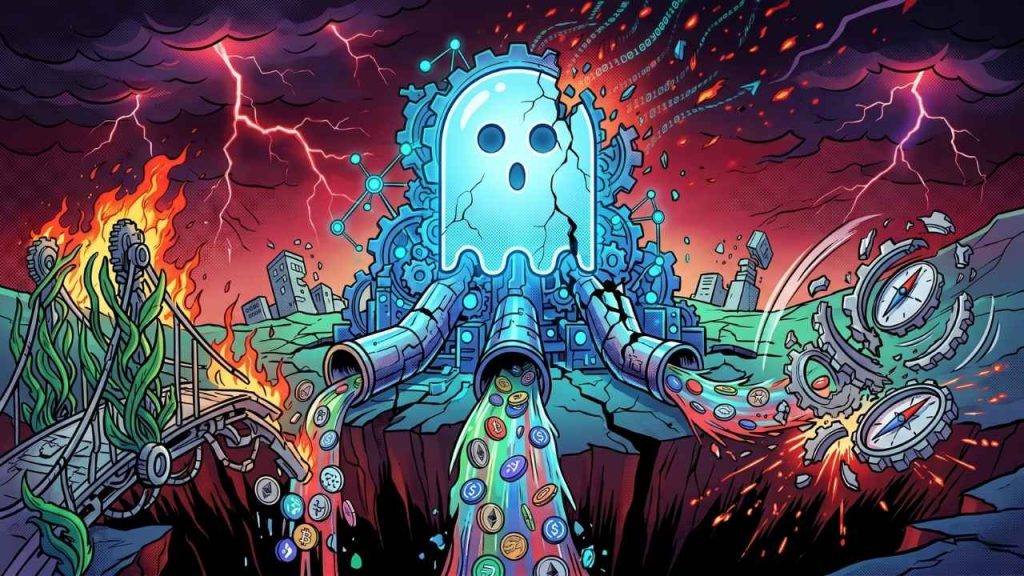
The decentralized financial ecosystem is facing its deepest security crisis with losses exceeding 570 million dollars. April 2026 records cumulative losses exceeding 570 million dollars due to vulnerabilities that expose weaknesses in bridge architecture and smart contract execution logic.
The recent DeFi exploits are not isolated incidents, but rather reveal a structural failure in the interaction between liquidity protocols and the underlying network virtual machines. This situation questions the sufficiency of current audits against attack vectors that exploit emergent behaviors in highly composable systems.
The central thesis of this analysis holds that the proliferation of attacks in April 2026 responds to a sophistication in the abuse of native functions of networks like Solana and the fragility of cross-chain messaging infrastructure. The Lazarus Group breached Kelp DAO’s cross-chain bridge through a key compromise technique that allowed the draining of assets worth 292 million dollars. This intrusion, detailed after breaching the bridge of the organization, demonstrates that even protocols with high total value locked (TVL) maintain single points of failure in their multi-signature custody implementations.
The technical fragility behind the Drift and Kelp attacks
The Drift Protocol case introduces a different technical dimension that aggravates the perception of systemic risk in the market. Instead of a traditional key theft, the attacker exploited a vulnerability in margin account handling and collateral calculation. Drift suffered a loss of 280 million dollars following the abuse of Solana-specific features related to real-time oracle state updates. This exploit highlights that the technical specifications of Solana’s programming model allow for manipulation vectors when applications do not implement strict external data dependency checks.
The convergence of these two massive attacks in a single month has generated a contagion effect toward lending protocols such as Aave. Although Aave was not directly breached, the debt market is suffering the consequences of extreme volatility and the illiquidity of collateral assets compromised in Kelp and Drift. Aave’s solvency depends on dynamic risk management that must adjust to the sudden drop in confidence in liquid staking derivatives. The platform’s risk management parameters are being tested as massive liquidation positions threaten to generate bad debt if underlying asset prices continue their descent.
Differential Analysis: The paradigm shift in attacks
Unlike the 2020 and 2022 cycles, where Solidity reentrancy attacks were the norm, the events of April 2026 show an evolution toward exploiting business logic and validation infrastructure. The differential argumentative block lies in identifying an “execution composability risk”: developers are building on base layers whose technical subtleties they do not fully understand. Attackers now exploit latency between execution layers, a phenomenon that is not detected in static code audits. While in previous years the focus was on the contract code, today the danger lies in how that contract interacts with the multichain execution environment and low-latency consensus mechanisms.
This structural change means that security can no longer be guaranteed solely by reviewing individual lines of code. The integration of protocols creates dangerous circular dependencies that become visible only under extreme market stress conditions or through orchestrated network state manipulations. Historically, following the Ronin hack in 2022, the ecosystem focused on securing validators; however, in 2026, the attack surface has shifted toward virtual machine memory introspection functions, allowing actors like the Lazarus Group to execute unauthorized transfers that the protocol interprets as legitimate.
The Counterpoint: Is transparency the problem or the solution?
A significant sector of security analysts argues that the current vulnerability is an inevitable consequence of full open-source transparency. They argue that by publishing every update, protocols provide a roadmap of possible vectors to state-sponsored attackers with advanced computing resources. Security through obscurity is rejected by the industry’s spirit, but some institutional providers suggest that certain governance and contract update functions should operate under zero-knowledge (ZK) schemes to avoid exposing critical logic before full execution.
However, this stance overlooks that transparency is the only real defense against internal design flaws. If the failures in Kelp and Drift had not been immediately detectable on-chain, the damage to global liquidity could have been irreversible before any intervention. The validity of the thesis holds that the problem is not open source, but the lack of secure interoperability standards. The attacks of April 2026 confirm that economic incentives for attackers outweigh current investments in proactive defense and real-time threat monitoring.
Perspectives and regulation in the face of the April crisis
The institutional response to these events is setting a precedent in the oversight of digital assets. Financial authorities have intensified the tracking of funds linked to sanctioned entities, using current financial sanctions to block the outflow of capital toward mixers. This regulatory pressure seeks to force companies operating decentralized protocols to implement more rigorous compliance controls, creating direct tension with the permissionless nature of DeFi technology.
The future of security in the ecosystem will depend on the adoption of solvent exploit insurance and the implementation of decentralized “emergency kill switches.” However, these solutions introduce centralization risks that the community is not yet willing to fully accept. The recurrence of massive attacks indicates that the market may be entering a consolidation phase where only protocols with massive treasury reserves and simplified architectures manage to survive technical and financial scrutiny.
If the volume of bad debt in secondary lending protocols increases by an additional 15% before the end of May, the liquidity crisis will force a mandatory restructuring of governance parameters across the sector.
This article is for informational purposes and does not constitute financial advice.