
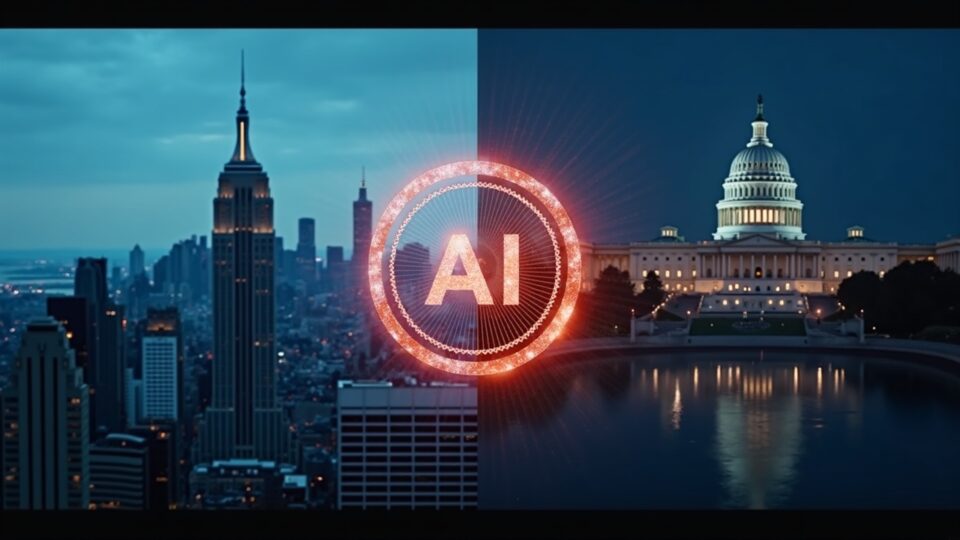
New York has enacted AI transparency and safety laws requiring disclosure of AI-generated performers in advertising, setting up a direct confrontation with a federal executive order issued in December 2025.
On December 11, 2025 Governor Kathy Hochul signed Senate Bill S2414, which requires explicit disclosure when advertisements or films use AI-generated performers or synthetic media. The state also put the Algorithmic Pricing Disclosure Act into effect in November 2025, obliging businesses to reveal automated pricing mechanisms. In June 2025 the Responsible AI Safety & Education (RAISE) Act (S6953) established requirements for independent audits of high‑risk AI systems.
New York’s approach couples disclosure with consumer‑protection enforcement. While an explicit penalty schedule remains under refinement, non‑compliance is expected to trigger civil fines likely ranging from tens of thousands to hundreds of thousands of dollars per infraction. The New York State Attorney General can pursue cease‑and‑desist orders, corrective advertising or injunctions, and the statutes create private rights of action for individuals alleging misuse of likeness or algorithmic harms.
New York mandates AI advertising disclosures: scope and enforcement
The federal government issued a series of executive orders across 2025 that culminated in a December 11–12, 2025 directive to establish a national AI framework and to preempt state laws. The administration rescinded the prior 2023 federal AI executive order earlier in 2025 and advanced a policy mix favoring deregulation and centralized governance, including a “Genesis Mission” to accelerate AI R&D, a “10‑to‑1” deregulation posture, and directives aimed at ensuring federal systems avoid perceived ideological bias.
The December 2025 order asserts federal supremacy under the preemption doctrine and empowers federal officials, including the Attorney General, to challenge conflicting state statutes and to use federal funding levers. The federal rationale emphasizes uniformity to reduce compliance fragmentation and to preserve U.S. competitiveness in AI development.
The clash articulates two competing regulatory rationales. New York frames its rules as consumer protection against deceptive synthetic likenesses and opaque automated decisioning, while the federal argument stresses regulatory predictability and the compliance burden that a state‑by‑state patchwork would impose on developers and vendors.
For product and compliance teams the immediate consequences are practical: rework product labeling and advertising workflows, expand audit and documentation capabilities for pricing algorithms, and budget for potential fines and litigation. Legal teams will need to prepare for preemption challenges in federal court while monitoring enforcement actions from the New York State Attorney General. Firms that operate nationally face either simultaneous compliance costs or potential legal exposure depending on how courts resolve the federal‑state conflict.
