
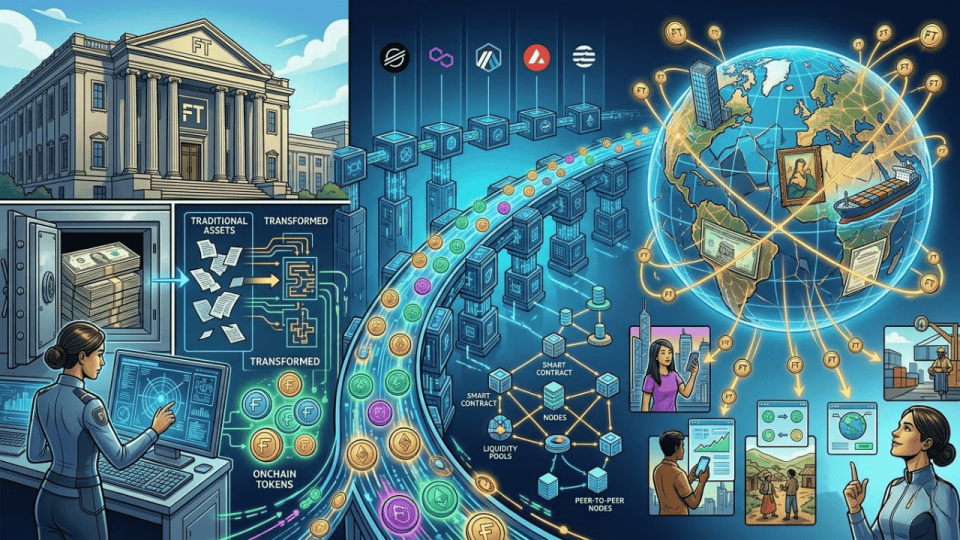
Franklin Templeton is not simply exploring blockchain technology; it is redesigning the foundations of asset management. Its bet on onchain markets seeks to eliminate the inefficiencies of traditional clearing systems. From this perspective, the firm distances itself from speculative noise to build real technical utility.
The FOBXX fund represents the first registered vehicle that uses a public ledger as its official accounting system. This strategic decision challenges the custody model conventional that has prevailed for decades. The inherent transparency of the blockchain allows for unprecedented traceability for the institutional investor.
The FOBXX Fund and the Genesis of the Public Ledger
The genesis of this transformation is embodied in the Franklin OnChain U.S. Government Money Fund. At the end of February 2026, the fund has reached eight hundred sixty million dollars in assets under management. This growth highlights an increasing demand for regulated financial instruments that operate natively on digital ledgers.
Unlike traditional funds, each share of FOBXX is represented by a BENJI token. The infrastructure allows ownership to be registered directly on networks like Stellar or Polygon, reducing dependence on financial intermediaries. This disintermediation is not just technical, but redefines the economy of scale in investing.
The integration of the Benji Investments app makes it easy for users to interact with Treasury securities effortlessly. Investors can convert their stablecoin reserves into fund shares almost instantaneously. In other words, Franklin Templeton is merging cryptographic liquidity with the security of government-backed assets.
This convergence positions the firm as a central actor in the invasion of the real. By using Treasuries as digital collateral, a solid foundation is being created for the financial ecosystem. The total market for tokenized money funds has already surpassed one point eight billion dollars globally.
Operational Efficiency: Dismantling the Custody Model
Franklin Templeton’s true competitive advantage lies in optimizing operating costs through automation. A recent IMF report highlights that tokenization can significantly reduce settlement costs. The firm uses smart contracts to manage daily dividend payments with absolute mathematical precision and total transparency.
At the same time, the elimination of T+2 settlement times is a strategic priority for the institution. By operating onchain, transactions settle atomically, meaning the exchange of ownership and cash happens simultaneously. This execution speed drastically improves capital efficiency for major institutional treasury managers currently operating.
Far from being a coincidence, this technical architecture allows Franklin to operate with more competitive margins. The reduction of manual processes in the back-office translates into a lower net expense ratio for the end investor. By optimizing infrastructure, the firm is democratizing access to high-quality institutional yields.
In other words, technology acts as an efficiency multiplier for internal accounting processes. The ability to track each accounting unit in real-time mitigates the reconciliation risks that often plague traditional banking. Franklin Templeton is proving that the future of savings involves the programmability of money.
Multichain: Benji’s Expansion Toward Interoperability
Franklin Templeton’s strategy is not tied to a single protocol, demonstrating notable technical agility. The expansion of the Benji platform to networks like Avalanche seeks to capture liquidity across diverse ecosystems. This multichain philosophy ensures that financial assets are available where investors choose to actively operate.
Recently, the firm announced its deployment on Coinbase’s Base network and BNB Chain. This diversification allows the FOBXX fund to act as a universal liquidity layer for the institutional sector. By being present in multiple layers, Franklin avoids being trapped in isolated technological silos that limit its growth.
In parallel, integration with the Canton network underlines its commitment to privacy and scalability. This network allows institutions to exchange tokenized assets with the necessary security to meet global regulatory requirements. Interoperability is, therefore, the pillar that supports the vision of a unified global market.
While it is true that each chain offers different advantages, Benji’s centralized control ensures consistency. The platform acts as the operating brain that synchronizes balances across various public distributed ledgers. Franklin Templeton is building an indestructible bridge between traditional finance and modern decentralized infrastructure.
The Mirror of 2008 and Algorithmic Transparency
To understand the relevance of this bet, it is necessary to compare it with the 2008 financial crisis. At that time, the opacity of underlying assets caused a systemic collapse of trust. Tokenization offers a technical solution through real-time verifiability of the fund’s reserves and holdings.
Unlike past cycles, where information arrived with a delay, the onchain record is immutable. Any investor can audit the fund’s composition through public block explorers at any time. This radical transparency is a potent antidote against the uncertainty that has historically paralyzed global markets.
PwC indicates that digital trust will be the most valuable asset in the next financial decade. Franklin Templeton has understood that legal and technical security are inseparable in the information age. Its regulated approach prevents the excesses seen in the initial coin offering era.
In other words, the firm is applying Wall Street rigor to Silicon Valley flexibility. By operating under the SEC’s Rule 2a-7, they ensure that credit risk is minimal for their participants. The maturity of the sector is reflected in this perfect balance between technological innovation and financial prudence.
Liquidity Fragmentation and the Regulatory Wall
However, the path to mass adoption is not without significant technical and legal obstacles. Liquidity fragmentation across dozens of blockchains could dilute the efficiency of the secondary market. If common standards are not established, we risk recreating the complexity of the legacy financial system.
Under this perspective, regulation remains the determining factor for the success of rwa tokenization. The passage of the GENIUS Act in 2025 has provided a framework, but uncertainty in international jurisdictions persists. Franklin Templeton must navigate a global regulatory maze that constantly changes and demands extreme legal vigilance.
Furthermore, institutional competition has intensified with the entry of players like BlackRock and its infrastructure in Securitize. The fight to define the industry standard will be fierce in the coming years. The risk of becoming obsolete before new faster settlement technologies is a latent but real threat.
In parallel, cybersecurity represents a constant challenge for any platform managing assets on public networks. A failure in smart contracts could compromise the integrity of the ownership record for investors. Therefore, Franklin invests millions in audits to ensure its infrastructure is resilient against sophisticated attacks.
If the volume of tokenized assets maintains its upward trajectory, Franklin Templeton will consolidate its absolute leadership. The ability to integrate traditional funds with digital payment rails will be the key to capturing next-generation liquidity. The firm is prepared to lead this unprecedented evolution.
If Benji app adoption exceeds five million active users by 2027, the traditional investment banking model will have changed forever. Everything points to us witnessing the end of unnecessary intermediaries in global asset management. Onchain efficiency has ceased to be optional.
