
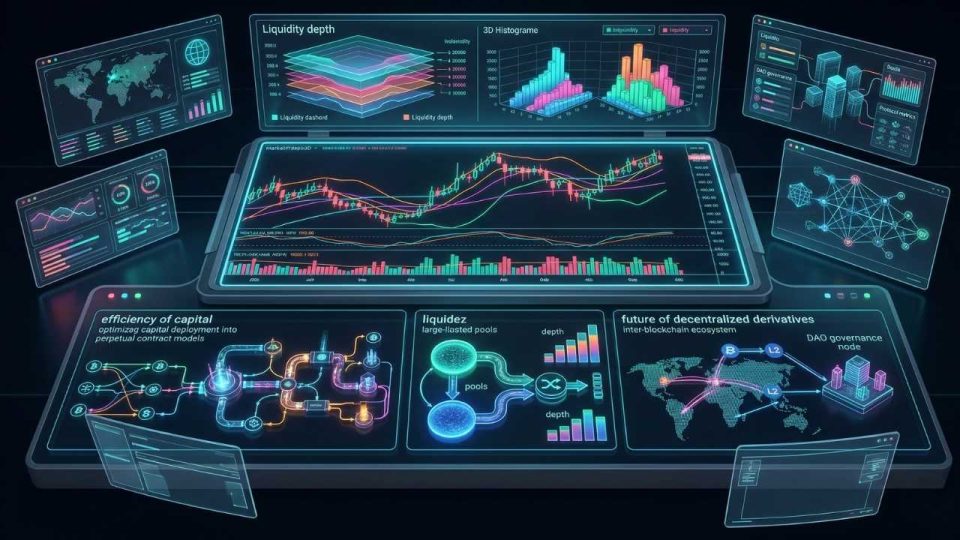
The evolution of cryptographic derivatives has reached a critical turning point where perpetual trading models define success. As protocols seek to capture institutional volume, the technical architecture determines whether liquidity is genuine or simply a temporary incentive that will soon vanish from the market.
Historically, the rise of decentralized finance prioritized algorithmic simplicity over precision in execution. However, the facts suggest that capital efficiency requires more robust infrastructures than those offered by the current passive liquidity pools typically found in the sector.
Competitive advantages of concentrated liquidity in order books
The Central Limit Order Book (CLOB) model allows market makers to provide liquidity at highly specific price levels. This structure is fundamental for reducing slippage in large-scale operations, allowing institutions to execute orders without displacing the price significantly.
This technical architecture, detailed in the dYdX v4 technical documentation, demonstrates that moving the matching engine off the main chain optimizes speed. Under this perspective, perpetual trading models based on order books mimic the efficiency of traditional financial centers.
Far from being a coincidence, the migration of protocols toward sovereign chains seeks to mitigate the latency limitations inherent in general networks. Consequently, total control over transaction ordering allows a user experience much closer to classic centralized exchanges.
In other words, the ability to place limit and stop-loss orders natively without incurring excessive gas costs is vital. This technical functionality attracts high-frequency traders who require precise execution and minimal latency for their complex and automated arbitrage strategies.
Structural challenges of automated market makers
On the other hand, automated market makers (AMM) revolutionized access to derivatives by democratizing the provision of liquidity. While it is true that they facilitate the listing of long-tail assets, the current landscape reveals serious inefficiencies during times of high market volatility.
Dependence on mathematical formulas like the constant product creates a systemic risk known as impermanent loss for liquidity providers. As explained in the GMX v2 technical documentation, balancing open interest between long and short positions is a constant challenge requiring very aggressive funding mechanisms to stabilize the system.
At the same time, perpetual trading models that use oracles to determine prices are vulnerable to manipulation attacks in markets with low liquidity. If external data feeds fail or are delayed, the protocol may suffer catastrophic losses of capital deposited by the system’s users.
Without real market depth, traders suffer a disproportionate price impact that makes professional trading at scale unfeasible. For this reason, many projects are integrating Uniswap v3 concentrated liquidity concepts to attempt to mitigate these structural deficiencies in their perpetual trading models.
Lessons learned from previous market cycles
The ecosystem has moved through phases of euphoria and collapse that have validated the importance of technical robustness over marketing. During the 2017 cycle, the absence of efficient decentralized derivatives limited institutional participation, concentrating volume in opaque centralized platforms with custody risks.
In the 2020 summer, the boom of yield protocols proved that liquidity can be extremely volatile without infrastructure. Data from past events, analyzed in this Federal Reserve Report, highlight how excessive leverage in fragile models can trigger dangerous cascading liquidations for the entire financial system.
The 2022 crisis evidenced that on-chain transparency is not enough if the execution engine is inefficient or manipulable. Those perpetual trading models that survived were those that maintained a strict correlation with the base asset price and verifiable collateral guarantees in real time by any external participant.
Remembering these milestones is crucial to understanding that the industry is heading toward a technical sophistication necessary for long-term survival. It is not just about decentralization, but about creating resilient systems that operate correctly under extreme market stress conditions, such as those seen previously.
The role of institutional capital in derivatives infrastructure
The flow of institutional capital does not simply seek price exposure, but guarantees of execution and regulatory compliance in their daily operations. Perpetual trading models must adapt to auditing and transparency standards that asset management firms consider an absolute priority.
According to the SEC Digital Asset Framework, clarity in the structure of derivatives is a determining factor for mass adoption. Under this scenario, order books offer a market depth traceability that regulators understand and accept with greater ease.
In other words, AMM architecture often hides the identity of counterparties and the origin of the total liquidity. This creates barriers to entry for funds that must comply with strict anti-money laundering policies and knowledge of their final customers.
On the contrary, systems based on order books allow for a clearer segmentation of participants and granular risk management. The ability to observe order flow in real-time provides an additional layer of transparency that is essential for building trust in decentralized derivatives markets.
Toward a hybrid model in perpetual swap execution
Despite the advantages of the order book, those who defend AMMs argue that their simplicity ensures superior censorship resistance. They could be right in a scenario where low-latency server infrastructure becomes a target of direct regulatory attacks against the network validators.
While it is true that AMMs allow any asset to be traded instantly, the sector trend suggests an inevitable technical convergence. Many developers are exploring hybrid perpetual trading models that combine the flexibility of algorithms with the efficiency of order books.
To delve deeper into these trends, it is useful to consult the latest blockchain news regarding innovation in Layer 2 protocols and specific applications. The integration of zero-knowledge proofs will allow order books to maintain privacy without sacrificing the speed necessary to compete with traditional trading.
If institutional liquidity flows persist above current levels for the coming months, we will see a consolidation toward the CLOB model. If blockchain network latency cannot be significantly reduced, optimized AMMs will remain the refuge for emerging assets and small retail traders.
