
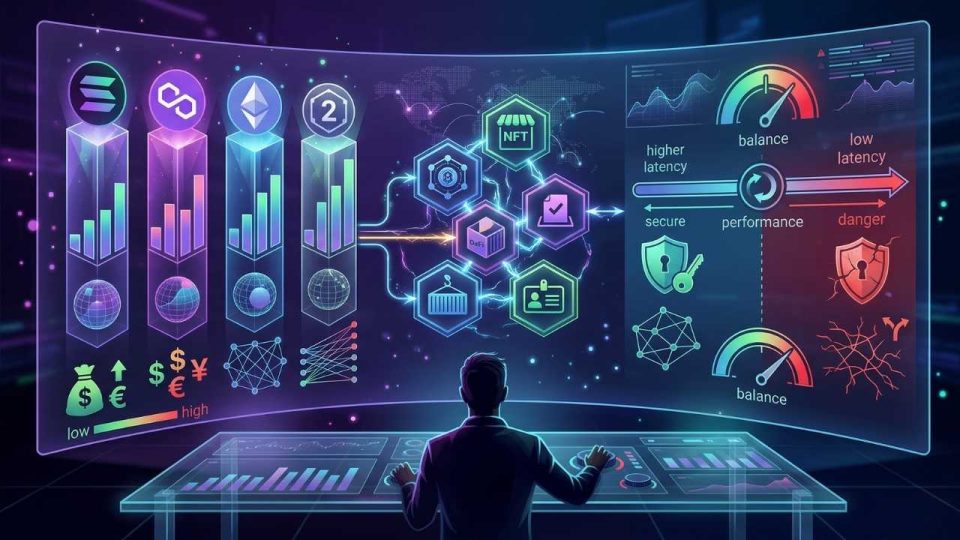
The evolution of the crypto ecosystem has drastically transformed operational efficiency. Currently, identifying the cheapest blockchains for DApp development is vital to prevent projects from becoming stuck in technical niches, much like when DApps are trapped in speculation and distanced from the mass retail market.
Everything points to low transactional costs no longer being an exclusive competitive advantage. While fee reduction democratizes access, the true sustainability of a decentralized platform depends on its ability to balance security with operational expenses that do not stifle the average developer in this current environment.
The Impact of EIP-4844 on Ethereum Layer 2s
The implementation of so-called data “blobs” has redefined the economic landscape for second-layer networks. Through the technical specification of EIP-4844, the costs of publishing data on Ethereum have dropped drastically. This positions solutions like Arbitrum among the cheapest blockchains for DApp development today.
Far from being a coincidence, the cheapening of fees in rollup networks allows for the execution of complex contracts for fractions of a cent. Developers find in this model a superior reduction in operational costs exceeding 90% compared to the levels recorded before the Dencun upgrade on the main network.
While it is true that gas costs are minimal, the initial deployment still requires a considerable investment. Liquidity fragmentation across various Layer 2s represents an indirect expense in technical interoperability that many novice development teams often ignore during their financial planning phase in the ecosystem.Solana and the Low-Cost High-Speed Standard
Solana remains the undisputed benchmark regarding raw throughput and extremely reduced fixed fees. According to official Solana documentation, the average cost per transaction is approximately 0.00025 dollars per execution, consolidating it as one of the cheapest blockchains for DApp development with high processing demand.
In other words, the parallel processing architecture allows thousands of users to interact simultaneously without triggering gas price spikes. This predictability is a strategic advantage for mobile applications requiring a fluid user experience, similar to traditional centralized web applications in the modern digital era.
However, developing on this network requires a deep mastery of rust. The complexity of the account model can raise security audit costs significantly, partially offsetting the savings obtained from network fees. It is a delicate balance between execution efficiency and spending on specialized human talent.
Polygon and the Versatility of the EVM Ecosystem
Polygon has managed to position itself as an efficient bridge for those seeking full compatibility with Ethereum tools. Its main network offers minimal fees, being frequently categorized among the cheapest blockchains for DApp development that need immediate access to DeFi protocols already established in the global market today.
In parallel, the launch of its zkEVM architecture has introduced a higher level of cryptographic security without sacrificing developer economy. The use of zero-knowledge proofs optimizes block space, allowing applications to scale massively without facing financial bottlenecks that usually hinder growth in more expensive environments.
Under this prism, developers migrating from Ethereum find a familiar environment with negligible costs. The maturity of its development tools allows time-to-market to be reduced significantly, which is a critical factor for the survival of any emerging project in a highly competitive sector.
Avalanche and Fee Customization through Subnets
Avalanche offers a differentiated approach through its custom networks or subnets. This technology allows developers to configure their own fee management mechanism, making them the cheapest blockchains for DApp development for institutional or corporate projects with highly specific gas parameters and requirements.
By operating on a dedicated subnet, a project does not compete for block space with other popular applications. This eliminates price volatility caused by external events, guaranteeing fixed costs for the user and operational stability that is difficult to replicate in general-purpose networks across the industry.
Such customization, therefore, requires its own validator infrastructure that can be costly to maintain initially. However, for large-scale protocols, total control over token and gas economics justifies the initial investment required to launch an independent sovereign network within the broader ecosystem of the platform.
Lessons from the Past: From 2021 Gas Wars to Current Deflation
If we analyze previous cycles, the 2021 congestion on Ethereum forced thousands of innovators toward alternative networks. That historical event proved that dependence on a single infrastructure was a systemic risk for growth, driving the search for the cheapest blockchains for DApp development available in the global market.
During the decentralized finance boom in 2020, average fees frequently exceeded fifty dollars for a simple swap transaction. Comparing that scenario with the current status of L2 fees reveals unprecedented technical progress that has definitively eliminated initial economic barriers for developers and users alike.
This structural shift suggests that the network cost problem has been solved through scalability engineering. Consequently, the competitive focus has shifted from gas prices toward the ability to retain users and generate real value within applications rather than just optimizing for micro-transactions.
The Hidden Price of Extreme Economy
There is a line of analysts warning about the dangers of prioritizing only low costs. A network with excessively cheap fees can be vulnerable to spam attacks, which compromises service stability for critical applications requiring fast transaction finality and robust security in a decentralized and permissionless environment.
Under this scenario, if a network lacks a sufficiently decentralized validator set, gas savings translate into a risk of censorship or collapse. Therefore, some teams prefer to pay slightly more on proven networks rather than risking their capital on experimental infrastructures that lack historical resilience.
In other words, choosing the cheapest blockchains for DApp development must be a comprehensive decision. The security inherited from Ethereum’s base layer usually justifies the marginally higher fees of rollups compared to other first-layer networks that sacrifice decentralization for raw speed and lower costs.
If institutional capital flows continue to migrate toward proven scalability solutions over the next six months, the consolidation of leading networks will be inevitable. The current outlook indicates that cost efficiency is now a basic standard, but security and deep liquidity will remain the true differentiating factors for success.
While competition to offer the lowest fees persists, the technical landscape suggests that the market has reached a point of maturity. Developers can now choose infrastructures offering nearly zero execution costs, allowing innovation to finally focus on utility rather than extreme gas optimization and technical constraints.
