
The “Adoption” Narrative is Dead; Long Live State Strategy
For the past decade, the digital asset industry has operated under an almost evangelical premise: mass adoption would come via retail payments and financial inclusion. However, the recent passage and implementation of the GENIUS Act (Global Economic National Innovation & U.S. Strategy Act) has dismantled that romantic narrative. Far from aiming for the average citizen to pay for their coffee in satoshis, Washington’s strategy reveals a much colder, more calculated ambition: monetary hegemony.
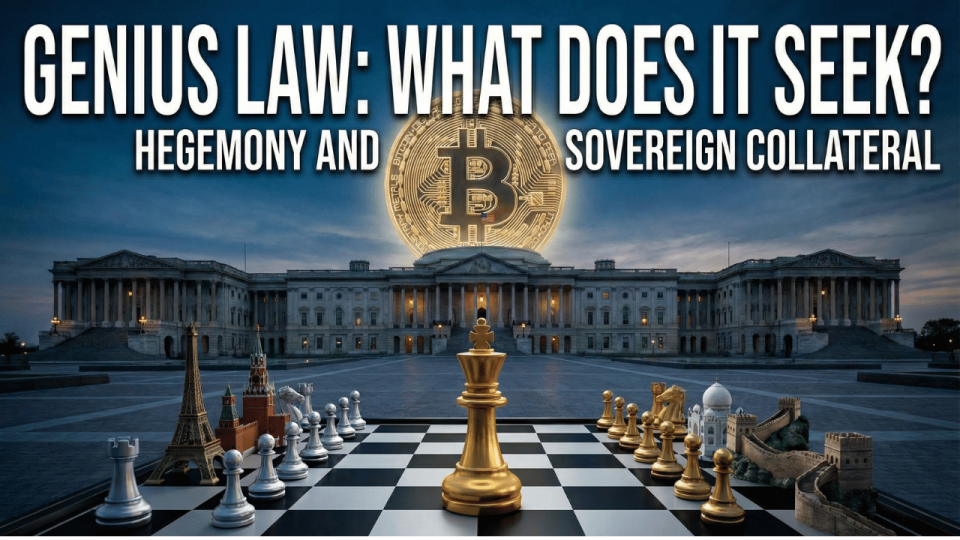
What we are witnessing with the implementation of a Strategic Bitcoin Reserve is not a validation of the technology per se, but a defensive move for the U.S. Dollar. While social media enthusiasm focuses on price action, the underlying reality suggests that the United States has initiated a game of geopolitical chess where Bitcoin ceases to be a speculative asset and becomes sovereign collateral. The question is no longer whether the price will rise, but which nation will dare to remain with zero exposure while the world’s leading economy absorbs the floating supply.
Weaponizing the Ledger: Data on Sentiment
To understand the magnitude of the GENIUS Act, we must look beyond the headlines and interpret structural flows. The legislation, which authorizes the U.S. Treasury to acquire up to 1 million BTC over a five-year period, fundamentally alters the asset’s supply and demand dynamics.
Under this prism, the market is no longer free in the traditional sense. According to recent on-chain data, the mere anticipation of these state purchases has caused Bitcoin supply on exchanges to drop to lows not seen since 2018. However, the critical metric is not scarcity, but institutional concentration. By establishing a program of scheduled purchases, the U.S. government has effectively created a “put” (implicit sell option) in the market. Unlike purchases by MicroStrategy or Tesla in previous cycles, the buyer here has the capacity to print the currency with which they purchase the scarce asset. This breaks the traditional correlation with the NASDAQ.
Sources close to G7 financial meetings indicate that the American maneuver has generated unease in Frankfurt and Tokyo. If the United States holds 5% of the total Bitcoin supply, any appreciation of the asset strengthens its national balance sheet to the detriment of holders of traditional fiat debt. Parallel to this, the GENIUS Act covers not just the purchase of the asset, but the protection of its production.
By classifying Bitcoin mining as critical energy infrastructure, it removes the regulatory barriers that suffocated the sector in 2022-2024. As a recent capital flow analysis report notes, “the entry of a sovereign actor with unlimited issuance capacity to acquire an asset of inelastic supply is an unprecedented event in modern economic history.”
Historical Context: From “Nixon Shock” to “GENIUS Lock”
To contextualize this move, it is imperative to look back to 1971. When Richard Nixon closed the gold window, he unmoored the dollar from the tangible, inaugurating the era of pure fiat currency. The GENIUS Act of 2026 could be interpreted as the structural inverse of that event: the partial re-anchoring of economic might to a “proof-of-work” asset.
In 2017, the market was driven by retail frenzy (ICOs). In 2020-2021, it was the corporate “inflation hedge” thesis. Today, the structural difference is implicit coercion. In previous cycles, a country could ignore Bitcoin. Today, if the dominant superpower accumulates it as a reserve, ignoring it becomes a national security risk. The United States is not legitimizing Bitcoin; it is de facto nationalizing it to prevent a rival (such as the BRICS) from using it against them. It is crucial to understand that this is not a repeat of El Salvador’s adoption. That was a financial inclusion experiment; this is a strategy of collateral domination.
Counterpoint: The Risk of Excessive Centralization
Even so, it would be intellectually dishonest not to address the systemic risks this legislation entails. Critics of the GENIUS Act, rightly so, argue that the accumulation of 1 million BTC in the hands of the U.S. government (added to the more than 200,000 already seized previously and held by the DOJ) attacks the decentralized ethos of the network.
There is a plausible scenario where this “state adoption” is, in reality, a Trojan horse for total regulatory capture. If the United States controls a significant portion of the supply and dominates the hash rate through regulated public miners (MARA, CORZ, RIOT), the network’s censorship resistance could be compromised. Furthermore, should the administration shift its political stance in the future, the threat of a massive sell-off by the Treasury would hang like a Sword of Damocles over the market, introducing a political volatility that Bitcoin was designed to avoid.
Conclusion: The Superpower Hypothesis
In conclusion, the GENIUS Act does not turn the United States into the “crypto capital” out of a love for freedom, but out of strategic necessity. The vision of a free and decentralized market now faces the reality of Realpolitik.
My hypothesis is as follows: If the execution of Treasury purchases remains constant over the next two quarters without selling interventions, we will see a definitive decoupling of Bitcoin from traditional risk assets. However, if other economic powers respond with prohibitionist regulations rather than competitive accumulation, we could enter a phase of global liquidity fragmentation, where Bitcoin’s value depends geographically on its legal status. The game has changed. It is no longer about “HODL” to buy a Lamborghini, but about holding reserves to ensure national sovereignty. And in this game, the United States has just made the first aggressive move.
