
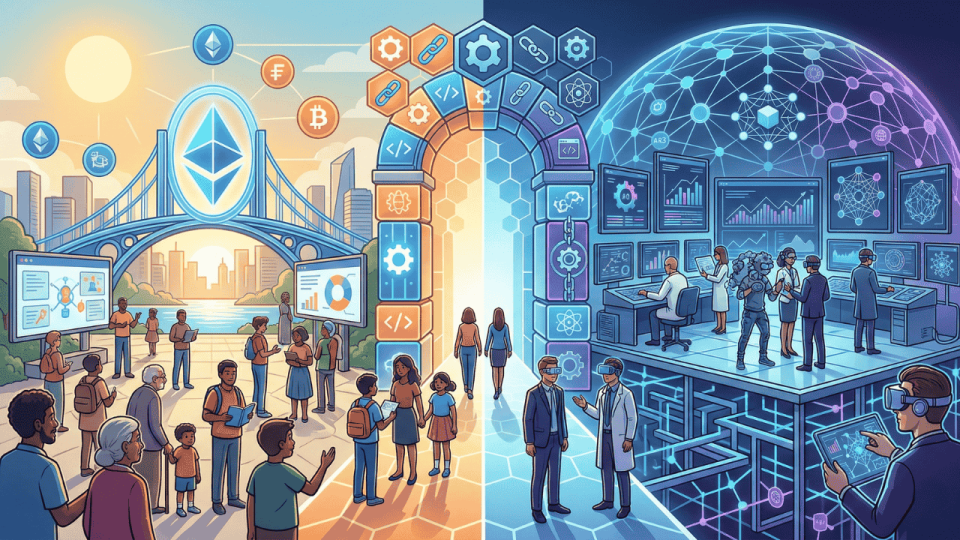
The crypto narrative maintains that decentralization is, by definition, democratic. It is argued that permissionless networks eliminate historical banking barriers. However, this view is a naive technocentrism. Without Web3 education, the technical infrastructure is insufficient to reduce real financial inequality today in 2026 across emerging global markets.
The underlying reality suggests that technology without deep knowledge only manages to deepen the existing gap. A “digital feudalism” arises where only experts capture the value. For blockchain to be inclusive, digital literacy is the determinant of economic sovereignty in the 21st century, preventing new unfair hierarchies.
The myth of technical democratization and the reality of data
According to the World Bank Global Findex Database 2025, 84% of adults in emerging economies own mobile phones. However, connectivity does not guarantee financial health. On-chain data reveals that yields remain concentrated in nodes belonging to developed economies, effectively perpetuating the long-standing global wealth gap.
The Chainalysis 2025 Report shows massive organic adoption in Nigeria and India. However, without training in private key management, these populations remain vulnerable to extreme volatility. Education acts as a firewall needed to manage personal wealth effectively in the new decentralized global economy and its networks.
Under this prisma, information asymmetry perpetuates persistent cycles of digital poverty. While DeFi protocols allow global access to capital, the lack of understanding regarding liquidation risk generates irreversible losses for retail users. Education must scale at the same pace as the total value locked within current smart contracts.
At the same time, the rise of rwa tokenization requires an unprecedented level of technical sophistication for the retail investor. It is not enough to own a token; it is imperative to understand governance and legal rights. Without training, the small investor is excluded from the most significant institutional gains.
Far from being a coincidence, countries with regulatory frameworks that encourage crypto education have lower rates of mass fraud. Regulation should not only protect but also incentivize protocol understanding. An educated user is the defense against systemic instability within modern emerging markets and their digital financial systems.
Lessons from history: From connectivity to economic sovereignty
Historically, network infrastructure in the 1990s expanded globally, but benefits concentrated among those who mastered the software. One example is M-Pesa in Kenya. Social mobility requires entrepreneurial capacity, not simply consuming technology in a passive manner as happens in many of today’s developing markets.
The fundamental difference in 2026 lies in the direct ownership of the sovereign digital asset. Recent studies in Scilit on blockchain technology highlight that digital financial literacy drastically minimizes transaction costs. Without this catalyst, the cost of learning via mistakes is prohibitive for the most marginalized social sectors.
In other words, Web3 education is the soft infrastructure that supports the technical architecture. Communities that manage to implement decentralized financial literacy programs will see an increase in their economic resilience. Those that only adopt technology will remain dependent on external capital and the interests behind it.
Adopting financial tools without educational context often leads to a dependence on centralized platforms that charge high fees. This defeats the original purpose of Web3. Economic sovereignty requires technical autonomy, something that is only achieved through rigorous, constant, and accessible formative processes for the general public.
If we observe institutional flows, we notice that large firms invest millions in understanding consensus mechanisms. The average user, however, is often guided by superficial narratives. This cognitive disadvantage is a risk that decentralized autonomous organizations must mitigate through specific and transparent educational funding.
The risk of abstraction and the fallacy of simplicity
Some critics argue that technical complexity is an insurmountable design flaw for today’s average user. From this perspective, the solution would be account abstraction to hide complex processes. While user experience must improve, delegating total control invalidates the very essence of decentralization and its fundamental goals.
If the user ignores the difference between a custodial wallet and a non-custodial one, third-party dependence persists. Furthermore, if advanced educational material remains only in English, Web3 will consolidate a dominant global technical elite instead of redistributing economic power to the Global South effectively and fairly.
Under this scenario, the thesis of education as a leveler would be invalidated if access to knowledge is excessively monetized. If high-quality courses are expensive, Web3 will simply replicate the exclusionary educational model. Knowledge must be as decentralized as the technical protocol that users are trying to operate.
Simplifying the interface without educating the user creates a false sense of technical security. Protocols that prioritize marketing over community training are building on sand. True inclusion requires conscious users who understand what is happening behind every digitally signed transaction on the public network.
The danger of “extreme simplicity” is that it turns the user into a passive subject, unable to audit their own finances. Web3 was born to grant control, not to hide responsibilities. Education is the necessary bridge between ease of use and individual financial security in the digital age.
Toward a new social contract based on knowledge
Consequently, reducing inequality through Web3 is a technical possibility, but not an absolute historical certainty. If literacy in decentralized protocols does not exceed 30% in emerging markets by 2027, wealth will concentrate again in a few hands, repeating the errors of the traditional financial system.
Finally, if institutional capital flows persist without a parallel educational effort, the social gap will increase significantly. The industry must choose between creating liquidity consumers or sovereign financial citizens. Success depends on this decision, both ethical and strategic, regarding the distribution of specialized protocol knowledge.
This evolution requires that DAOs allocate significant budgets to the translation and cultural contextualization of their technical documents. Education cannot be an annex; it must be the core of development. Only then will capital stop flowing solely toward traditional technical power centers of the developed world.
If educational adoption levels grow, we will see a structural change in remittances and global savings. Real empowerment does not come from the application, but from the understanding of the system. Web3 will rewrite the economy provided the user manual is shared by everyone in an equitable way.
