CeDeFi’s Glass Ceiling: Is Binance’s Dominance a Drag on Real Innovation?
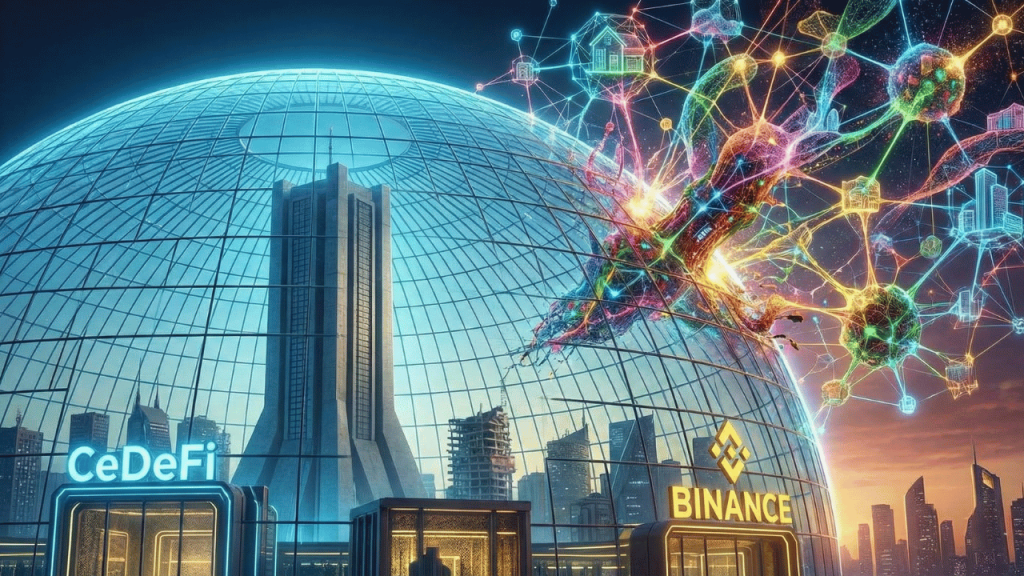
The prevailing narrative in 2026 presents Binance as the undisputed victor of crypto industrialization. With a user base exceeding 300 million, the network has established itself as the primary entry port for massive global capital flows and the retail sector at large in this cycle.
However, the underlying reality suggests that this operational efficiency masks a profound structural risk for the ecosystem. By relying on a consensus architecture based on proof of staked authority, the network prioritizes transaction speed over the censorship resistance that defines the very essence of blockchain technology.
Everything points to the fact that hegemony in strategic sectors like rwas is not a result of technical superiority. Instead, it is the gravitational force of its liquidity that attracts projects which, in neutral conditions, would seek much more decentralized, sovereign, and open development environments.
Through this lens, the value of tokenized assets on the BNB network has surpassed 2.15 billion dollars this year. This growth is driven by the integration of institutional funds that use these assets as direct collateral within their centralized trading platforms and diverse liquidity pools.
The capture of Artificial Intelligence and Tokenized Assets
At the same time, the explosion of ai agents and the development of middleware raises reasonable doubts about total data transparency. Financial systems based on AI could become dangerously opaque if they depend entirely on a validation infrastructure that is controlled by a single predominant global operator.
Far from being a coincidence, the rise of traditional assets in controlled environments responds to a need for accelerated regulatory compliance. The implementation of specific policies in 2025 allowed Binance to operate under a surveillance model that sacrifices individual privacy for the sake of institutional safety and control.
In other words, there is a risk of building a financial system that simply replicates traditional banking inefficiencies. If technological innovation can only occur under the permissions of a central operator, the original promise of sovereignty and decentralized finance is effectively lost for good on the way.
To explore the technical expansion, the official BNB Blockchain Roadmap 2026 details how they plan to scale to 20,000 transactions per second. However, this scalability does not resolve the ethical dilemma regarding the extreme centralization of computing power within a single entity.
Historical Context: From 2020 Pragmatism to 2026 Centralization
The current situation evokes the 2020 cycle, when the launch of the then Binance Smart Chain saved the retail sector. At that time, the project’s success proved that the mass market always prioritizes immediate accessibility over any kind of ideological purity or advanced technical decentralization.
Nonetheless, history teaches us that infrastructure monopolies tend to stagnate without real competition. While they have facilitated the entry of corporate capital, their dominance over stablecoin flows grants the exchange an absolute veto power over general market liquidity and organic growth in the long term.
Compared to events like the Reuters historical report on Mt. Gox’s collapse, Binance has shown an operational resilience that is noteworthy. It has achieved historic settlements with global authorities that have allowed it to stabilize its dominant position while other competitors vanished under extreme pressure.
Under this scenario, the argument in favor of centralization is that it acts as a necessary bridge for mass adoption. Proponents of this view argue that decentralization is a spectrum and that Binance occupies the optimal point of utility for the average user seeking immediate returns.
Operational Efficiency as a Necessary Evil
To be intellectually honest, critics of the centralized model often ignore the unbearable friction of open alternatives. Without this coordinated ecosystem, it is very likely that mass adoption of rwa tokenization by retail investors would be a non-existent process in the complex market of 2026.
The network offers an account abstraction layer and immediate liquidity that other chains are still seeking. Users prefer a smooth and cheap experience over understanding the technical intricacies of node governance or the actual distribution of computing power within a specific and isolated blockchain network.
According to the analysis of the SEC’s Project Crypto and the Atkins Framework, regulatory clarity has favored these hybrid environments. This trend suggests that traditional financial institutions prefer partners with a “face and name” to manage their large digital treasuries.
Consequently, long-term success should not depend on exclusivity, but on the ability to act as neutral infrastructure. The reality is that the market will always seek the path of least resistance, even if that path compromises the individual sovereignty of all its active and passive participants.
The Legacy Infrastructure Hypothesis
The thesis that this ecosystem drives innovation will only hold if the system allows for real technical competition. If capital flows persist but the validator set is not expanded in an open way, the network runs the risk of becoming permanently stagnant legacy infrastructure for the industry.
The conditional hypothesis suggests that if institutional capital in tokenized assets exceeds 5 billion without decentralization, there will be flight. Smart capital will seek refuge in modular networks where regulatory capture is much more difficult for governments and central entities to execute or enforce against users.
The challenge for 2026 is not merely about processing a higher amount of transactions per second. The strategic priority must be proving that these transactions cannot be censored by a single global actor that currently holds a dominant and undisputed market position in the crypto space.
Under this prism, true financial innovation will not be dictated by speed, but by data sovereignty. The market will soon decide whether it prefers the comfort of a corporate golden cage or the freedom of truly open and resilient decentralized protocols in the future.