Algorand and Post-quantum Cryptography: Technical Shield or Institutional Survival Strategy?
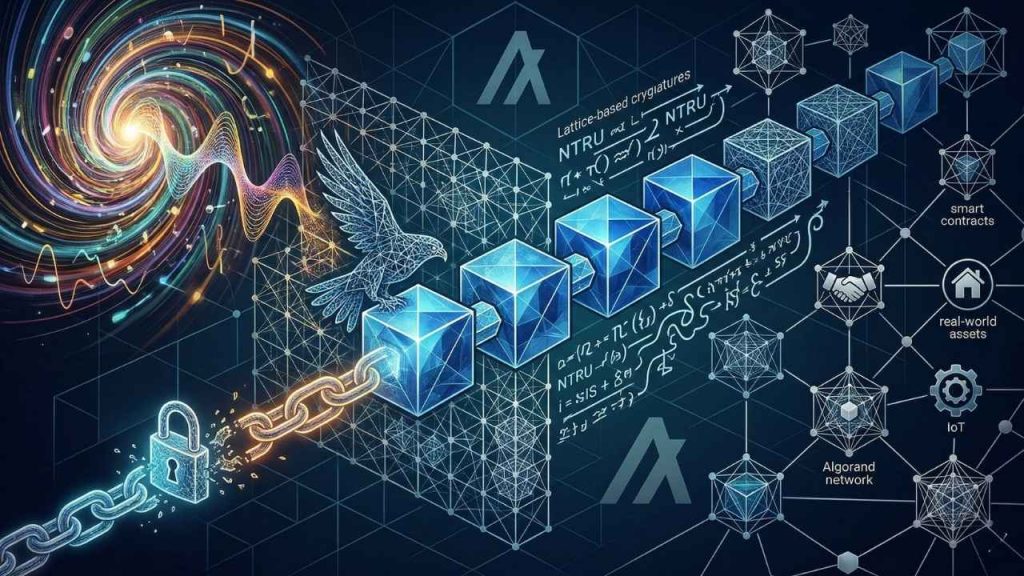
The acceleration in the development of quantum processors has ceased to be a theoretical concern to become a systemic risk. Post-quantum cryptography emerges as the only viable defense against the computing power that could compromise current digital signatures in distributed networks.
While Bitcoin and Ethereum operate under traditional elliptic curve schemes, the Algorand ecosystem has integrated native solutions. This technical advantage suggests that the network not only seeks efficiency but also to guarantee the inviolability of assets over the long term against future computational threats.
The vulnerability of traditional encryption systems
Shor’s algorithm represents the most forceful threat to the security of conventional blockchain technology. According to research published on the Google Research portal, the ability to factor large prime numbers would allow compromising private keys from public addresses visible on the ledger.
This scenario, known as “Y2Q,” implies that any network that does not transition towards post-quantum cryptography will face sudden obsolescence. Attack vectors focus on intercepting transactions before confirmation, where quantum computing power would overcome any standard cryptographic defense capability.
This risk is particularly acute in networks with slow update protocols or fragmented governance processes. The danger of quantum computing for Bitcoin shows that migrating trillions of dollars in value requires a near-perfect technical consensus that currently seems distant for older blockchains.
Algorand and the implementation of Falcon signatures
Unlike its competitors, Algorand has implemented the Falcon signature standard within its state proofs. This algorithm was selected by the National Institute of Standards and Technology (NIST) as one of the foundations of post-quantum cryptography due to its efficiency and reduced key size.
Algorand’s architecture allows these signatures to verify block validity independently of the main network. This ensures that cross-chain communication is resistant to quantum attacks, an essential component for future interoperability. The integration of Algorand’s post-quantum technology demonstrates a commitment to structural security.
The use of state proofs allows external applications to trust the network’s state without needing full nodes. This feature is fundamental to attracting capital flows that demand military-grade security standards. Consequently, the network positions itself as a bastion for high-security rwa tokenization.
Migration challenges in first-generation networks
The process of updating a global network without interrupting its operational activity is extremely complex. While Algorand was born with a modular structure, other networks must face contentious forks. Google warns about post-quantum cryptography noting that the margin for legacy systems decreases drastically every year.
In previous cycles, such as 2017 or 2021, the priority was scalability and yield farming. However, the current landscape prioritizes cryptographic resilience against the progress of firms like IBM and its quantum roadmap, which projects systems with more than one thousand qubits by year-end.
Financial history demonstrates that systems ignoring structural technological changes are often displaced by more agile innovations. Post-quantum cryptography is not a technical luxury but the foundation on which institutional trust will be built. Without effective migration, the integrity of financial data will be at permanent risk.
The “harvest now, decrypt later” scenario
There is a critical practice known as harvest now, decrypt later, where malicious actors store encrypted data today. The goal is to decrypt this sensitive information once quantum computers are fully functional. Under this prism, post-quantum cryptography must be implemented immediately, even before quantum supremacy.
Organizations handling long-duration data, such as government records or legal contracts, are already evaluating networks with these protections. Algorand, through its technical documentation on State Proofs, offers a framework where information stored today will remain secure next decade, neutralizing any retrospective decryption attempt.
Ignoring this trend could lead to a loss of institutional investor confidence in digital assets. Conversely, platforms that have already passed security tests from the Internet Engineering Task Force (IETF) for signature algorithms, like Falcon, gain a hard-to-ignore competitive advantage.
The response from detractors and technical limits
There are voices that consider the quantum threat to be a remote and overestimated possibility. Some experts argue that error correction in quantum computers is a physical challenge that could take decades to solve. In this scenario, Algorand’s post-quantum cryptography would be a premature solution for a non-existent problem.
While it is true that implementing heavier algorithms can affect latency, Algorand has mitigated this technical effect. However, if quantum development were to stall, the resources invested in these defenses could have been used to improve ecosystem liquidity. The balance between security and utility remains an open debate.
Nevertheless, the cost of inaction far outweighs any expenditure on preventive development today. The history of cybersecurity is full of robust systems that collapsed by not foreseeing the increase in computing power. Post-quantum cryptography acts as an indispensable insurance policy for the preservation of digital value.
If quantum computing development maintains its current pace, networks that already integrate Falcon solutions will be the only ones eligible for state infrastructure. The resilience demonstrated by Algorand against theoretical attacks suggests technical superiority for critical applications. Only if institutional interest in maximum security fades would this advantage lose its market relevance.