
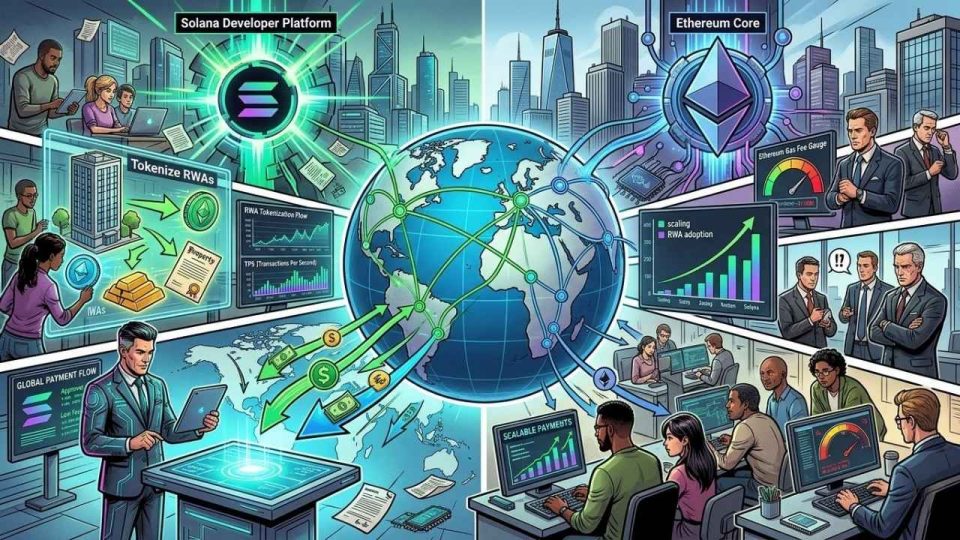
The landscape of distributed ledger technology is undergoing a paradigm shift where operational efficiency has displaced theoretical decentralization as an institutional priority. The Solana Developer Platform has emerged as the axis of this movement, offering an infrastructure capable of processing commercial volumes that current modular models still cannot achieve fluidly within their fragmented ecosystems.
Through this lens, the industry is witnessing a shift of capital and talent from fragmented ecosystems toward single-state solutions. The current scenario suggests that atomic execution capability is the determining factor for companies deciding to migrate their financial operations to a public and highly programmable global settlement layer capable of handling institutional demand.
Integrated Architecture vs. Modular Fragmentation
The primary competitive advantage presented by the Solana Developer Platform lies in its monolithic approach optimized for transaction parallelism. Unlike Ethereum, which has delegated its scalability to multiple second-layer networks, this ecosystem maintains total network state synchronization in every produced block by the validators across the entire global network.
Far from being a coincidence, this design allows companies to avoid risks associated with cross-chain bridges and liquidity dispersion. Consequently, the implementation of complex financial services becomes much simpler when operating on a unified code base that does not require managing technical interoperability between divergent layers and different consensus mechanisms.
In other words, Solana’s infrastructure eliminates the technical friction suffered by enterprise applications on saturated networks. By guaranteeing confirmation times of less than one second, the network allows traditional payment systems to find a viable and superior substitute for the obsolete banking rails that currently dominate the global commercial landscape.
Tokenization of Real World Assets (RWA) at Institutional Scale
The convergence between traditional finance and the blockchain has found a strategic ally in this network for the issuance of securities. To understand the scope of this trend, it is vital to analyze what are RWAs in crypto and how the Solana Developer Platform facilitates regulatory compliance through advanced and flexible token tools.
Corporate adoption is reflected in major moves such as the Franklin Templeton Digital Assets Technology initiative, where the firm utilizes the network to manage investment funds. This level of integration proves that institutions seek deterministic execution environments and transaction costs that do not fluctuate unpredictably during periods of high demand from retail users.
At the same time, the network allows real-world assets to benefit from immediate secondary liquidity without relying on slow intermediaries. This ability to program digital ownership with intrinsic compliance rules turns the platform into the de facto standard for the new economy of tokenized assets on a global scale for financial entities.
Payments and Settlement: The Use Case Ethereum Could Not Hold
Technical superiority in data processing has allowed financial giants to integrate their operations directly. The Visa Deep Dive on Solana highlights that the network is capable of handling the throughput necessary for mass settlement systems, overcoming structural limitations observed in previous smart contract protocols that lacked sufficient parallel processing.
While Ethereum’s legacy is unquestionable, its current architecture hinders retail payment adoption due to variable fees. In contrast, the Solana Developer Platform offers cost predictability that allows companies like PayPal to launch their Official PayPal PYUSD Announcement with unprecedented economic efficiency within the current cryptocurrency sector for end-user applications.
In other words, the network has positioned itself as the preferred transport layer for next-generation regulated stablecoins. The native integration of USDC Infrastructure on Solana facilitates businesses settling invoices and cross-border transactions in seconds, eliminating counterparty risk associated with traditional financial messaging systems and the delays of the correspondent banking network.
The Impact of ZK Compression on Enterprise Operating Costs
One of the largest obstacles to massive enterprise adoption has been the cost of on-chain data storage. The Solana Developer Platform has addressed this issue through ZK Compression Technical Documentation, an innovation that drastically reduces the expense of maintaining account states for millions of simultaneous users without compromising the integrity of the data.
Through this lens, corporations can manage massive customer databases with a marginal cost that is practically zero compared to other networks. While significant investment in rent-exemption fees was previously required, this technology ensures that economic scalability is achievable and sustainable for projects with long-range global ambitions in the institutional market.
Concurrently, the reduction in network resource usage does not compromise the security or integrity of processed information. Consequently, the use of zero-knowledge proofs to compress data allows the network to be orders of magnitude more efficient than its direct competitors, consolidating its technical lead in the corporate market today.
Liquidity Fragmentation: Ethereum’s Obstacle
The scalability strategy based on layers has caused a disconnection that negatively affects the institutional user experience. It is fundamental to understand the yield schism to comprehend how capital dispersion among different protocols reduces the global financial efficiency of decentralized systems that operate under fragmented and isolated liquidity pools.
Unlike this scenario, the Solana Developer Platform maintains a unified liquidity market where every asset is immediately accessible. This cohesion prevents companies from having to fragment their reserves across multiple networks, allowing for optimized treasury management and much deeper, less volatile order execution for large institutional investors and corporate funds.
Compared to the 2021 cycles, where congestion paralyzed operations, the network has demonstrated remarkable technical maturity in its latest updates. The focus on robustness has allowed the financial sector to trust Solana as enterprise-grade critical infrastructure, capable of supporting mission-critical applications without significant technical interruptions for the users.
Hardware Risks and the Technical Counterpoint
Critics of this thesis argue that network speed is achieved at the cost of higher hardware requirements for node operators. They contend that the requirements to operate a validator on the Solana Developer Platform exclude smaller participants, concentrating power in the hands of entities with massive computing capabilities and significant financial resources.
However, the enterprise perspective values reliability and performance over absolute decentralization that proves inoperative for actual trade. The fact suggests that a necessary balance exists where the network is secure enough to protect billions of dollars while maintaining technical agility unreachable for other ecosystems currently focused on modular architectures.
On the other hand, governance and execution client diversity are improving with the launch of new independent technical implementations. This reduces systemic failure risks and ensures the infrastructure can evolve according to corporate needs, maintaining censorship resistance suitable for today’s regulated financial operations within the increasingly complex global regulatory framework.
Toward a Global Infrastructure Standard
The success of enterprise adoption depends not only on speed but on the ability to create products that work invisibly. The Solana Developer Platform is achieving this milestone by allowing crypto technology to act simply as an invisible data rail and extremely efficient tool for global commerce without friction or complex hurdles for the end-user.
If the integration of tokenized assets by major banks exceeds the $100 billion threshold before 2027, the hegemony will be indisputable. The ability to attract persistent institutional flows depends on maintaining this consistency in technical performance and continuing to lower entry barriers for new developers who want to build corporate solutions.
If the ecosystem manages to maintain its operational stability while Ethereum continues to struggle with its layers, the game will have changed. The situation indicates that the future of RWAs and mass payments will be built on the technical capacity demonstrated today by integrated platforms that prioritize efficiency over the inherent complexity of fragmentation.
