
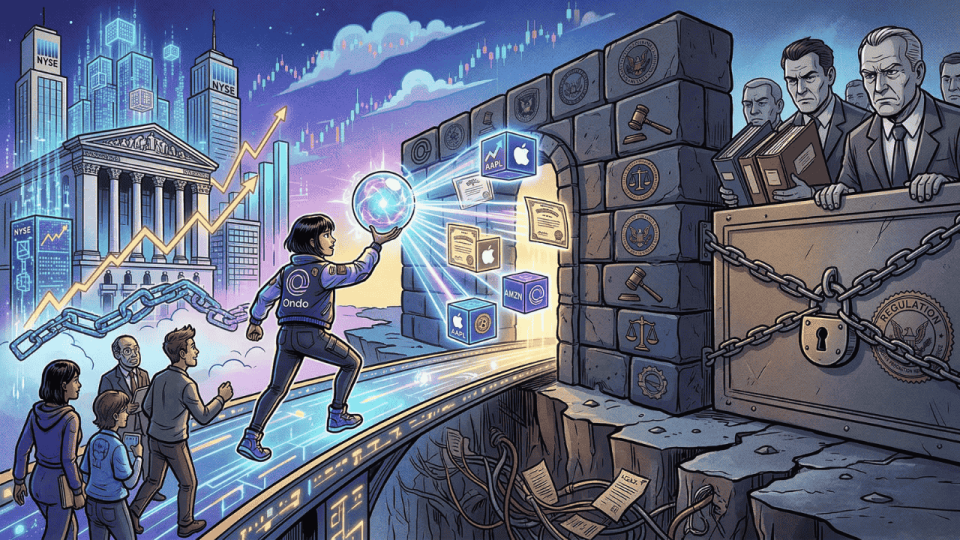
The promise of migrating traditional stock markets toward the blockchain has evolved drastically today. Everything indicates that Ondo Finance currently leads the global stock tokenization, establishing a hybrid infrastructure that profoundly transforms how modern institutional capital operates globally across the entire interconnected digital economy.
Far from representing an anarchic revolution, this massive adoption demands questioning the ecosystem’s true nature. Analyzing the tokenized BUIDL fund launch backed by major financial giants, it becomes clearly evident that the cryptographic industry is rapidly building a blockchain facade of traditional systems.
The architecture behind the onchain Wall Street
The integration of conventional financial assets into cryptographic rails accelerates at unprecedented speeds. Under this prism, the underlying infrastructure for tokenized real world digital assets is consolidating as the definitive technological bridge designed to capture the massive global liquidity stemming from highly sophisticated corporate investors.
Institutional metrics reveal a resounding paradigm shift within the broader digital financial market. As detailed in recent reports where tokenized stocks surpass 1 billion, the traction these regulated platforms generate has surpassed historical market growth expectations significantly during the current macroeconomic and digital financial cycle.
The purely speculative paradigm of yield farming has died, replaced by sustainable and regulated yields. By deepening the detailed Ondo Finance analysis, it is proven that capturing the profitability of United States Treasuries through the official Treasury market constitutes its primary structural competitive advantage.
To sustain this immense operational volume, robust strategic alliances are absolutely vital for the ecosystem. The direct and undeniable dependence on Wall Street corporate institutional reserves demonstrates that developers actively prioritize traditional financial solidity over native cryptographic experiments that lack any tangible and verifiable monetary backing.
The clash against the relentless regulatory barrier
Issuing conventional financial securities on a public blockchain demands absolute and uncompromising legal rigor. Official guidelines issued by federal regulators consistently confirm that no technological innovation will ever exempt the strict compliance with federal regulations that traditionally govern the commercialization of corporate stock market assets.
Consequently, the operational model implemented by these digital platforms requires exhaustive surveillance mechanisms. Institutional capital participation is strictly conditioned upon rigorous controls where thorough identity verification and legal compliance permanently destroy any remaining illusion of transactional anonymity within this supposedly public new digital environment.
This strict corporate alignment resonates very positively within the highest spheres of global capital. Central bankers eagerly anticipate that this digital infrastructure will undoubtedly form the next generation of financial markets, enabling almost instantaneous atomic settlements and an operational efficiency that drastically reduces administrative costs.
Exhaustive research regarding inherent systemic risk strongly supports this conservative approach adopted by the industry. Technical documents like the financial stability implications assessment elaborated by the Federal Reserve, highlight exactly how institutional tokenization mitigates credit risks by demanding instant settlement backed by highly liquid assets.
Lessons from the past: From speculative chaos to order
Analyzing this contemporary financial phenomenon requires a necessary historical contrast with past speculative cycles. If we clearly remember the 2017 funding fever, that widespread speculative bubble without real backing completely lacked the legal and institutional scaffolding that completely dominates the digital capital landscape today.
Direct government intervention marked a definitive turning point for the entire global cryptographic ecosystem. The historical investigative report on DAO tokens published by the securities commission established that securities legislation applies to cryptoassets, annihilating the popular notion of a legally untouchable decentralized economy forever.
At that specific moment, the main ideological premise consisted of evading and replacing the banking sector. Concurrently, our contemporary reality clearly demonstrates that a strategic alliance with Wall Street is absolutely indispensable to scale any technological solution of tokenized assets toward a truly sustained massive global adoption.
The structural maturation of the financial sector is entirely undeniable at this stage of technological development. While previous bullish cycles provided abstract technical innovation, today we witness the active construction of an institutional infrastructure of this cycle, prioritizing absolute legal security over unregulated anonymous financial freedom.
The inherent vulnerability of permissioned digital systems
Those who fiercely defend decentralized orthodoxy validly point out the hidden systemic risks of the model. They strongly argue that relying on centralized traditional custodians inevitably creates catastrophic single points of failure, compromising the immutable value proposition that originally drove the creation of public blockchain networks.
If a federal regulatory authority orders the preventive freezing of certain corporate funds, the underlying smart contract will obediently comply. Put another way, the evident loss of censorship resistance capabilities invalides the fundamental concept of truly sovereign programmable digital money, free from any direct state interference.
While it is certainly true that this philosophical vulnerability exists permanently, the underlying reality suggests pragmatic adaptation. Large-scale institutional capital will never operate in environments without clear legal guarantees, gladly accepting to sacrifice technical decentralization in exchange for obtaining an ironclad corporate legal protection globally.
The conditionally driven future of corporate digital liquidity
Everything reliably points to the definitive result being a massive interconnected hybrid financial ecosystem. These corporate projects do not seek to destroy traditional banking, but rather execute a technological upgrade of financial systems, optimizing their antiquated operational conduits to transition smoothly toward a globalized digital era.
The evaluation of global liquidity fragmentation reveals an urgent technical challenge today. Integrating these currently isolated corporate ecosystems will require highly robust interoperability standards, guaranteeing that capital flows without technical restrictions between multiple public chains and private banking networks under strict compliance frameworks.
The definitive long-term consolidation of this model will heavily depend on short-term macroeconomic evolution. If international regulatory frameworks stabilize and the institutional flows persist with strength during the next calendar year, the corporate adoption of tokenized real world assets will be absolutely validated before the global market.
