
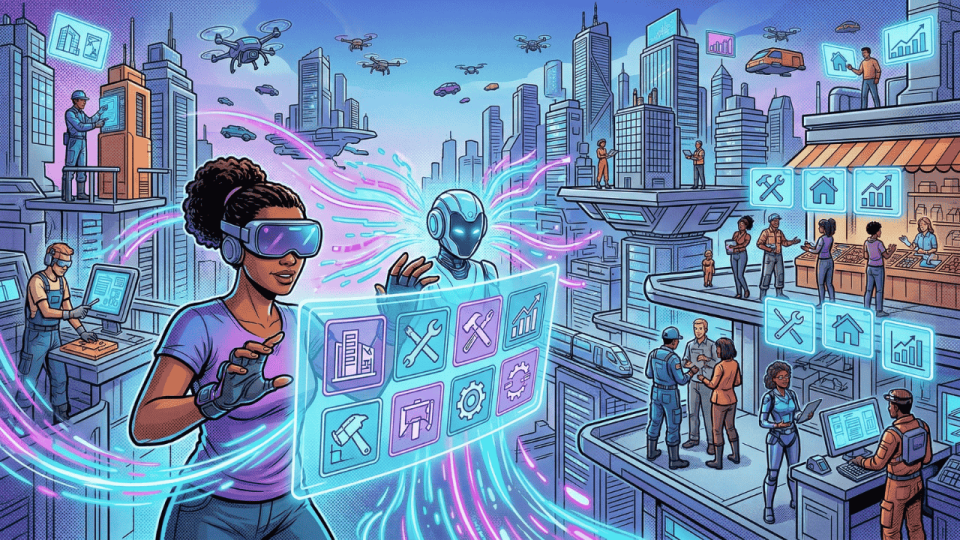
The narrative that sentenced the metaverse to death following the rise of generative AI turns out to be a superficial reading of cycles. The underlying reality suggests we are witnessing a necessary metamorphosis toward infrastructure of spatial computing, far from the empty speculation that dominated previous years.
Without the capacity to process massive data and generate automated content, immersive environments were doomed to operational failure. AI has not come to replace this technology, but to rescue it through the optimization of technical processes that were previously financially unfeasible for any modern digital ecosystem.
Virtual Architecture Automation and Dynamic Design
The main obstacle to mass adoption was always the lack of dynamic content. Historically, creating virtual worlds required armies of designers. However, the implementation of artificial intelligence allows environments to self-generate, drastically reducing production times and capital costs for global developers and companies.
According to the McKinsey report on value creation in the metaverse, the economic impact could reach trillion-dollar figures. This technical scalability is only possible if procedural asset creation is achieved, transforming the supply of virtual spaces into a real-time algorithmic response.
This evolution transforms the concept of user-generated content into structures co-created with machines. We are no longer talking about simple avatars, but high-fidelity virtual architectures with zero marginal costs. AI eliminates the developer’s creative friction, allowing the spatial economy to thrive in the long term.
Under this prism, technological convergence facilitates users experiencing an unprecedented technical immersion. Far from being a coincidence, the alignment of these tools defines Web 4.0 as a standard, where artificial intelligence acts as the logical rendering engine for every human interaction.
From Static NPCs to Synthetic and Operational Consciousness
One of the biggest failures of the early metaverse was the feeling of absolute loneliness. Non-player characters were mere decorations. Today’s reality, driven by intelligent agents, allows synthetic inhabitants to possess memory and negotiation skills, significantly improving final user retention across all platforms.
This evolution of synthetic consciousness is fundamental for sectors such as advanced e-commerce. Interaction must be fluid and contextually relevant to justify the use of extended reality hardware. Without autonomous agents, the metaverse would lack the social density necessary to survive in the digital era.
In parallel, the industrial field has found its most pragmatic application in digital twins. Leading companies use the Omniverse platform for industrial simulation, where AI processes physical laws. This allows the metaverse to be a vital operational efficiency layer for contemporary global logistics.
In other words, high-precision simulation allows for saving billions of dollars in preventive maintenance. Artificial intelligence provides these digital twins with unparalleled predictive capacity, transforming simple graphic representations into strategic decision-making tools for corporate boards of directors and technical teams.
Computational Infrastructure and Web 4.0 Deployment
This resurgence cannot be analyzed without observing the graphic processing capacity. The demand for units to train models is the same required for rendering virtual worlds. Therefore, the development of massive data centers paves the way for immersive experiences in the cloud for everyone.
The official document on the strategy for Web 4.0 from the European Commission highlights technological sovereignty. Interoperability and computational power are the pillars of future connectivity, where AI manages the immense complexity of massively generated spatial data globally.
The integration of artificial intelligence at the edge ensures that the environment’s response occurs in milliseconds. This low latency is indispensable for the viability of persistent environments, allowing the metaverse to function as a robust and decentralized operating system for the entire global society.
Lessons from the Past and the Technical Maturity Cycle
To understand the present, it is imperative to remember the virtual land bubble of 2021. That narrative lacked a solid technical foundation. A clear parallel is found in the dot-com bubble burst, where ideas were correct but the infrastructure was non-existent back then.
Today, AI provides the intelligent software layer that was missing for commercial success. Research published in IEEE Xplore on technological convergence shows that machine learning solves critical rendering problems. Current investment is structural in data centers, not purely speculative as before.
Unlike previous cycles, today’s technology allows for a transparent transition between worlds. The metaverse has surpassed the trough of disillusionment to enter a phase of real productivity, driven by computer vision algorithms that provide coherence to the final user experience worldwide.
The Risk of Centralization and Data Sovereignty
It is necessary to recognize that this convergence is not free from critical risks. The concentration of power in infrastructure providers could create an unprecedented digital panopticon. If AI manages what we see, the risk of algorithmic manipulation grows exponentially in immersive environments daily.
Under this scenario, if privacy standards do not evolve, the metaverse could be invalidated. The viability of this ecosystem depends on the regulation of artificial intelligence, limiting the power of proprietary models to protect the individual sovereignty of citizens on the net.
Reality suggests that without transparent and decentralized governance, freedom would be lost. Therefore, technical development must be accompanied by a robust and ethical legal framework, ensuring that artificial intelligence serves the user and not only the interests of large corporations globally.
If investment flows in semiconductors remain high for two years, the convergence will be total. The metaverse did not need more hype, but a functional brain. Artificial intelligence is the organ that will finally grant utility, economy, and a clear purpose to the new digital frontier.
