Can Securitize Become the “Nasdaq” of Tokenized Assets?
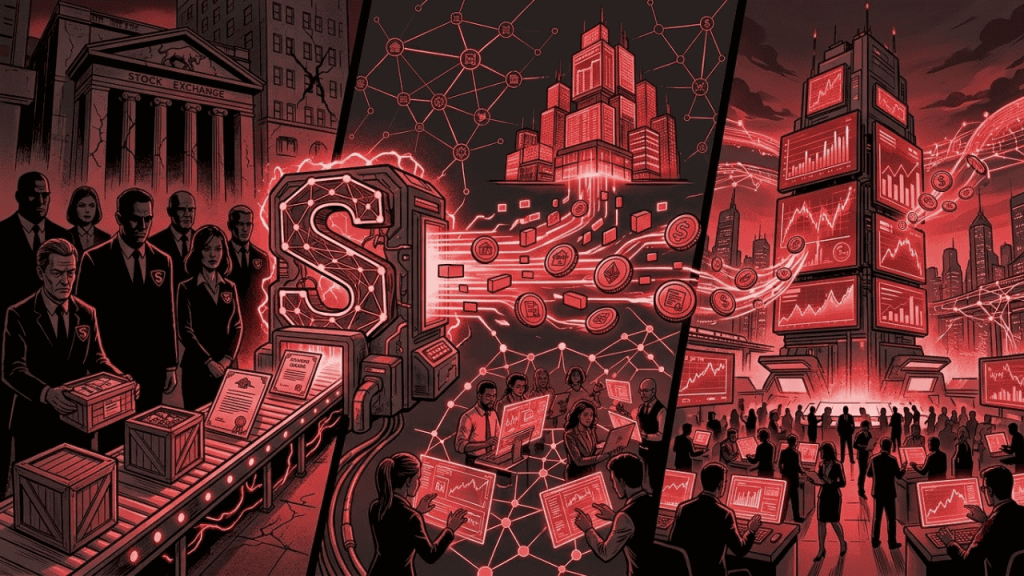
The transformation of capital markets through distributed ledger technology has ceased to be a technical promise and has become a profound structural change. Securitize leads this transition by providing the necessary infrastructure for real-world assets to fully integrate into the global digital ecosystem.
Different analysts suggest that the tokenization of financial assets will reach trillion-dollar figures by the end of the current decade. Under this perspective, the platform positions itself not just as an issuer, but as the potential foundation for a new global secondary market similar to Nasdaq, operating under superior digital efficiency standards.
The BlackRock-Securitize Axis and the End of Experimentation
BlackRock’s entry into the sector through its buidl fund marks a turning point for the industry. Securitize acts as bridge fundamental, allowing the world’s largest asset manager to use public networks to offer U.S. Treasury yields to qualified institutional investors.
This movement has validated the thesis that blockchain is the natural evolution of the stock market. At the close of February 2026, the fund has surpassed two billion dollars in assets under management, demonstrating unprecedented traction for a regulated, native digital financial product.
The collaboration between both firms is not limited to asset issuance, but to the creation of liquidity. BlackRock invested forty million dollars in the platform, consolidating a strategic alliance that seeks to standardize how traditional securities are represented within contemporary immutable digital records.
In other words, the testing phase for blockchain has definitively concluded. The scale reached by these financial vehicles suggests that the securitize infrastructure is capable of supporting flows of massive institutional capital, overcoming the operational limitations of traditional clearing and settlement systems currently in operation.
Regulatory Infrastructure as a Competitive Barrier to Entry
Unlike conventional crypto-asset exchange platforms, Securitize operates strictly within the framework of federal legislation. The company holds licenses as a registered transfer agent with the SEC, allowing it to manage the ownership of securities legally and completely transparently.
In parallel, its Securitize Markets division functions as an Alternative Trading System (ATS). This designation is vital, as it allows secondary trading of tokenized securities, closing the cycle necessary for a digital asset to be considered a viable alternative to stocks listed on traditional exchanges.
Regulatory compliance is not an accessory but the core of its competitive advantage. By complying with FINRA guidelines, the platform eliminates the legal frictions that have historically prevented major investment banks from adopting distributed ledger solutions for their daily market operations.
Far from being a coincidence, this structure attracts entities seeking absolute legal certainty. While other protocols face regulatory scrutiny, Securitize has built a defensive moat based on transparency and compliance, essential elements for any entity aspiring to become the stock market infrastructure of the immediate future.
Secondary Liquidity and Scaling Toward Trillions
Securitize’s potential to emulate Nasdaq lies in its ability to fractionalize the ownership of traditionally illiquid assets. From real estate to private equity, tokenization democratizes access to markets that were previously reserved exclusively for institutional investors or ultra-high-net-worth individuals.
A report by McKinsey projects that the tokenized asset market could reach two trillion dollars by 2030. Under this scenario, the need for a robust trading platform is evident, and Securitize is positioned to capture a dominant market share through its already operational infrastructure.
The key to success does not lie solely in the initial issuance, but in the depth of the secondary market. If users can trade their holdings in private credit funds with the same ease as a tech stock, capital efficiency will increase drastically, attracting even more liquidity into the institutional digital ecosystem.
Consequently, the company’s vision transcends the mere digitization of paper certificates. It seeks to create a 24/7 trading environment that eliminates T+2 settlement times, allowing for instant value transfer that traditional markets, due to their legacy technical architecture, simply cannot offer today.
Lessons from the 2017 Cycle and Current Maturity
It is essential to differentiate the current landscape from the 2017 ICO boom. That period was marked by excessive speculation and a lack of real underlying assets, resulting in a widespread collapse of trust following intervention by regulatory authorities in multiple global jurisdictions.
In contrast, the cycle that began in 2024 is defined by the presence of tangible and regulated collateral. The Federal Reserve has noted that the tokenization of safe assets, such as Treasury bonds, brings stability to the crypto ecosystem by providing a reliable reserve asset that does not depend on algorithmic volatility.
The evolution from initial experiments to products like BlackRock’s BUIDL fund evidences a shift in corporate mentality. The industry has understood that long-term success requires investor security and integration with the existing financial system instead of attempting a total and radical replacement of traditional custodial institutions.
In other words, the maturity of the sector is reflected in the adoption of institutional-grade standards. Securitize has capitalized on this lesson by focusing on interoperability with banking systems, positioning itself as the de facto standard for the digital representation of securities as reported by Reuters.
Systemic Risks and the Challenge of Centralization
However, the thesis that Securitize will become the digital Nasdaq has valid detractors. Some advocates of decentralization argue that relying on a permissioned platform contradicts the original spirit of the technology, creating single points of failure that could be vulnerable to political pressure or centralized operational failures.
Under this perspective, while regulation provides security, it also imposes limits on global accessibility. The scenario where this model would fail is one where investors prefer open decentralized finance (DeFi) protocols, which offer greater resistance to censorship and do not require authorized intermediaries to facilitate asset exchange.
Furthermore, institutional competition is fierce. Other tech giants and traditional stock exchanges could develop their own in-house solutions, attempting to marginalize pioneering players like Securitize by consolidating their existing customer bases and using their massive political influence in global financial centers.
Liquidity Fragmentation and the Interoperability Challenge
At the same time, the fragmentation of liquidity across different blockchains represents a significant technical risk. If total and fluid interoperability is not achieved, the tokenized market could be divided into isolated silos, preventing Securitize from reaching the critical mass necessary to replicate the success and depth of traditional exchanges.
To mitigate this risk, the platform must integrate protocols that allow for seamless cross-chain asset transfers without operational friction. The current fragmentation between Ethereum, Polygon, and private networks could dilute trading volume, weakening the value proposition of a unified and globally accessible secondary market for everyone.
If institutional capital flows into tokenized assets maintain their current growth rate, it is highly likely that Securitize will consolidate its position as the central node of the digital market. The convergence between regulatory clarity and technology will be the determining factor in defining its long-term success.
If secondary trading volume on its ATS exceeds ten billion dollars per month over the next biennium, the comparison to Nasdaq will cease to be a metaphor and become a statistical fact. Everything points to us witnessing the birth of a financial infrastructure that will define the coming decades of global trade.