
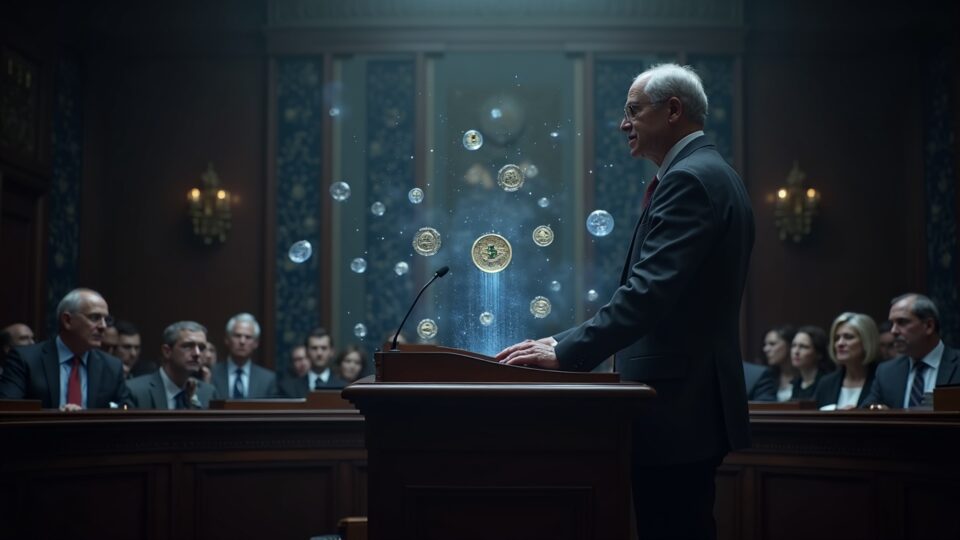
During an oversight hearing held this Tuesday, the United States Congress questioned top financial regulators regarding the future of stablecoin regulation. Travis Hill, acting chair of the Federal Deposit Insurance Corporation (FDIC), announced that the agency will present a crucial regulatory proposal later this month. Meanwhile, Michelle Bowman, Federal Reserve Vice Chair for Supervision, defended the need for banking institutions to understand and operate with digital assets under current law.
The debate intensified when Representative Stephen Lynch questioned Bowman about her previous comments made at the Santander International Banking Conference in November. Lynch expressed concern over the official’s stance, who had urged banks to “engage fully” with the sector. Bowman clarified that her statements referred to digital assets in general and not exclusively to cryptocurrencies, underscoring that the Federal Reserve has a mandate from Congress, through the GENIUS Act, to develop a safe operational framework.
Will the Federal Reserve be able to clarify definitions amidst Congressional pressure?
On the other hand, the discussion revealed notable terminological confusion among lawmakers regarding the fundamental differences between volatile digital assets and stablecoins. While many cryptocurrencies experience drastic price fluctuations, stablecoins are designed to maintain parity with the US dollar. The overwhelming majority of these coins rarely fluctuate beyond 1% of their peg, a technical distinction Bowman attempted to emphasize against comparisons to the algorithmic collapse of Terra that occurred in the past.
Likewise, the GENIUS Act, signed by President Donald Trump in July, has become the cornerstone for the legitimation of these financial activities. Bowman reiterated that this legislation requires regulators to promulgate regulations allowing banks to participate in the digital economy. The official highlighted that understanding the technology is vital for effective supervision, even suggesting in August that Fed staff should be permitted to hold small amounts of crypto assets for educational purposes.
Will the new FDIC framework manage to stabilize the cryptocurrency market?
In this context, Travis Hill’s testimony provided a clear timeline for the industry, something investors have been eagerly awaiting. Hill confirmed that the FDIC is one of the agencies responsible for implementing the GENIUS Act and that the upcoming framework will include strict requirements. The proposal will focus on the rigorous supervision of stablecoin issuers, seeking to mitigate systemic risks and protect consumers without stifling financial technological innovation.
Furthermore, the need for these regulations arises at a time when institutional adoption is increasing and legal clarity is indispensable. The lack of precise definitions in the past has been a hurdle, but current legislative pressure is accelerating processes. Regulators seek to balance banking security with the undeniable evolution of digital payments, ensuring that the United States does not fall behind in the global race for the modernization of its financial infrastructure.
To conclude, the hearing made it clear that, although there are frictions regarding terms and the scope of banking participation, the path toward regulation is set. With the FDIC ready to reveal its framework in the coming weeks and the Fed operating under the mandate of the GENIUS Act, the sector is preparing for significant changes. It is expected that these new guidelines will provide the necessary certainty for sustainable growth of the digital asset ecosystem in the country.
